Epstein-Barr virus rash, and the amoxicillin rash myth
A morbilliform rash in glandular fever, with or without an aminopenicillin - and the figures almost everyone quotes about it are wrong.
Red flags
- Before settling on a benign EBV rash, screen for a severe cutaneous adverse reaction - this patient is on an aminopenicillin. Examine the mucosae (eyes, mouth, genitals); ask about skin pain or burning rather than itch; look for dusky or targetoid lesions, blistering, a positive Nikolsky sign, pustules, or facial oedema; and check the eosinophil count and liver function. SJS/TEN, DRESS and AGEP all begin as a morbilliform drug rash, and this entry's strongest instruction - that the rash is not an allergy - must never become a reason to stop looking
- Airway compromise from tonsillar hypertrophy - stridor, drooling, difficulty swallowing secretions or sleeping sitting up. This is the emergency in glandular fever and it is not the rash
- Left upper quadrant pain, shoulder tip pain or haemodynamic instability - splenic rupture, which can follow trivial trauma
- Dehydration from an inability to swallow
- Jaundice or marked hepatitis
Recognise
Pink to red macules and papules becoming confluent, most obvious on the trunk and proximal limbs, appearing within days of starting an aminopenicillin or arising spontaneously during the illness.
A morbilliform eruption depends almost entirely on erythema, which is exactly the sign least visible on brown and black skin, so this rash is routinely under-recognised and under-recorded in darker-skinned patients. The eruption is usually palpable - run the back of a hand over the trunk for the fine irregularity of confluent papules - and may appear violaceous, grey or simply as a change in skin texture and sheen rather than as redness. Examine the palatal mucosa for petechiae and the conjunctivae, where pigment interferes least. NICE NG240 makes this general point explicitly - rashes can be hard to detect on brown, black or tanned skin - and asks you to check all over the body and to look for petechiae in the conjunctivae. Examining in good light is this page's own practical advice, not NG240's. Post-inflammatory hyperpigmentation afterwards is common and prolonged.
- A sore throat with marked tonsillar enlargement, cervical lymphadenopathy and profound fatigue
- Palatal petechiae and periorbital oedema - both more specific than the rash
- Hepatosplenomegaly on careful examination
- The rash is often itchy, which a simple viral exanthem usually is not
- Atypical lymphocytosis on the blood film
Distribution
Photographs
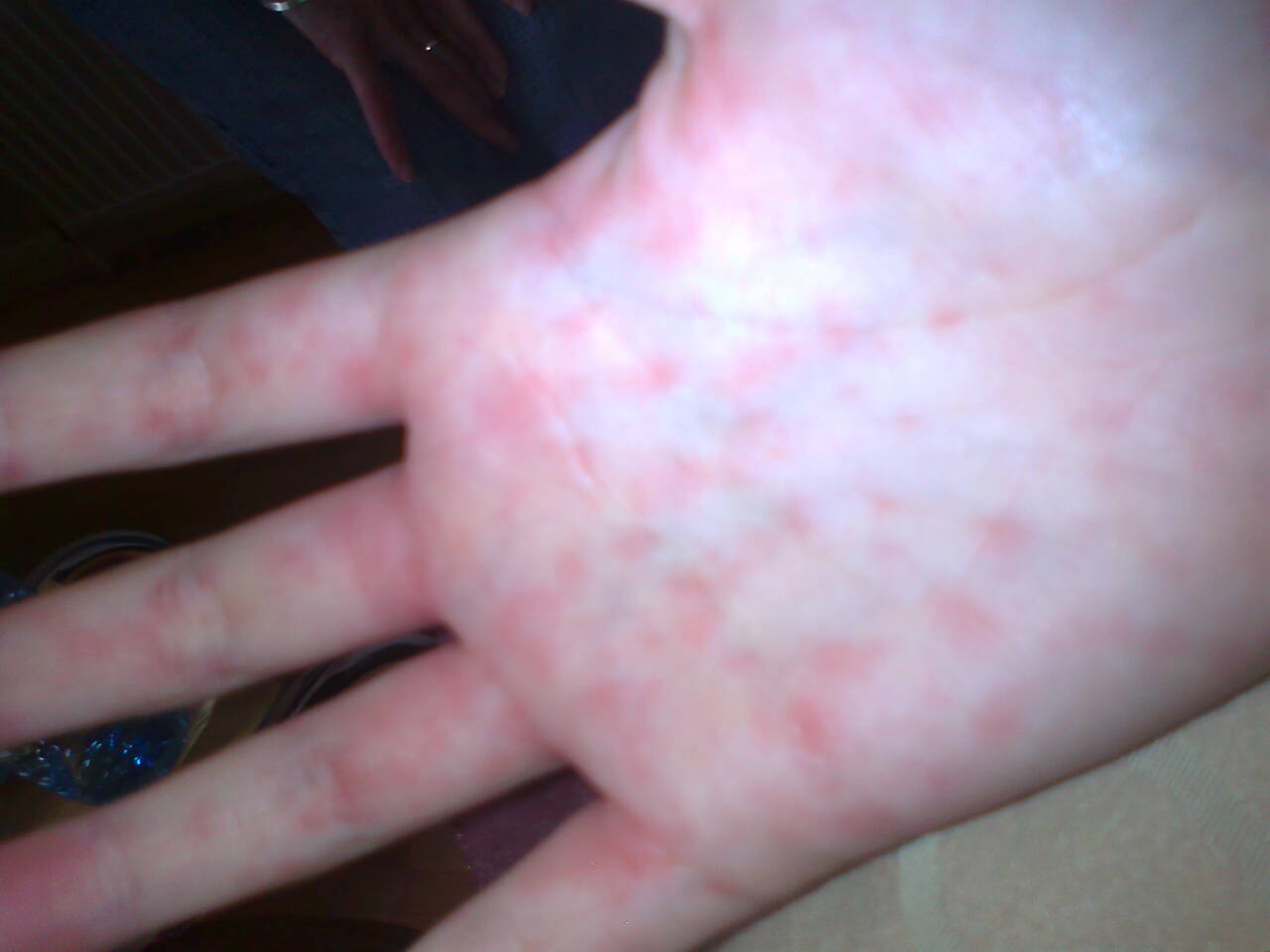
Mimics
- Stevens-Johnson syndrome / toxic epidermal necrolysis — The one that must be excluded before reassuring. Both begin as a morbilliform eruption in a febrile patient on an antibiotic; necrolysis adds mucosal erosions, skin pain and sheet-like detachment. Examine the mucosae
- Acute generalised exanthematous pustulosis — Also an aminopenicillin reaction with fever - ampicillin and amoxicillin are the drugs EuroSCAR named - but studded with tiny sterile pustules on sheets of confluent erythema, concentrated in the flexures
- Measles — Both morbilliform and febrile. Measles has coryza, conjunctivitis, Koplik spots and a cephalocaudal spread, and is notifiable
- Scarlet fever — Also a sore throat with a rash, but sandpapery, flexurally accentuated, with a strawberry tongue - and it genuinely needs penicillin
- Drug eruptions - morbilliform and fixed — The central confusion. A morbilliform rash after amoxicillin in glandular fever is usually not an allergy - see the actions below before anyone writes penicillin allergy in the notes
- DRESS - drug reaction with eosinophilia and systemic symptoms — Also drug-associated, with fever and lymphadenopathy. Look for it actively rather than using the differences to dismiss it - facial oedema, eosinophilia and organ involvement, usually at a longer latency (RegiSCAR median 22 days, IQR 17-31). The aminopenicillin exposure here is the same exposure that causes it
- Rubella — Also morbilliform with posterior cervical lymphadenopathy, but milder and shorter, and the pregnancy implications differ entirely
What to do in the ED
- Once a severe cutaneous adverse reaction has been excluded (see the first red flag), do not label the patient penicillin-allergic on the strength of this rash. The association is with the Epstein-Barr infection, not with a durable drug allergy, and a wrongly recorded penicillin allergy follows a patient for life and worsens their care
- Correct the figure if it is quoted at you. The 80-100% ampicillin rash incidence comes from accounts in the 1960s. A retrospective study of 238 children with serologically proven acute infectious mononucleosis found rash after amoxicillin in 29.5% (95% CI 18.5-42.6). Rash occurred in 32.9% of antibiotic-treated children and 23.1% of untreated children, a difference that did not reach significance - so the rash is not reliable evidence that an antibiotic caused it, and not reliable evidence of Epstein-Barr infection either
- Assess the airway first, every time. Tonsillar hypertrophy is what makes glandular fever dangerous
- Examine for splenomegaly and give explicit advice to avoid contact sport and heavy lifting
- Send monospot or EBV serology and a full blood count with film; stop the aminopenicillin
- Record the event accurately in the notes as a rash occurring during Epstein-Barr infection with aminopenicillin exposure, so that a future clinician can interpret it rather than inherit a label
Disposition
Most patients go home with supportive advice and GP follow-up. Admit for airway compromise, inability to maintain hydration, suspected splenic rupture or significant hepatitis. Corticosteroids are for airway compromise, not for symptom relief, and that decision is a senior one.
Safety-netting
Sources
- Chovel-Sella A, Ben Tov A, Lahav E, Mor O, Rudich H, Paret G, Reif S. Incidence of rash after amoxicillin treatment in children with infectious mononucleosis. Pediatrics 2013;131(5):e1424-7
- NICE NG240 - Meningitis (bacterial) and meningococcal disease: recognition, diagnosis and management. Recommendation 1.1.12: check all over the body (including nappy areas), check for petechiae in the conjunctivae, and note that rashes can be hard to detect on brown, black or tanned skin