Rubella
A mild illness in the patient and a serious one for a fetus - the reason to make the diagnosis is the pregnant contact.
Red flags
- Any contact with a pregnant woman - this is the reason the diagnosis matters, and it needs same-day action
- Rubella in a pregnant patient - urgent obstetric and health protection discussion
- Failure to notify - rubella is a notifiable disease
- A purpuric rash, bruising or bleeding - post-infectious thrombocytopenia is a recognised complication
- Severe headache, drowsiness or confusion - encephalitis is rare but described
Recognise
Fine pink discrete macules and papules beginning on the face, in a child who is only mildly unwell, with tender lymph nodes behind the ears and at the back of the neck.
The rash is faint even in pale skin and may be genuinely invisible in brown and black skin, so the diagnosis rests far more heavily on the lymphadenopathy and the contact history. Palpate for the suboccipital and postauricular nodes, which are the most reliable tone-independent sign. Do not exclude rubella because you cannot see a rash in a child with tender nodes behind the ears and a relevant exposure.
- Tender suboccipital, postauricular and posterior cervical lymphadenopathy - often more striking than the rash
- A mildly unwell patient - no significant prodrome, unlike measles
- The rash is discrete and fades in about three days
- Joint pain, particularly in adolescent girls and adult women
- Immunisation and contact history, including any contact with a pregnant woman
Distribution
Photographs
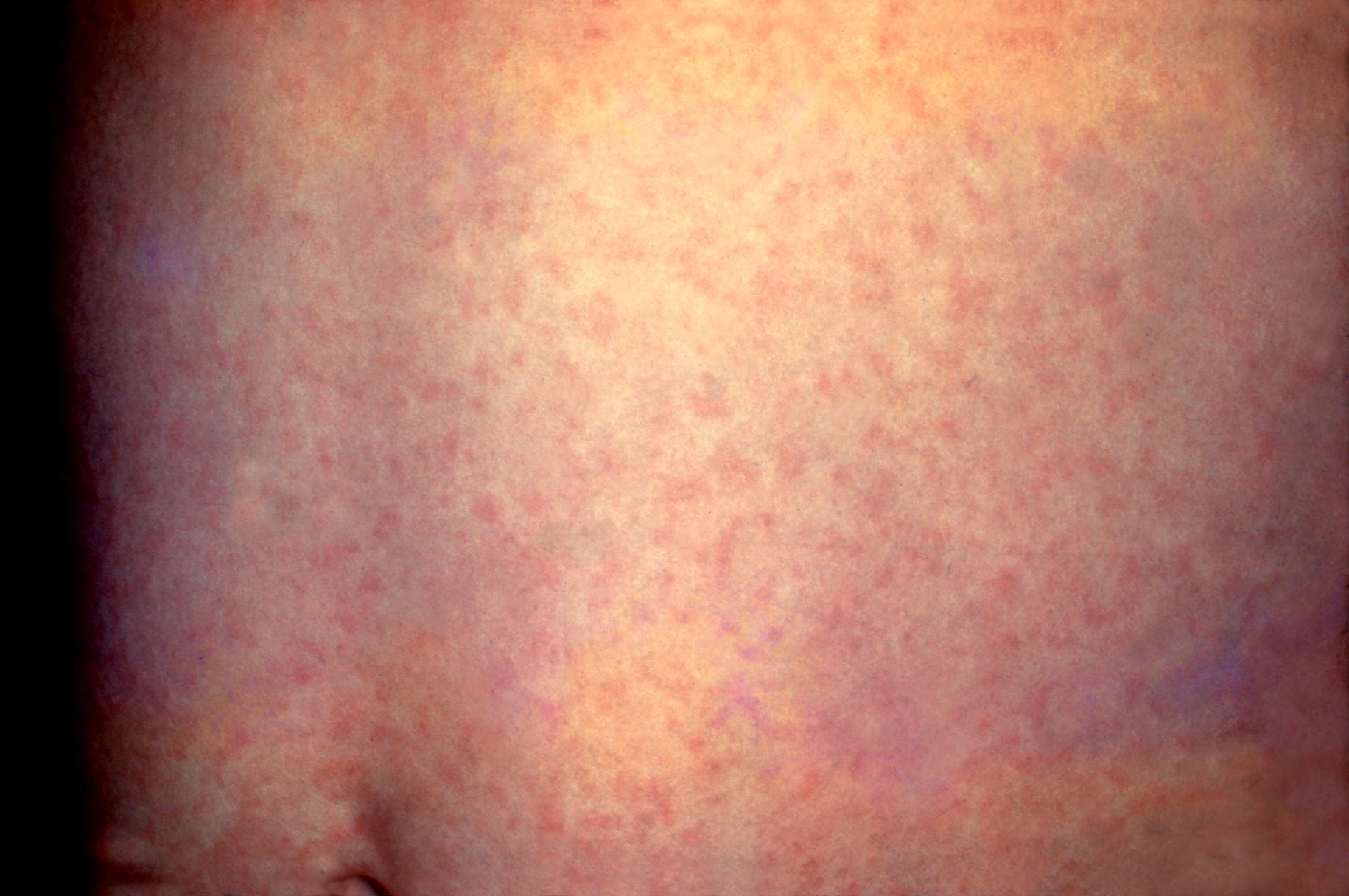
Mimics
- Measles — Measles is much more unwell, with a three to four day prodrome and a confluent descending rash
- Parvovirus B19 (slapped cheek disease) — Also mild with joint symptoms, and also matters in pregnancy; the facial appearance differs
- Scarlet fever — Scarlet fever has a sandpaper texture, perioral pallor and a sore throat
- Roseola infantum — Roseola's rash appears as the fever breaks in an infant, which rubella's does not
What to do in the ED
- Isolate on arrival and notify the health protection team the same day on clinical suspicion - rubella is notifiable
- Ask explicitly about contact with anyone pregnant, and act on the answer today rather than leaving it to the GP
- Arrange oral fluid testing as directed by the health protection team; clinical diagnosis is unreliable and laboratory confirmation matters here
- Check immunisation status and recommend MMR where indicated
- Assess for thrombocytopenia if there is any purpura or bleeding
- Advise exclusion from school or work for five days after the rash appears, and avoidance of pregnant contacts
Disposition
Supportive care at home with notification and exclusion advice. Pregnant patients and pregnant contacts need same-day obstetric and health protection input.
Safety-netting
Sources
- NICE CKS - Rubella
- UKHSA - Health protection in children and young people's settings, including education
- Lim HW et al. International Expert Consensus on Knowledge Gaps in Care for Dermatologic Disorders in Skin of Color. Int J Dermatol 2026
- NICE CG153 1.2.1.5 - erythema may be underestimated in skin types V-VI (stated in the psoriasis guideline; cited here for that general point about assessing erythema, not for this condition)