Scarlet fever
A sandpaper rash with a sore throat - notifiable, penicillin-responsive, and a marker of circulating group A streptococcus.
Red flags
- Severe pain out of proportion, or a soft tissue focus - invasive group A streptococcal disease and necrotising fasciitis arise from the same organism
- Hypotension, a diffuse erythema and multi-organ upset - streptococcal toxic shock syndrome
- Recent or concurrent chickenpox - a recognised risk factor for invasive group A streptococcal infection, and a reason for a much lower threshold
- Neck swelling, drooling, stridor or trismus - deep neck space infection
- A child who deteriorates after starting antibiotics
Recognise
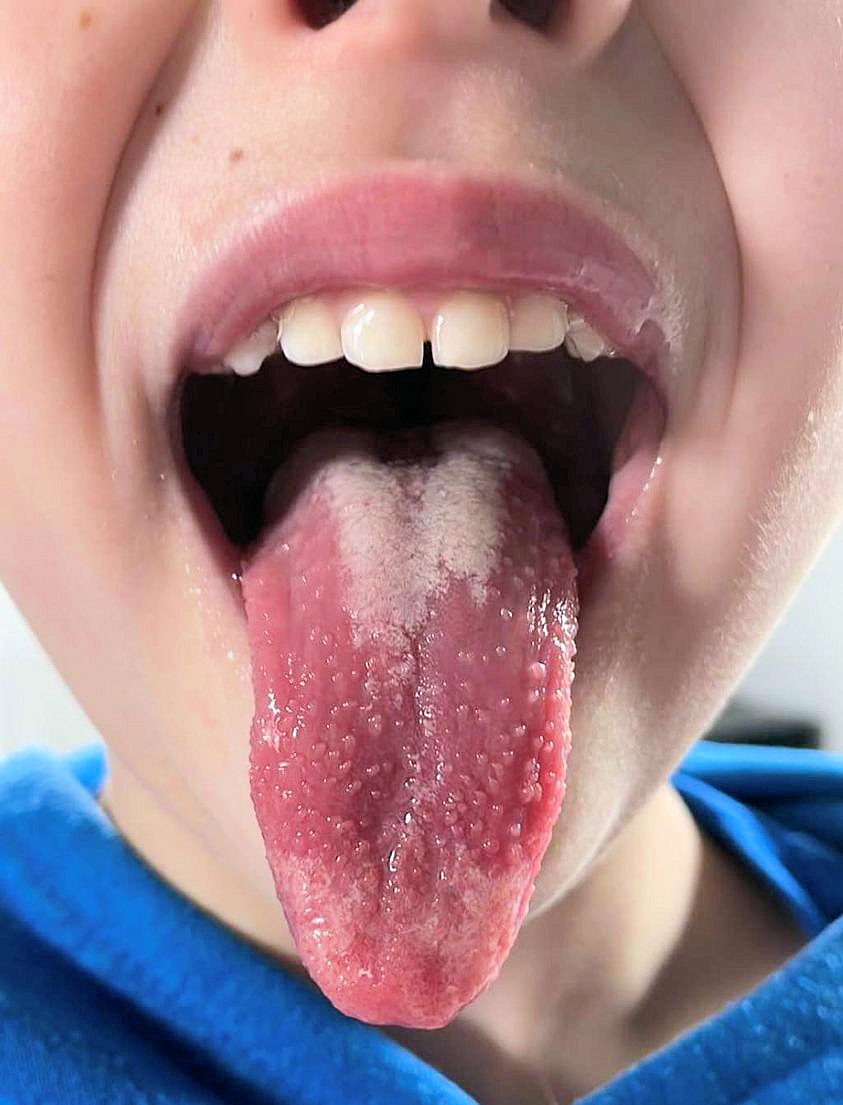
Widespread fine red punctate erythema likened to sunburn with goosepimples, blanching on pressure, with flushed cheeks, pallor around the mouth, and a white then red strawberry tongue.
The redness that gives the disease its name may be invisible, and the classic flushed cheeks with perioral pallor cannot be assessed at all in darker skin. The texture is the diagnosis here: run the back of your hand over the chest and abdomen and feel for the fine sandpaper roughness, which is completely independent of pigment. Look inside the mouth for the strawberry tongue and check the skin folds, where the accentuated rash may show as darker linear streaks. The later peeling of the fingertips is also tone-independent. Scarlet fever is more likely to be missed in brown and black skin, and since it is both notifiable and a marker of invasive group A streptococcal activity, that miss has public health consequences as well as clinical ones.
- Sandpaper texture - feel it rather than look at it
- Sore throat with fever, and often headache, vomiting and abdominal pain
- Strawberry tongue: white coated first, then red and swollen
- The rash is accentuated in the flexures, and blanches on pressure
- Peeling of the fingers, toes and groin one to two weeks later
- Clusters in schools and nurseries - ask about contacts
Distribution
Photographs
Mimics
- Kawasaki disease — Both give strawberry tongue and later desquamation; Kawasaki has conjunctival injection and a fever of five days or more
- Measles — Measles has cough, coryza, Koplik spots and a descending blotchy rash rather than a sandpaper one
- Toxic shock syndrome — Streptococcal TSS shares the organism and the erythema but is shocked - an important progression to watch for
- DRESS - drug reaction with eosinophilia and systemic symptoms — A drug eruption can look similar, but lacks the sandpaper texture and the sore throat
What to do in the ED
- Treat with antibiotics per local policy - phenoxymethylpenicillin is the usual UK first choice, with a macrolide in penicillin allergy
- Notify the health protection team the same day - scarlet fever is a notifiable disease and notification is on clinical suspicion
- Throat swab where local policy directs, but do not delay treatment for the result
- Examine every limb and the whole skin for a soft tissue focus, especially where there is disproportionate pain
- Ask specifically about recent chickenpox in the child or household, because of the invasive disease risk
- Advise exclusion from school or nursery until 24 hours after starting antibiotics
- Give explicit safety-netting about invasive disease - most children do well, and the small number who do not deteriorate quickly
Disposition
Antibiotics and discharge for the well child, with notification and exclusion advice. Admit for any suspicion of invasive group A streptococcal disease, dehydration, or systemic upset.
Safety-netting
Local variation
Sources
- NICE CKS - Scarlet fever
- UKHSA - Invasive group A streptococcal disease: managing close contacts in community settings
- UKHSA - Health protection in children and young people's settings, including education
- Lim HW et al. International Expert Consensus on Knowledge Gaps in Care for Dermatologic Disorders in Skin of Color. Int J Dermatol 2026
- NICE CG153 1.2.1.5 - erythema may be underestimated in skin types V-VI (stated in the psoriasis guideline; cited here for that general point about assessing erythema, not for this condition)