Drug eruptions - morbilliform and fixed
Most drug rashes are benign and self-limiting - the whole skill is identifying the few that are not.
Red flags
- Mucosal involvement, skin pain, blistering or a positive Nikolsky sign - epidermal necrolysis, which goes to a burns centre
- Facial oedema, fever, lymphadenopathy, eosinophilia or deranged liver function - DRESS, which is a multi-organ disease with a long latency
- Widespread sterile pustules with fever - AGEP
- Any systemic upset at all with a drug rash - a simple exanthem does not make the patient ill
- Involvement of more than half the body surface, or rapid progression
Recognise
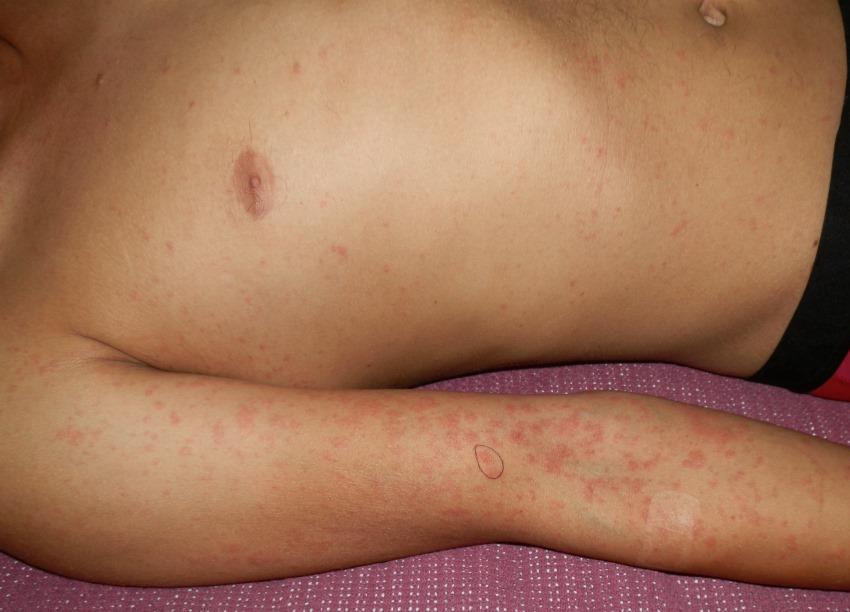
Symmetrical pink-red macules and papules becoming confluent, mildly itchy; a fixed drug eruption is a well-demarcated round dusky red or violaceous plaque, sometimes blistering.
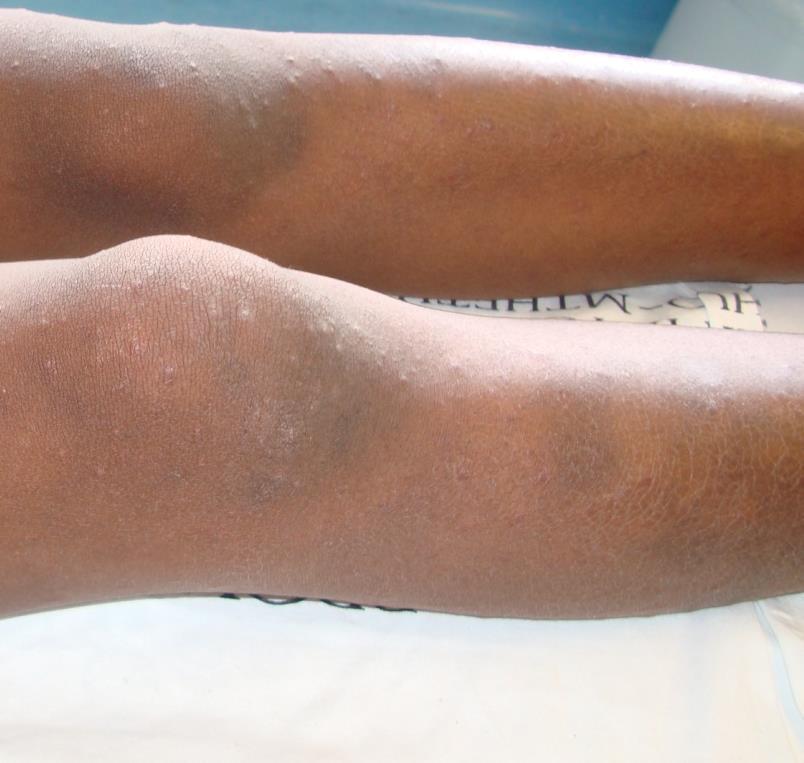
The morbilliform eruption may be almost impossible to see, appearing as subtle darkening or a faint violaceous change, and severity is systematically underestimated as a result - which matters because judging extent is part of deciding how worried to be. Palpate for the papular texture. The fixed drug eruption is the opposite case and is arguably easier to identify in darker skin, because its hallmark is the intensely hyperpigmented, well-demarcated round patch it leaves behind, which persists for months and darkens further with each recurrence - patients frequently present with the residual patch rather than the acute lesion, and the history of recurrence at the identical site is diagnostic. Post-inflammatory hyperpigmentation after any drug eruption is prolonged and is a common reason for re-presentation.
- Timing: a simple morbilliform eruption usually appears within the first days to about two weeks of a new drug, and sooner on re-exposure. The contrast that matters is with DRESS, whose median latency in the RegiSCAR series was 22 days (IQR 17-31) - so a rash appearing three weeks in is not a simple exanthem until proven otherwise
- Symmetrical and truncal at onset, spreading outwards
- Mildly itchy, with the patient otherwise well
- A fixed drug eruption recurs at exactly the same site - ask whether this has happened before in the same place
- Check for the features that make it dangerous: fever, facial oedema, mucosal involvement, skin pain, blistering, or lymphadenopathy
Distribution
Photographs
Mimics
- Stevens-Johnson syndrome / toxic epidermal necrolysis — The dangerous end of the same spectrum - mucosal erosion and detachable epidermis
- DRESS - drug reaction with eosinophilia and systemic symptoms — Longer latency, facial oedema, eosinophilia and organ involvement
- Acute generalised exanthematous pustulosis — Rapid onset with sterile pustules and fever
- Measles — A viral exanthem can be indistinguishable; measles has a prodrome, cough, coryza and Koplik spots
- Parvovirus B19 (slapped cheek disease) — Viral exanthems in adults are a common alternative explanation
- Syphilis - the secondary rash — Involves palms and soles and does not itch
- Acute urticaria — A drug-induced urticarial eruption migrates and each weal clears within a day; a morbilliform drug rash is fixed in place for days
What to do in the ED
- Run through the danger list explicitly before concluding this is benign: fever, facial oedema, mucosal involvement, skin pain, blistering, lymphadenopathy, and the extent of involvement
- Take FBC, liver and renal function where there is any systemic feature - DRESS is diagnosed on bloods, not on the rash
- Construct a proper drug timeline covering the preceding weeks, not days, including over-the-counter and herbal preparations
- Stop the likely culprit where it is safe to do so, and discuss with the prescribing team where the drug is essential
- Record the reaction in the allergy record with the drug name, the date and what actually happened - a vague 'rash' entry causes harm later, both by blocking useful drugs and by failing to block dangerous ones
- For a fixed drug eruption, identify the culprit from the history of recurrence and advise lifelong avoidance
- Treat symptomatically with an emollient, a topical corticosteroid and an antihistamine for a simple exanthem
Disposition
A well patient with a simple morbilliform eruption and no danger features can be discharged with the drug stopped and clear advice. Any danger feature changes the diagnosis and the destination.
Safety-netting
Sources
- NICE CG183 - Drug allergy: diagnosis and management
- Kardaun SH et al. Drug reaction with eosinophilia and systemic symptoms (DRESS): an original multisystem adverse drug reaction. Results from the prospective RegiSCAR study. Br J Dermatol 2013
- Lim HW et al. International Expert Consensus on Knowledge Gaps in Care for Dermatologic Disorders in Skin of Color. Int J Dermatol 2026
- NICE CG153 1.2.1.5 - erythema may be underestimated in skin types V-VI (stated in the psoriasis guideline; cited here for that general point about assessing erythema, not for this condition)