Measles
A notifiable, highly infectious illness that is resurging in the UK - isolate the patient at the front door, then notify.
Red flags
- Any breathing difficulty - pneumonia complicates 1 to 6% of cases on CKS's figures and is a standard reason for admission. (CKS ranks respiratory and gastrointestinal complications as the commonest overall; it makes no cause-of-death ranking, and nor does the Green Book or the WHO fact sheet, so none is claimed here)
- Drowsiness, confusion, seizures or a severe headache - encephalitis
- Dehydration from mouth ulceration and poor intake, particularly in a young child
- Immunosuppression, pregnancy, an infant under 12 months, or an adolescent or adult - the Green Book states that measles case fatality is age-related, high under one year, lower from one to nine, and rises again in teenagers and adults. All of these need urgent specialist discussion
- Failure to isolate the patient on arrival - the risk to other patients in the department is part of the clinical presentation
Recognise
Erythematous maculopapular rash beginning at the hairline and behind the ears, becoming confluent and blotchy as it descends, in a miserable child with cough, coryza and conjunctivitis.
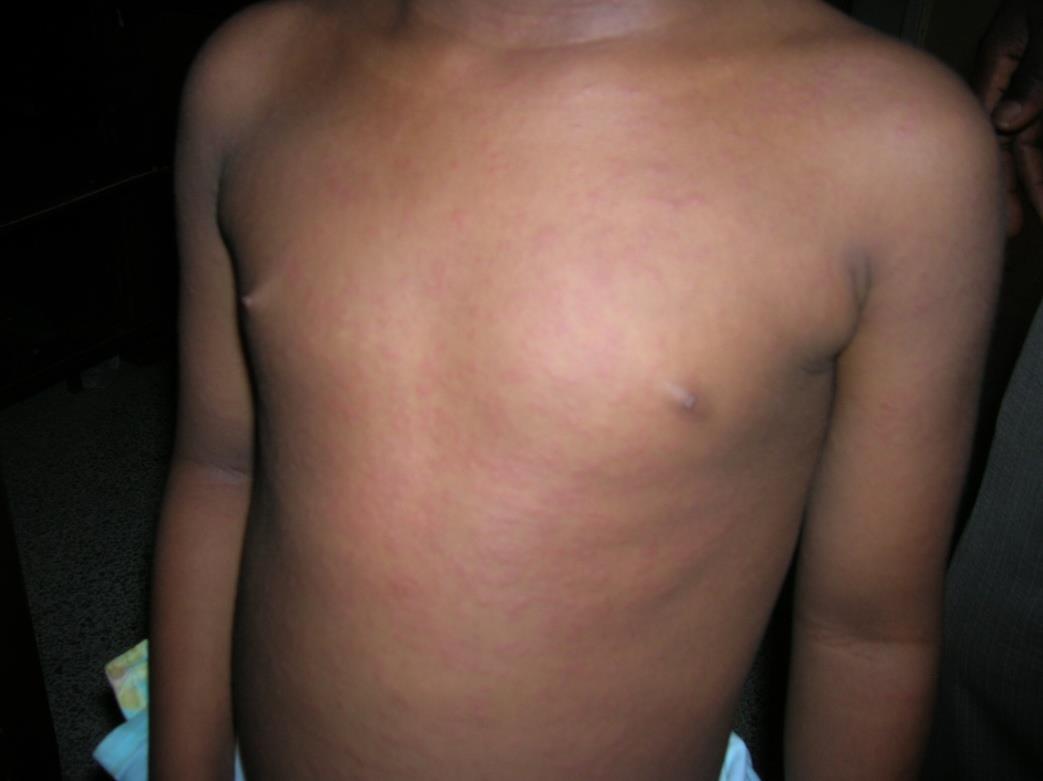
Measles in brown and black skin frequently does not look red, and the widely taught description of a blotchy red rash is one of the clearest examples of how a white-skin textbook fails. It more often appears as darker, violaceous or hyperpigmented macules and papules, and may be easier to feel than to see - palpate for the papular texture across the cheeks and hairline. Koplik spots on the buccal mucosa are entirely unaffected by skin tone and are worth looking for properly with a torch. Desquamation during resolution and prolonged post-inflammatory hyperpigmentation are both more conspicuous, and the hyperpigmented phase can persist for weeks.
- The prodrome comes first: three to four days of fever, cough, coryza and conjunctivitis before any rash
- A miserable, unwell child - measles is not a mild illness
- Koplik spots - small white spots on the buccal mucosa, present early and pathognomonic when seen
- The rash descends from the head downwards and becomes confluent, unlike the discrete rash of rubella
- Ask about immunisation status and travel or contact history, but remember that a vaccinated person can still get measles. Mind the Gap’s practical instruction for the measles rash in dark skin is to expose the trunk fully and use adequate lighting, and to look for a reddish undertone that may progress to a purple hue
Distribution
Photographs
Mimics
- Rubella — Rubella is milder, its rash is discrete rather than confluent, and there is no significant prodrome
- Kawasaki disease — Both give fever, rash and red eyes; measles has cough, coryza and Koplik spots
- Scarlet fever — Scarlet fever has a sandpaper texture and perioral pallor rather than a descending blotchy rash
- Parvovirus B19 (slapped cheek disease) — Slapped-cheek disease is a well child with a striking facial rash and a lacy body rash
- DRESS - drug reaction with eosinophilia and systemic symptoms — A morbilliform drug eruption looks similar; DRESS adds facial oedema, eosinophilia and organ involvement
What to do in the ED
- Isolate immediately on arrival - a negative-pressure or single room, away from the waiting area, and mask the patient. This precedes clinical assessment
- Notify the local health protection team the same day on clinical suspicion. Measles is a notifiable disease and notification does not wait for confirmation
- Take an oral fluid sample or throat swab for PCR and salivary antibody as directed by the health protection team
- Assess for pneumonia, encephalitis and dehydration - these are what make measles dangerous
- Identify contacts who are pregnant, immunosuppressed or infants; post-exposure prophylaxis is time-critical and is arranged through the health protection team
- Check and record immunisation status, and use the attendance to recommend MMR where indicated
- Treatment is supportive; advise the family on isolation until four days after the rash appears
Disposition
Most previously well children are managed at home in isolation with supportive care and same-day notification. Admit or discuss for respiratory or neurological complications, dehydration, immunosuppression, pregnancy, an infant under 12 months, or an unwell adolescent or adult.
Safety-netting
Sources
- NICE CKS - Measles
- UKHSA - Measles: guidance, data and analysis
- UKHSA - Health protection in children and young people's settings, including education
- Lim HW et al. International Expert Consensus on Knowledge Gaps in Care for Dermatologic Disorders in Skin of Color. Int J Dermatol 2026
- Mukwende M, Tamony P, Turner M. Mind the Gap: A handbook of clinical signs in Black and Brown skin. St George’s, University of London (2020)