Parvovirus B19 (slapped cheek disease)
A well child with red cheeks - harmless in most, but dangerous in pregnancy, immunosuppression and haemolytic anaemia.
Red flags
- Sickle cell disease, thalassaemia, hereditary spherocytosis or any chronic haemolytic anaemia - parvovirus B19 causes transient aplastic crisis; check a full blood count and reticulocytes urgently and admit if anaemic
- Pregnancy, at any gestation - risk of fetal anaemia and hydrops. CKS applies no gestational threshold: at any stage of pregnancy, virology or infectious diseases should be contacted immediately, and confirmed infection needs urgent fetal medicine referral. Do not let gestation lower the urgency
- Immunosuppression - risk of chronic anaemia and prolonged infection
- Pallor, breathlessness, tachycardia or lethargy - assume aplastic crisis until the blood count says otherwise
Recognise
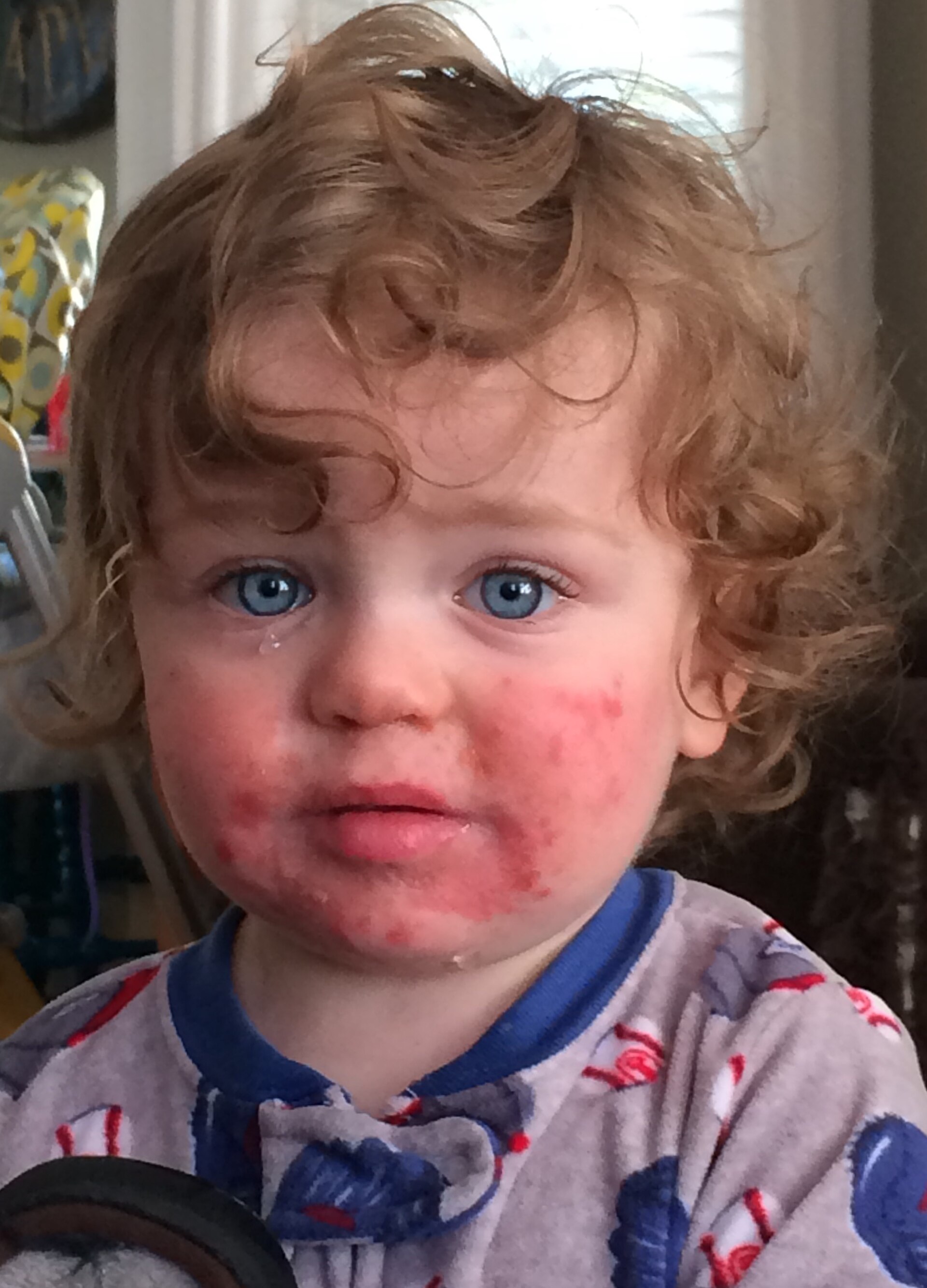
Striking bright red firm erythema over both cheeks with perioral sparing, then a fine lacy pink reticular rash on the limbs.
The slapped-cheek appearance depends entirely on visible redness and is frequently absent or unrecognisable in brown and black skin - the facial finding may be no more than a subtly darker or warmer-toned area over the cheeks, or nothing at all. The lacy, net-like reticular pattern on the limbs is a pattern rather than a colour and is the more reliable sign; look for it in good light across the outer arms and thighs, and feel the warmth and slight induration of the cheeks. Relying on the classic red cheeks will under-diagnose this condition in exactly the populations where sickle cell disease, and therefore aplastic crisis risk, is commonest - which makes this one of the highest-stakes recognition gaps in the band.
- The child is well and often already better by the time the rash appears
- Facial change first, the lacy limb rash days later
- The limb rash recurs for weeks, triggered by heat, exercise or sunlight - this alarms parents and is not a relapse
- By the time the rash is visible the patient is generally no longer infectious
- Joint pain, often symmetrical and in the hands, particularly in adult women
Distribution
Photographs
Mimics
- Rubella — Both mild with arthralgia; rubella's rash is discrete and it carries a different pregnancy risk
- Measles — Measles has a prodrome, a cough and a miserable child; parvovirus has a well child
- Acute urticaria — The lacy reticular rash can be mistaken for urticaria, but it does not itch in the same way and is fixed in pattern
What to do in the ED
- Ask about haemoglobinopathy in the child and the family, and about pregnancy in every household contact - these two questions carry the entire clinical risk
- In any child with a haemolytic condition, take FBC and reticulocytes and treat a falling haemoglobin as an aplastic crisis
- In pregnancy, arrange serology and same-day obstetric discussion; do not defer to the GP
- Explain that the lacy rash will come and go for weeks with heat and sunlight and does not mean the illness is returning
- Exclusion from school is not required once the rash has appeared, because infectivity has usually passed - but a pregnant or immunosuppressed contact still needs advice
- No specific treatment in the well child; supportive care only
Disposition
A well child needs no more than explanation and supportive care. Admit or discuss urgently for aplastic crisis, immunosuppression, or fetal concern in pregnancy.
Safety-netting
Sources
- NICE CKS - Parvovirus B19 infection
- UKHSA - Health protection in children and young people's settings, including education
- Lim HW et al. International Expert Consensus on Knowledge Gaps in Care for Dermatologic Disorders in Skin of Color. Int J Dermatol 2026
- NICE CG153 1.2.1.5 - erythema may be underestimated in skin types V-VI (stated in the psoriasis guideline; cited here for that general point about assessing erythema, not for this condition)