Syphilis - the secondary rash
A non-itchy rash involving the palms and soles - regularly missed, and diagnoses in the UK have been climbing for a decade on UKHSA surveillance.
Red flags
- Neurological symptoms, visual change or hearing loss - neurosyphilis and ocular or otosyphilis can occur at any stage and need urgent specialist management
- Pregnancy - congenital syphilis is preventable and this needs same-day specialist involvement
- HIV co-infection - test for it in every case; the two travel together and co-infection alters management
- Any painless genital ulcer, which is syphilis until proven otherwise
- A patient who cannot be contacted for results - make the referral pathway robust before they leave
Recognise
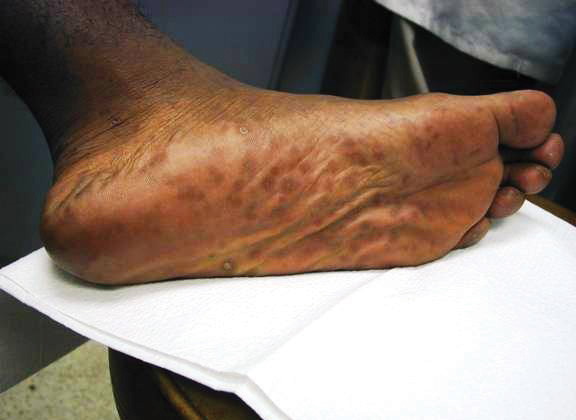
Coppery-red or ham-coloured symmetrical macules and papules on the trunk, palms and soles, non-itchy, sometimes scaly, with moist wart-like condylomata lata in the flexures.
The coppery or ham-red colour on which the classic description rests is not perceptible in brown and black skin, where lesions more often appear as hyperpigmented, violaceous or dusky macules and papules, and annular forms are often said to be commoner in patients with darker skin, though that is not cited here because it could not be traced to a source read in full - treat it as a reason not to expect the textbook picture rather than as an established fact. The reliable features are distributional and symptomatic rather than chromatic: a symmetrical eruption involving the palms and soles that does not itch, with generalised lymphadenopathy. Examine the palms and soles deliberately in any unexplained widespread rash, and take a sexual history rather than relying on appearance.
- Palms and soles involved - very few rashes do this, and it should trigger the thought
- Not itchy - which separates it from most widespread eruptions
- Symmetrical and widespread
- Generalised lymphadenopathy, sometimes with fever, sore throat, malaise and patchy hair loss
- A preceding painless genital, oral or anal ulcer weeks earlier that healed without treatment - often not volunteered, so ask
- Condylomata lata: moist, flat, wart-like plaques in the flexures, highly infectious
Distribution
Photographs
Mimics
- DRESS - drug reaction with eosinophilia and systemic symptoms — Both give a widespread eruption with systemic features; syphilis is not itchy, involves palms and soles, and has no drug latency
- Measles — Measles is febrile with coryza and cough and a descending rash; syphilis has palms and soles and no prodrome
- Herpes simplex — A painful grouped vesicular genital lesion is herpes; a solitary painless indurated ulcer is syphilis
- Parvovirus B19 (slapped cheek disease) — Both can give a widespread symmetrical rash with arthralgia in adults
What to do in the ED
- Examine the palms and soles in every unexplained widespread rash, and ask about a preceding painless ulcer
- Take blood for syphilis serology and offer HIV testing at the same time
- Refer to sexual health services urgently - they manage treatment, partner notification and follow-up serology, and an ED diagnosis without that referral achieves little
- Do not start treatment in the ED without specialist discussion; staging determines the regimen
- Ask about pregnancy and involve obstetrics the same day if relevant
- Ask directly about visual, hearing and neurological symptoms, which change the urgency completely
- Give clear written information about how results will reach them and what happens next
- In anyone under 18, syphilis is a safeguarding matter as well as a clinical one. The entry is written for adults, but a sexually active 16- or 17-year-old is exactly the patient in whom it is missed - take a confidential history, consider exploitation and coercion, and follow your local safeguarding route alongside the sexual health referral. In a child, involve paediatrics and safeguarding the same day
Disposition
Urgent sexual health referral rather than dermatology in most cases - the entry is filed as derm-urgent because this tool has no disposition value for urgent sexual health; read it as the urgency, not the specialty. Same-day specialist involvement for pregnancy, or for neurological, ocular or auditory symptoms.
Safety-netting
Local variation
Sources
- NICE CKS - Syphilis
- Lim HW et al. International Expert Consensus on Knowledge Gaps in Care for Dermatologic Disorders in Skin of Color. Int J Dermatol 2026
- UKHSA - Sexually transmitted infections and screening for chlamydia in England: official statistics
- NICE CG153 1.2.1.5 - erythema may be underestimated in skin types V-VI (stated in the psoriasis guideline; cited here for that general point about assessing erythema, not for this condition)