Seborrhoeic dermatitis
Greasy scale in the sebaceous areas - common, chronic and easily treated, but widespread disease should prompt an HIV test.
Red flags
- Abrupt, severe or widespread disease in an adult - offer HIV testing
- Associated Parkinsonism or another neurological disorder, with which it is strongly associated
- Erythroderma - rare but described
- Failure to respond to appropriate treatment - reconsider psoriasis, tinea or a contact allergy to a shampoo, and note this is one of CKS's four referral criteria
- Eyelid involvement that has not settled with eyelid hygiene - a CKS referral criterion in its own right, and easy to treat around and never refer
- In an infant, a rash that is not settling or that is associated with failure to thrive or diarrhoea - reconsider the diagnosis
Recognise
Ill-defined pink-red patches with fine greasy yellowish scale in the nasolabial folds, eyebrows, scalp and behind the ears.
The underlying erythema is frequently invisible and, importantly, seborrhoeic dermatitis in brown and black skin often presents as hypopigmented patches rather than pink ones - including the petaloid pattern, described in Fitzpatrick skin types V to VI as pink or hypopigmented polycyclic coalescing rings that look nothing like the textbook description and can mimic lupus erythematosus. That report calls the petaloid form uncommon overall while noting it is the form seen in dark skin, so treat it as a pattern to recognise rather than as the usual presentation. A wider review confirms that seborrhoeic dermatitis presents differently across skin tones and that post-inflammatory pigment alteration is itself a feature of the disease in richly pigmented skin. It is regularly misdiagnosed as pityriasis versicolor, vitiligo or eczema. The greasy scale, the distribution in the sebaceous areas and the symmetry are the reliable features. Warn patients that pigment will return slowly once the inflammation is controlled - the hypopigmentation is not permanent.
- Distribution in the sebaceous areas - scalp, brows, nasolabial folds, behind the ears, central chest
- Fine, greasy scale rather than the thick adherent scale of psoriasis
- Ill-defined margins, symmetrical
- Chronic and relapsing, often worse in winter and with stress
- Severe, sudden or unusually extensive disease should prompt an HIV test - it is a recognised early feature
- Infantile cradle cap is self-limiting and behaves differently from the adult disease
Distribution
Photographs
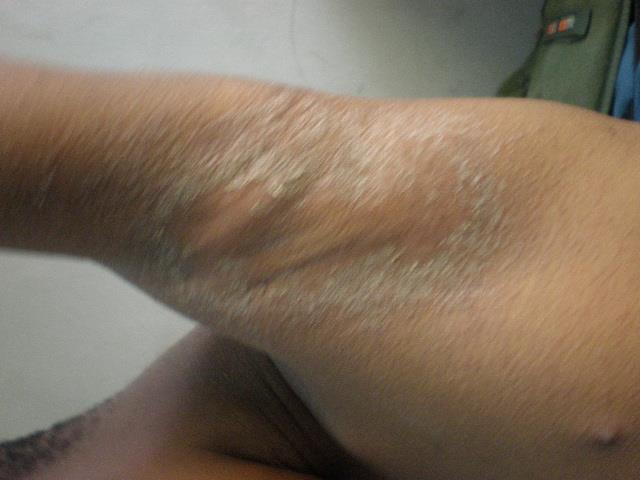
Mimics
- Psoriasis, including guttate — Scalp and facial overlap is genuine; psoriatic scale is thicker, drier and more adherent, with sharper margins
- Tinea capitis and kerion — Scalp scale with hair loss, broken hairs and lymphadenopathy is fungal, not seborrhoeic - and needs oral treatment
- Vitiligo — The hypopigmented form in darker skin is frequently mistaken for vitiligo; seborrhoeic patches scale and have indistinct borders
- Atopic eczema and infected eczema — Distribution separates them - sebaceous areas rather than flexures
- Nappy rash, candida, and patterns that should worry you — Infantile seborrhoeic dermatitis involves the nappy area as well as the scalp
- Pityriasis versicolor — Both scale in sebum-rich areas and both leave hypopigmentation; versicolor favours the upper trunk and arms rather than the face and scalp
What to do in the ED
- Mind the age restrictions, because they differ by site and by preparation. Scalp and beard at any age: ketoconazole 2% shampoo or an over-the-counter anti-dandruff shampoo, considering a short course of a corticosteroid scalp application such as betamethasone valerate 0.1% for itch. Face and body: ketoconazole 2% cream in adults only, or another topical imidazole such as clotrimazole or miconazole in adolescents and adults, with a short course of a mild topical corticosteroid such as hydrocortisone 1% for flares
- Medicated shampoo for scalp disease, used with adequate contact time - technique matters more than the product
- For cradle cap, emollient and gentle removal of scale, considering a topical imidazole cream or a short course of a mild topical corticosteroid if needed - CKS gives infants their own regimen, not the adult one. It is self-limiting and CKS puts resolution at around 8 to 12 months, which is the figure parents want
- Think about an underlying cause in severe, abrupt or extensive adult disease. CKS advises that investigations may be appropriate where an underlying cause such as HIV, or an alternative diagnosis such as tinea or lupus, is suspected - so offer HIV testing in that situation rather than treating and discharging
- Explain the relapsing course so that recurrence is not read as treatment failure
- In darker skin, explain the hypopigmentation explicitly and say that colour returns once inflammation settles
- Consider a contact allergy to hair products if disease persists despite correct treatment
Disposition
Topical treatment and GP follow-up. The referral criteria are wider than resistant disease - CKS gives four, for adults and children alike: diagnostic uncertainty, failure to respond to routine treatment, severe or widespread disease, and eyelid involvement where eyelid hygiene measures have not worked. This entry's own distribution includes the brows and periocular skin, so the eyelid criterion is not a remote possibility.