Vitiligo
Complete loss of pigment in well-defined patches - medically benign, frequently devastating, and never to be dismissed as cosmetic.
Red flags
- Severe psychological distress, depression or suicidal ideation - ask directly. This is the most important red flag on the page and it is a medical problem, not a cosmetic one
- Rapidly progressive depigmentation - warrants prompt dermatology referral, as early treatment gives better results
- Associated autoimmune disease, particularly thyroid disorder - check thyroid function
- Sunburn of depigmented skin - it has no melanin protection
- Ocular or auditory symptoms with vitiligo - rare associated syndromes exist
Recognise
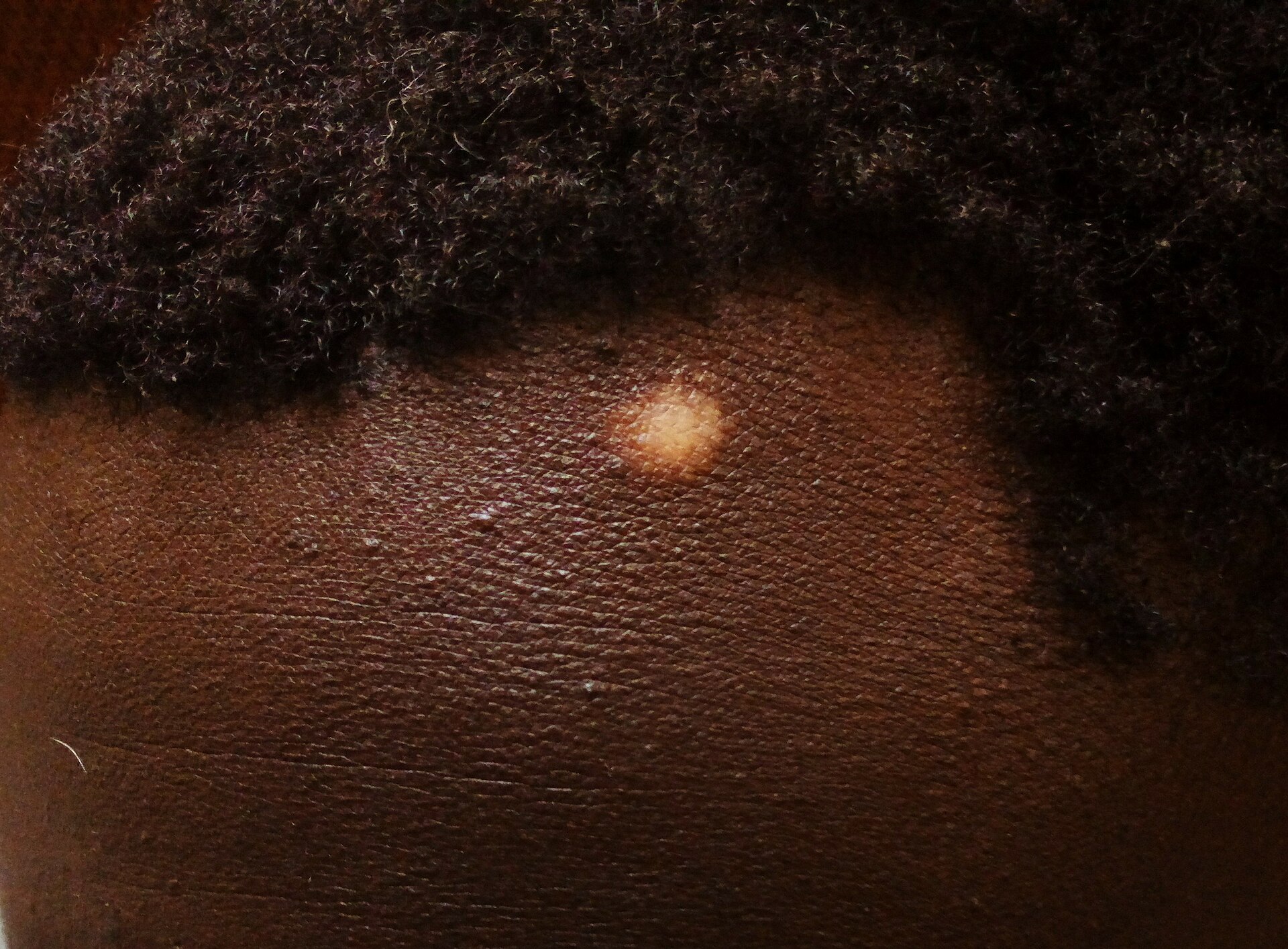
Well-demarcated milk-white patches, most obvious in summer or under Wood light, with no scale and no change in skin texture.
This is the entry where skin tone changes the significance of the condition rather than merely its appearance. In brown and black skin vitiligo is far more visible, and the psychological, social and in some communities the marital and occupational consequences are severe - it is a well-recognised cause of profound distress and, in some settings, of stigma. No figure is given here because none could be traced to a source read in full; the clinical instruction does not depend on one. The patches themselves are easier to see, not harder, so recognition is rarely the problem; the failure mode here is dismissing it as cosmetic. The depigmentation is complete and chalk-white against surrounding skin, with normal texture and no scale, which separates it from post-inflammatory hypopigmentation and from pityriasis versicolor. Depigmented skin has no protection from ultraviolet light and burns readily, so sun protection is a medical instruction, not advice about appearance.
- Complete depigmentation - chalk or milk white, not merely pale
- Well-demarcated borders, normal skin texture, no scale
- Symmetrical and often periorificial and acral in the common form
- Koebner phenomenon - new patches at sites of trauma or friction
- White hairs within a patch indicate follicular involvement and a poorer response to treatment
- Ask about autoimmune disease, especially thyroid, which is associated
Distribution
Photographs
Mimics
- Seborrhoeic dermatitis — Hypopigmented seborrhoeic dermatitis in darker skin is a very common misdiagnosis; it scales and its borders are indistinct
- Atopic eczema and infected eczema — Post-inflammatory hypopigmentation after eczema is partial and fades; vitiligo is complete and persistent
- Tinea corporis, cruris and pedis — Pityriasis versicolor gives fine scaly hypopigmented patches; vitiligo has no scale and is completely depigmented
- Benign neonatal rashes - the reassurance set — Pigment changes in infancy have their own differential
- Pityriasis versicolor — The distinction that matters in brown and black skin, where versicolor may show only as pale patches. Vitiligo is chalk-white, completely depigmented and has no scale; versicolor is off-white and scales
What to do in the ED
- Do not describe this as cosmetic. Name it, acknowledge its impact, and ask how the patient is coping
- Refer to dermatology - treatment exists, and earlier treatment of active disease works better, so referral is not a courtesy
- Check thyroid function and consider screening for associated autoimmune disease
- Advise high-factor sun protection for depigmented skin, explaining that it burns without melanin
- Ask directly about mood and about the impact on work, relationships and daily life; refer for psychological support where needed
- Signpost to patient support organisations, and to camouflage services, which are available on the NHS in many areas and are frequently not mentioned
- Avoid implying the condition is trivial by the speed of the consultation
Disposition
Dermatology referral for treatment, with earlier referral for active or rapidly progressive disease. Psychological support where the impact warrants it.
Safety-netting
Local variation
Sources
- NICE CKS - Vitiligo
- Lim HW et al. International Expert Consensus on Knowledge Gaps in Care for Dermatologic Disorders in Skin of Color. Int J Dermatol 2026
- NICE CG153 1.2.1.5 - erythema may be underestimated in skin types V-VI (stated in the psoriasis guideline; cited here for that general point about assessing erythema, not for this condition)
- Gawkrodger DJ et al. Guideline for the diagnosis and management of vitiligo. Br J Dermatol 2008;159(5):1051-76 (British Association of Dermatologists; dated 2008 and still the UK national guideline)