Tinea capitis and kerion
Scalp ringworm needs oral treatment - and it disproportionately affects Black children, in whom it is routinely mistaken for dandruff or eczema.
Red flags
- A kerion mistaken for a bacterial abscess and incised - it should be treated with oral antifungals, not cut; incision risks permanent scarring alopecia
- A suspected kerion - arrange urgent dermatology referral from the ED. CKS makes this the first step for any suspected kerion: it may need high-dose oral antifungal treatment, specialist removal of thick crust, or oral corticosteroid, culture is often falsely negative, and delay causes permanent scarring alopecia. Do not wait for scarring to appear before treating it as urgent
- Extensive disease or failure of treatment
- Widespread or unusually severe disease - consider immunosuppression
- Repeated presentations attributed to hair care without the scalp having been examined
Recognise
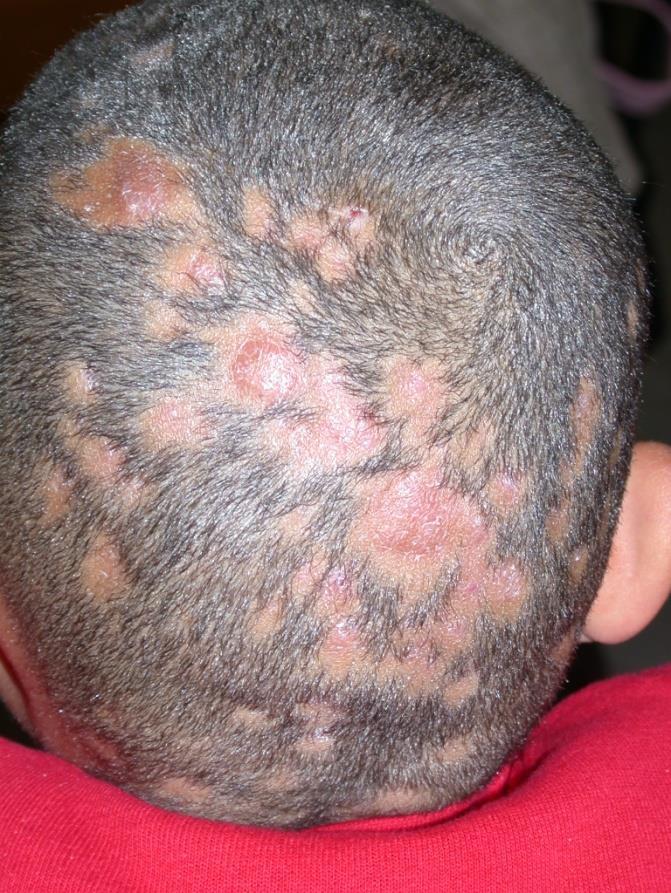
Scaly patches with broken-off hairs and areas of alopecia, sometimes with visible black dots where hairs have broken at the surface; kerion appears as a boggy red swelling studded with pustules.
This entry exists largely because of a recognition failure that falls almost entirely on Black children. Tinea capitis is more prevalent in patients from African-Caribbean backgrounds and commonest between about 3 and 9 years (Mind the Gap), and its scaling is repeatedly attributed to dandruff, dry scalp, eczema or hair-care practices, so diagnosis is delayed and children are left with avoidable scarring alopecia. Redness is not a usable sign here. Look for the structural findings: patchy scale, broken-off hairs, black dots at the follicular openings, and occipital or cervical lymphadenopathy - the last is a genuinely useful and tone-independent discriminator from simple dandruff. Part the hair systematically and examine the scalp itself rather than the hair. Consider it in any child with scalp scale and lymphadenopathy, and lower your threshold further, not higher, if the family attributes it to hair products.
- Scaling with hair loss - dandruff does not cause alopecia
- Broken hairs and black dots at the follicular openings
- Occipital or posterior cervical lymphadenopathy - a useful supporting sign
- Kerion: boggy, tender, pustular swelling, easily mistaken for a bacterial abscess
- Commonest in pre-pubertal children; ask about affected siblings and shared combs or clippers
Distribution
Photographs
Mimics
- Tinea corporis, cruris and pedis — Body and groin disease responds to topical treatment; scalp disease does not and needs oral therapy
- Skin abscess, boils and folliculitis — A kerion looks like an abscess. Incising it is harmful - the discriminator is the associated scale, broken hairs and lymphadenopathy
- Atopic eczema and infected eczema — Seborrhoeic or atopic scalp disease scales but does not cause patchy hair loss with broken hairs
- Impetigo — Crusted scalp lesions may be bacterial, but without alopecia and broken hairs
What to do in the ED
- Send scalp scrapings, brushings or plucked hairs for mycology - but do not let sampling delay treatment. CKS allows an adult to start an oral antifungal on strong clinical suspicion before mycology results are back, and treatment is given empirically until culture returns. For a child, CKS asks either for a certain diagnosis with appropriate primary-care prescribing expertise, or specialist advice from a paediatric dermatologist before starting. Least of all delay in a suspected kerion, where culture is often falsely negative and waiting costs hair
- Start oral antifungal treatment under local policy - scalp disease does not clear topically; topical treatment alone does not clear scalp disease and is used only as an adjunct to reduce transmission
- Do not incise a kerion. Treat it as fungal infection; add antibiotics only if there is genuine bacterial superinfection
- Examine and consider screening household contacts, including asymptomatic carriers, and advise against sharing combs, brushes and clippers
- Refer to dermatology where there is scarring, diagnostic doubt or treatment failure
- Examine the scalp properly in any child presenting with scale - part the hair and look at the skin
- Address the family's explanation respectfully, but do not let an attribution to hair products substitute for an examination
Disposition
Urgent dermatology referral for any suspected kerion. Otherwise mycology sampling and oral antifungal treatment via the GP, with dermatology referral for scarring, diagnostic doubt or treatment failure. Admission is almost never required.
Safety-netting
Sources
- NICE CKS - Fungal skin infection - scalp
- NICE CKS - Fungal skin infection - body and groin
- Laude TA. Approach to dermatologic disorders in black children. Semin Dermatol 1995
- Mukwende M, Tamony P, Turner M. Mind the Gap: A handbook of clinical signs in Black and Brown skin. St George’s, University of London (2020)