Psoriasis, including guttate
A chronic inflammatory disease, not an infection - and in the ED the job is to recognise it, treat the flare and refer, not to start systemic therapy.
Red flags
- Erythroderma - near-total skin involvement is a medical emergency with burn physiology, not a bad flare
- Generalised pustular psoriasis - widespread sterile pustules with fever, which is an emergency in its own right
- Rapidly worsening disease after stopping a systemic corticosteroid - a recognised trigger for pustular and erythrodermic forms, and a reason not to give oral steroids for psoriasis
- New or worsening joint pain and swelling - psoriatic arthritis, which causes irreversible damage if untreated
- Severe disease with a major impact on mood, work or sleep - this warrants urgent referral on its own
Recognise
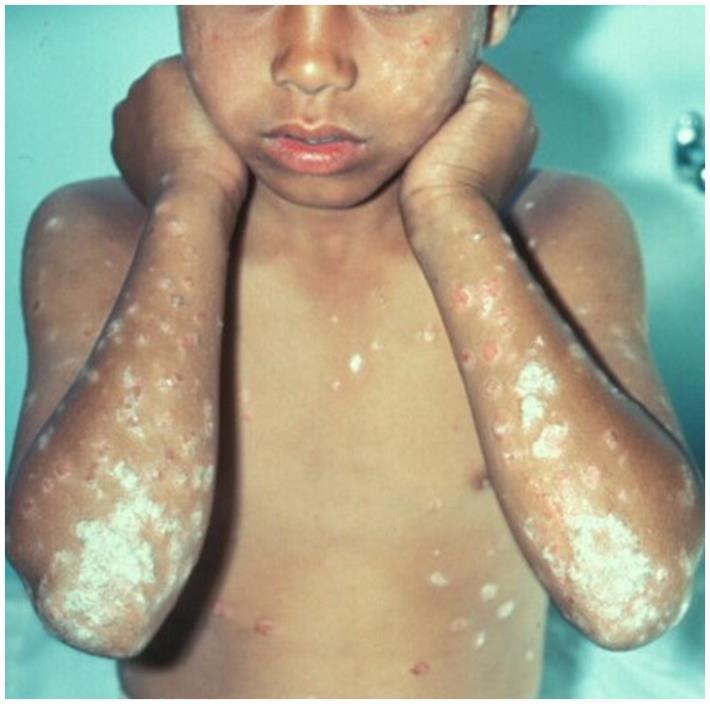
Well-demarcated salmon-pink or red plaques with thick adherent silvery-white scale, symmetrically over extensor surfaces, with nail pitting and onycholysis.
The salmon-pink of every textbook description is absent. Plaques in brown and black skin more often appear violaceous, grey, or dark brown, and the scale can look greyer and is frequently thicker, so the plaques are both harder to identify and often more extensive by the time they are diagnosed. The well-demarcated border, the palpable thickness of the plaque and the adherent scale are the tone-independent findings - feel the edge and the induration rather than judging colour. Two things here are quotable. NICE CG153 1.2.1.5 says in terms that erythema may be underestimated in people with darker skin types, such as skin types 5 and 6 on the Fitzpatrick scale - the guideline itself warns that PASI will under-read. And Costa and Romiti's review of psoriasis in skin of colour reports that less apparent erythema and violaceous or dark brown plaques contribute to delayed diagnosis and reduced diagnostic accuracy, with patients frequently presenting with greater body-surface involvement and thicker scale. The resulting post-inflammatory change is severe and, in that review, can persist for years after the plaques clear: prolonged hyperpigmentation and sometimes striking hypopigmentation after plaques clear, lasting many months, which patients often find more distressing than the psoriasis itself and which must be explained as not being scarring or a treatment failure.
- Well-demarcated plaques with a palpable edge - unlike the ill-defined margins of eczema
- Thick adherent scale that is hard to remove
- Symmetrical, on extensor surfaces, scalp and sacrum
- Nail changes: pitting, onycholysis, subungual hyperkeratosis
- Guttate: a sudden shower of small drop-like lesions, often after a streptococcal throat infection, commonest in children and young adults
- Ask about joint pain - psoriatic arthritis is frequently missed and is a reason for prompt referral
Distribution
Photographs
Mimics
- Tinea corporis, cruris and pedis — Tinea is asymmetrical with a raised active scaly edge and central clearing; psoriasis is symmetrical with uniform thick scale
- Atopic eczema and infected eczema — Eczema is itchy with ill-defined margins; psoriasis is sharply demarcated. The commonest misdiagnosis in darker skin
- Seborrhoeic dermatitis — Scalp and facial overlap is genuine; seborrhoeic scale is greasier and the margins less defined
- Generalised pustular psoriasis — The emergency form of the same disease
- Erythroderma — Psoriasis is a leading cause of erythroderma
- Pityriasis rosea — Guttate psoriasis and pityriasis rosea both give a sudden truncal eruption in a young person
What to do in the ED
- Avoid oral corticosteroids in psoriasis unless a specialist has advised them. Withdrawal of a systemic corticosteroid is a recognised trigger for pustular and erythrodermic disease, both of which CKS classes as medical emergencies - so a short course given for convenience can produce a far worse problem weeks later
- In a child or young person, CG153 1.2.1.12 is unconditional: refer any type of psoriasis to a specialist at presentation. Do not use very potent corticosteroids in children and young people at all (1.3.1.15), and take durations from the BNF for Children - the adult figures below do not transfer
- Treat a flare with emollient and topical therapy, and let site govern potency. On the trunk and limbs in adults, CG153 1.3.2.1 offers a potent corticosteroid once daily plus a vitamin D preparation once daily, applied separately - one in the morning and one in the evening - for up to 4 weeks. CG153 1.3.4.4 is an explicit prohibition: do not use potent or very potent corticosteroids on the face, flexures or genitals. At those sites offer a short-term mild or moderate potency preparation instead, once or twice daily for a maximum of 2 weeks (1.3.4.1), because they are particularly vulnerable to steroid atrophy. Do not use potent corticosteroids continuously at any site for longer than 8 weeks, or very potent ones for longer than 4 weeks
- For guttate psoriasis, ask about a recent sore throat and treat confirmed streptococcal infection, while explaining that guttate disease often settles over weeks to months
- Ask about joints, and refer to rheumatology as well as dermatology if there is inflammatory joint pain
- Refer to dermatology for extensive, unresponsive or severe disease; admit for erythroderma or generalised pustular disease
- Explain the pigment changes that will follow, especially in brown and black skin, before the patient discovers them
- Ask about mood - the psychological burden is substantial and routinely unaddressed in an ED visit
Disposition
In adults, topical treatment and GP follow-up, with dermatology referral for extensive, severe or unresponsive disease and rheumatology for joint involvement. Any child or young person with psoriasis of any type is referred to a specialist at presentation, per CG153 1.2.1.12 - not managed by the GP alone. Admit for erythroderma or generalised pustular psoriasis.