Nappy rash, candida, and patterns that should worry you
Whether the skin creases are spared or involved tells you which it is - and the nappy area is also where non-accidental injury is found.
Red flags
- Any bruise in a baby who is not yet independently mobile - NICE CG89 lists this first among the bruising features that should prompt suspicion of maltreatment, whatever the site, and most infants presenting with nappy rash are in exactly this group. Before escalating, satisfy yourself it is a bruise: dermal melanocytosis over the sacrum, buttocks or back is a normal finding in babies with brown and black skin, is more uniform in colour than a bruise, and is the classic benign mimic - see the neonatal rashes entry. Bruising in darker skin is also harder to see in the first place, so absence of visible bruising is not reassurance
- Bruising, petechiae, burns, bite marks or injuries in the nappy area, perineum or genitals - these sites are rarely injured accidentally. Follow NICE CG89 and your local safeguarding process; a skin finding you cannot explain is a safeguarding assessment, not a dermatology one
- Any injury inconsistent with the history given, or with the child's developmental stage
- Delayed presentation, or an account that changes between tellings
- Severe erosive or ulcerated disease, or failure to respond to appropriate treatment
- An unwell or febrile infant, or skin involvement extending well beyond the nappy area
Recognise
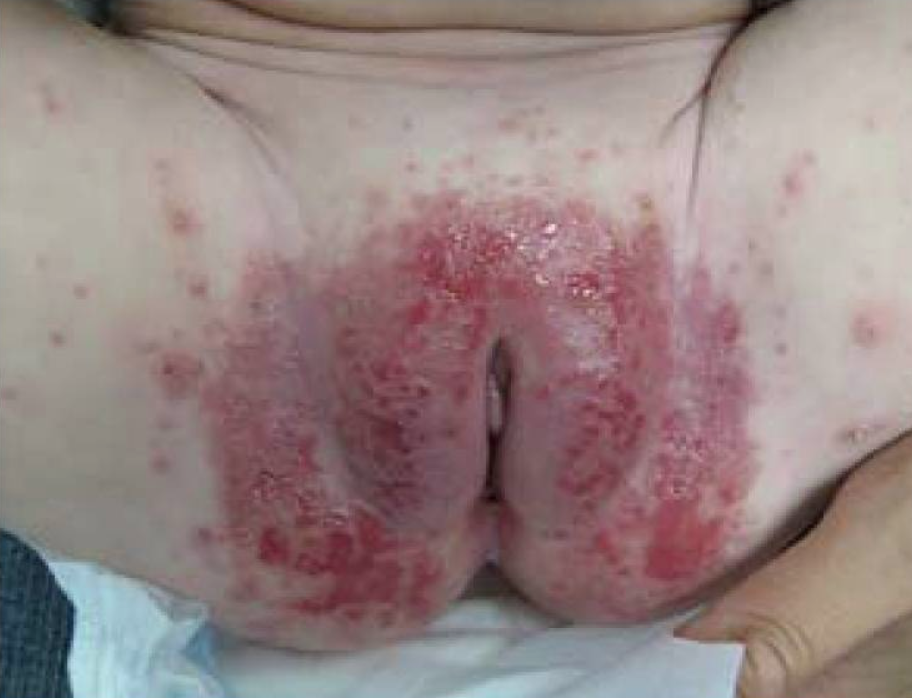
Irritant: shiny red confluent erythema over the convexities with sparing of the folds. Candidal: beefy red involvement including the folds, with a scalloped edge and satellite papules and pustules.
The distinction rests on redness in every textbook description and that is not available in brown and black skin, where an inflamed nappy area may look darker, violaceous, greyish or simply shiny. Use the anatomy, which is tone-independent: are the creases spared or involved, and are there satellite lesions beyond the main area. Feel for the moist, macerated texture of candidal involvement in the folds. Post-inflammatory hypopigmentation in the nappy area afterwards is common, can be extensive and alarming to parents, and is regularly mistaken for scarring or for steroid damage - explain it unprompted.
- Folds spared - irritant contact dermatitis, the common one
- Folds involved, with satellite lesions - candidal infection
- Soreness and distress at nappy changes
- Consider other causes if it is severe, persistent or unresponsive: seborrhoeic dermatitis, psoriasis, atopic eczema, or rarely zinc deficiency
- Look beyond the nappy area - a rash elsewhere changes the diagnosis
Distribution
Photographs
Mimics
- Atopic eczema and infected eczema — Eczema usually spares the nappy area because it is moist and occluded, so florid nappy-area eczema should prompt a rethink
- Impetigo — Bullous impetigo favours the nappy area in infants
- Benign neonatal rashes - the reassurance set — In the newborn, nappy-area lesions have their own benign differential
- Staphylococcal scalded skin syndrome — SSSS begins in the flexures and can be mistaken early for a severe nappy rash - but the child is febrile and the skin shears
What to do in the ED
- Decide irritant versus candidal on whether the folds are involved, and treat accordingly - barrier preparation and nappy-free time for irritant, topical antifungal for candidal
- Advise frequent nappy changes, gentle cleansing, and generous barrier application
- For a rash that looks inflamed and is causing discomfort in a child aged 1 month or over, CKS supports hydrocortisone 1% cream in addition to the barrier preparation - a thin layer once a day until symptoms settle or for a maximum of 7 days, with the barrier applied a few minutes afterwards. This is ordinary primary-care prescribing, not a specialist decision. Where candida is suspected or confirmed on swab, CKS prescribes a topical imidazole (clotrimazole, econazole or miconazole) and advises against a barrier preparation until that infection has settled
- Examine the whole child undressed, every time, in good light. The nappy area is one of the commonest sites of inflicted injury, and a nappy rash consultation is an opportunity to look properly. Mind the Gap notes that increased melanin makes immediate bruising hard to see - it may only become obvious as it darkens to purple, brown or black, and the yellow of an older bruise is more subtle too - so compare both sides and inspect closely rather than relying on a glance
- If anything raises a safeguarding concern, follow NICE CG89 and the local child protection process, seek senior review, and document the findings and the history verbatim
- Arrange follow-up for anything severe, persistent or atypical rather than repeatedly re-treating
Disposition
Treat and discharge with GP follow-up. Any safeguarding concern requires senior review and the local child protection pathway before the child leaves.
Safety-netting
Local variation
Sources
- NICE CKS - Nappy rash
- NICE CG89 - Child maltreatment: when to suspect maltreatment in under 18s
- NICE NG76 - Child abuse and neglect
- Lim HW et al. International Expert Consensus on Knowledge Gaps in Care for Dermatologic Disorders in Skin of Color. Int J Dermatol 2026
- Mukwende M, Tamony P, Turner M. Mind the Gap: A handbook of clinical signs in Black and Brown skin. St George’s, University of London (2020)