Pityriasis versicolor
A superficial Malassezia infection that is most often mistaken for vitiligo, and in brown and black skin may show only as pale patches.
Red flags
- Widespread or rapidly extending disease in an immunosuppressed patient - reconsider the diagnosis and discuss
- Failure to respond to adequate topical treatment - reconsider vitiligo, seborrhoeic dermatitis, tinea corporis or secondary syphilis
Recognise
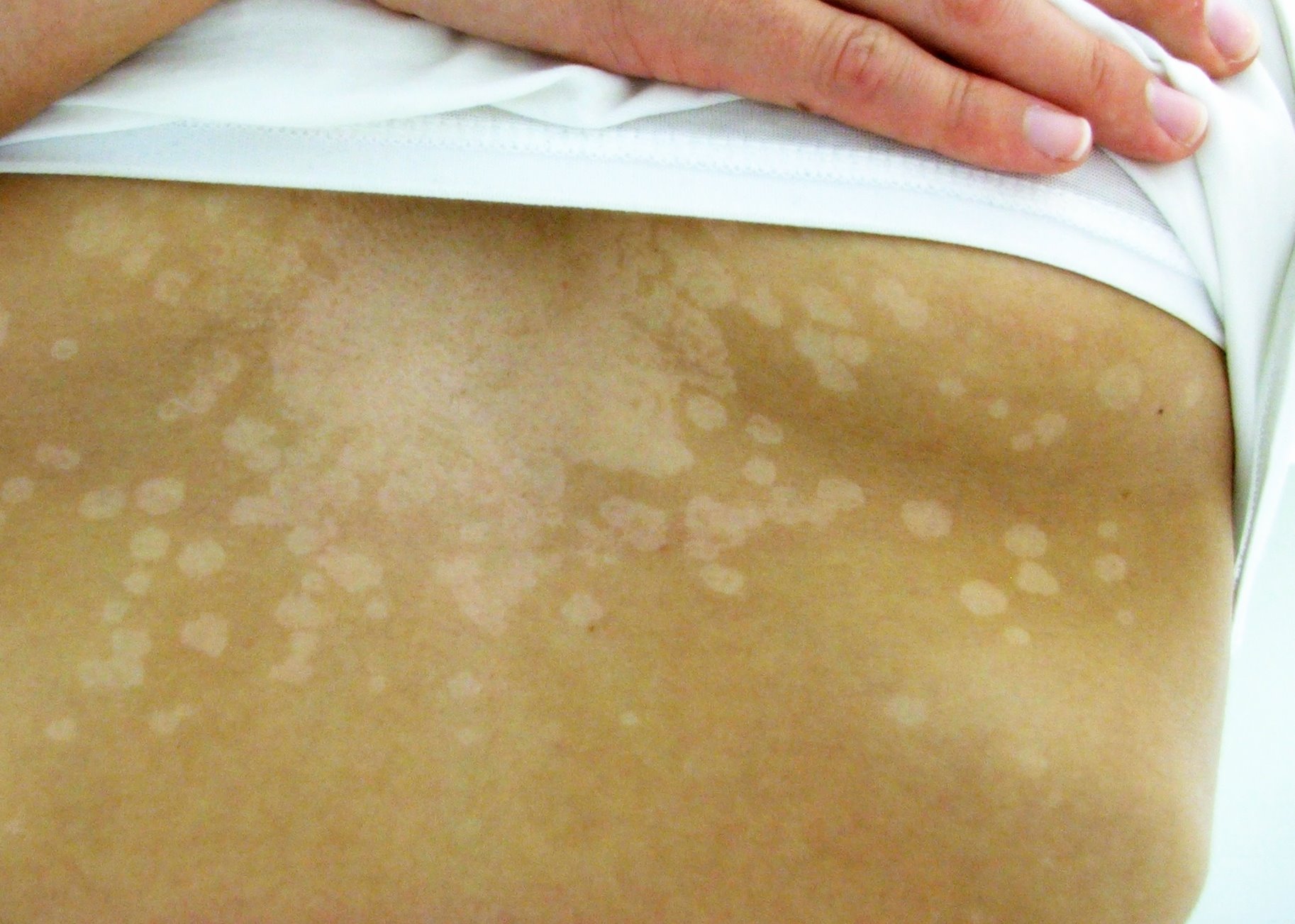
Multiple round or oval macules and confluent patches on the upper trunk and arms. CKS gives the full colour range as fawn, pink, red, brown, black or almost white - the pale end is not exclusive to darker skin - with a fine scale that is easily overlooked until the surface is stretched or scratched.
NICE CKS is explicit that in a darker skin tone the only visible lesions may be the pale ones - so the “versicolor” of the name, the mixed fawn-pink-brown palette of the textbook photograph, may be entirely absent and the only finding is pale patches. That single fact is why this entry exists: pale patches on the trunk in a patient with brown or black skin are far more often pityriasis versicolor than vitiligo, and being told it is vitiligo carries a very different prognosis and a very different emotional weight. The tone-independent discriminators are the fine surface scale, which can be brought out by stretching or lightly scraping the skin, and the incomplete, off-white depigmentation - vitiligo is chalk-white, sharply marginated and has no scale at all.
- Round or oval macules that become confluent patches, on the upper trunk, upper arms, neck and abdomen
- A fine scale is the key sign - often subtle, and easier to see if you stretch the skin or scrape it lightly
- Usually asymptomatic, though mild itch sometimes occurs
- Uncommon in young children; typically from the late teens onwards
- Commoner in hot and humid conditions, and in the UK more often noticed after summer or foreign travel
Distribution
Photographs
Mimics
- Vitiligo — The distinction that matters. Vitiligo is chalk-white, completely depigmented, sharply marginated and has no scale; pityriasis versicolor is off-white or fawn, incompletely depigmented and scales
- Seborrhoeic dermatitis — Both scale in sebaceous areas and both can leave hypopigmentation; seborrhoeic dermatitis favours the face, scalp and nasolabial folds rather than the upper trunk
- Tinea corporis, cruris and pedis — Both are fungal and both scale, but tinea corporis has an advancing annular edge with central clearing rather than confluent macules
- Pityriasis rosea — Both give oval truncal lesions; pityriasis rosea has a herald patch, a collarette of scale and a self-limiting course over weeks
- Syphilis - the secondary rash — Secondary syphilis can give a widespread macular truncal eruption - the discriminators are palm and sole involvement and generalised lymphadenopathy
What to do in the ED
- Confirm clinically. Diagnosis is usually made on appearance alone and microscopy of scrapings is not usually needed - that is CKS's position, and CKS is the only clinical source this entry has, so read the topic before acting on the detail below
- Look for scale before you call pale patches vitiligo. This is the single most useful thing the ED can do with this presentation
- Ketoconazole 2% shampoo once daily for 5 days is the usual first treatment, or an antifungal cream such as clotrimazole for a small area. Check the preparation and duration against the BNF and local formulary
- For extensive disease or topical failure, an oral antifungal such as itraconazole or fluconazole is an option in a non-pregnant adult - but children and pregnant or breastfeeding women are referred to dermatology rather than treated orally in primary care
- Set expectations about pigment explicitly: the colour change usually settles over several weeks to months once treatment starts, and can persist for years. Patients who are not told this conclude the treatment failed
- Explain that relapse is common, that re-treating each episode as for the first is appropriate, and that ketoconazole shampoo every 1 to 4 weeks can reduce recurrence. For the patient whose episodes follow heat or travel, prophylactic ketoconazole 2% shampoo once daily for up to 3 days before the exposure is an option
Disposition
Treat and discharge with GP follow-up. Dermatology referral for children and for pregnant or breastfeeding women needing systemic treatment, and for diagnostic doubt.