Generalised pustular psoriasis
The emergency form of psoriasis - fever, widespread sterile pustules and a systemically unwell patient.
Red flags
- Fever, hypotension or tachycardia - this can cause hypovolaemia, hypocalcaemia, acute kidney injury and sepsis
- Extensive involvement or progression to erythroderma - thermoregulation and fluid balance fail
- Recent withdrawal of systemic corticosteroid - the classic trigger
- Pregnancy - impetigo herpetiformis is a pustular psoriasis of pregnancy with fetal risk and needs urgent obstetric and dermatology input
- Secondary bacterial infection through broken skin
Recognise
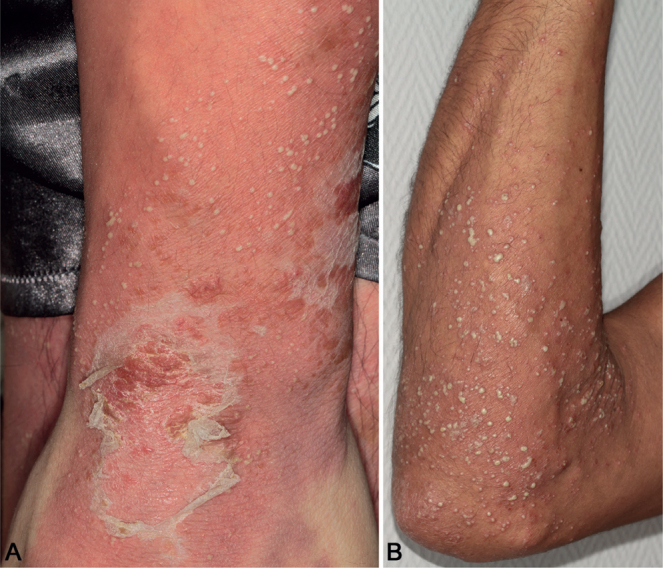
Sheets of small sterile pustules on bright red, tender, oedematous skin, coalescing into lakes, with fever and rigors.
The pustules are the tone-independent finding and remain visible as pale yellow-white points on any background, but the inflamed skin beneath may look violaceous, dark or simply swollen and glossy rather than red - so the striking contrast described in textbooks is muted, and the eruption can appear less dramatic than the patient's physiology. Judge severity on the fever, the tenderness, the extent and the observations rather than on redness.
- Fever and systemic upset with the eruption - this is not a cosmetic flare
- Widespread sterile pustules coalescing into lakes of pus
- Painful, tender skin
- Often a known history of psoriasis, and frequently a trigger: corticosteroid withdrawal, infection, pregnancy, or drugs
- May progress to erythroderma with the same physiological consequences
Distribution
Photographs
Mimics
- Acute generalised exanthematous pustulosis — The key differential. AGEP follows a new drug within days and settles on stopping it; pustular psoriasis usually has a psoriasis history and a different trigger. Histology and the drug timeline separate them, and the distinction matters because the treatments diverge
- Psoriasis, including guttate — The same disease in its emergency form
- Erythroderma — Pustular psoriasis frequently becomes erythrodermic
- Stevens-Johnson syndrome / toxic epidermal necrolysis — Both give widespread painful skin with fever; necrolysis detaches epidermis and erodes mucosa rather than forming pustules
What to do in the ED
- Treat as an acute medical emergency, not a rash: observations, fluid balance, and bloods including renal function, calcium, albumin and CRP
- Swab a pustule to confirm sterility and exclude bacterial infection
- Take a careful drug history covering the preceding weeks, specifically asking about stopping a systemic steroid as well as starting anything new
- NICE CG153 1.2.1.11 is explicit: people with generalised pustular psoriasis or erythroderma should be referred immediately for same-day specialist assessment and treatment - and CKS classes both as rare medical emergencies that may be life-threatening. Admit - this is not a discharge diagnosis
- Warm the patient, replace fluids, and manage the skin as a barrier failure with emollient and non-adherent dressings
- Do not start or stop systemic corticosteroids without dermatology advice, as both can worsen the disease
- In pregnancy, involve obstetrics urgently
Disposition
Admit with same-day dermatology. Critical care input if thermoregulation, fluid balance or renal function are failing.
Sources
- NICE CG153 - Psoriasis: assessment and management
- NICE CKS - Psoriasis
- Sidoroff A et al. Risk factors for acute generalized exanthematous pustulosis (AGEP) - results of a multinational case-control study (EuroSCAR). Br J Dermatol 2007
- Costa A, Romiti R. Psoriasis in skin of color: clinical presentation, diagnostic challenges, and therapeutic considerations. An Bras Dermatol 2026