Pityriasis rosea
A single herald patch followed days to three weeks later by a truncal eruption in a young person - self-limiting, and the main job is to exclude syphilis.
Red flags
- Palm and sole involvement, or no itch with generalised lymphadenopathy - test for syphilis. Secondary syphilis is the classic mimic and is rising in incidence
- Pregnancy - CKS notes that pityriasis rosea in the first trimester has been associated with adverse outcomes including miscarriage and premature delivery, while also advising that women should be reassured it is likely self-limiting and that in most cases there is no harm to the pregnancy. Discuss with obstetrics, and give both halves of that message rather than only the alarming one
- An atypical morphology or distribution, or a course beyond about 5 months - reconsider the diagnosis, including a drug eruption or guttate psoriasis. Note that 2 to 3 months is the expected duration, not a prolonged one
- A recent new drug - a pityriasis rosea-like drug eruption is well recognised
- Systemic upset, which does not belong with this diagnosis
Recognise
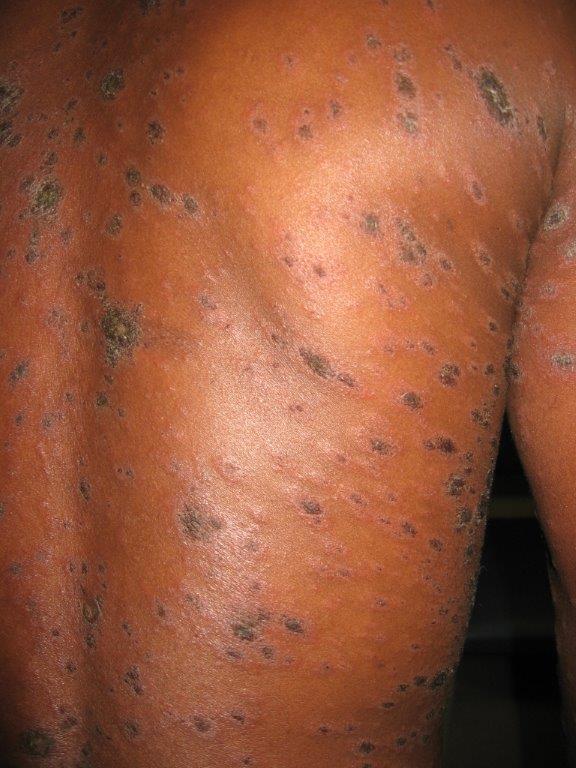
A single larger salmon-pink oval scaly herald patch, then crops of smaller pink oval plaques with a fine collarette of scale inside the edge, aligned along the ribs.
The salmon-pink colour does not translate, and lesions appear grey, dark brown, violaceous or hyperpigmented. Two variants are worth knowing: a papular form, and an inverse distribution involving the axillae, groins and face rather than the trunk - either of which means the classic fir-tree pattern may be absent entirely. Both are widely described as commoner in children and in brown and black skin, but no frequency figure is given here because none could be traced to a source read in full. The oval shape, the long axis following skin cleavage lines, and the trailing collarette of scale just inside the lesion edge are the tone-independent features - stretch the skin gently to bring out the collarette. Post-inflammatory hyperpigmentation and sometimes hypopigmentation are prominent and can last months after the eruption clears.
- Herald patch - a single larger lesion, typically 2 to 5 cm, appearing a few days to three weeks before the generalised rash, which CKS puts at up to 90% of people. Subsequent lesions are typically 0.5 to 1 cm, so the size difference is part of the pattern. A patch that appeared eighteen days ago still fits; its absence does not exclude the diagnosis
- Oval lesions with the long axis along the ribs
- A fine collarette of scale trailing inside the edge of each lesion
- Mild or no systemic symptoms in a young person, typically 10 to 35 years old
- Self-limiting, but slower than patients expect. CKS says new crops may continue for up to 6 weeks and the rash often worsens before it settles, and that it usually settles within 2 to 3 months, occasionally taking up to 5 months to disappear
- Palms and soles are spared - if they are involved, think syphilis
Distribution
Photographs
Mimics
- Syphilis - the secondary rash — The one to exclude. Secondary syphilis involves palms and soles, does not itch, and has lymphadenopathy
- Psoriasis, including guttate — Guttate psoriasis also gives a sudden truncal eruption in a young person, but lesions are thicker-scaled and there is no herald patch or collarette
- Tinea corporis, cruris and pedis — The herald patch alone is frequently misdiagnosed as ringworm and treated with an antifungal
- Drug eruptions - morbilliform and fixed — A pityriasis rosea-like drug eruption is recognised - check what is new
- Seborrhoeic dermatitis — Both can give scaly truncal patches, but the oval shape and collarette distinguish this
What to do in the ED
- Examine the palms and soles and ask about a preceding painless ulcer, and test for syphilis if there is any doubt - this is the single most important action on this page
- Ask about pregnancy. If the patient is pregnant, discuss with obstetrics - and convey CKS's balanced position: an association with adverse outcomes in the first trimester, alongside reassurance that it is usually self-limiting and most pregnancies are unharmed
- Review the drug history for a recent new medication
- Explain the natural history, and be concrete about it: new crops are possible for up to 6 weeks, a rash that often worsens before it settles, and resolution usually within 2 to 3 months, occasionally up to 5. Itch is managed with emollient and a mild topical corticosteroid or an antihistamine
- Warn about post-inflammatory pigment change, particularly in brown and black skin, so it is not mistaken for persisting disease
- No investigation is needed in a typical case with a herald patch and a classic distribution
Disposition
Reassure and discharge with an explanation of the timescale. Test for syphilis where the distribution is atypical, and involve obstetrics in pregnancy.
Safety-netting
Sources
- NICE CKS - Pityriasis rosea
- NICE CKS - Syphilis
- Lim HW et al. International Expert Consensus on Knowledge Gaps in Care for Dermatologic Disorders in Skin of Color. Int J Dermatol 2026
- NICE CG153 1.2.1.5 - erythema may be underestimated in skin types V-VI (stated in the psoriasis guideline; cited here for that general point about assessing erythema, not for this condition)