Tinea corporis, cruris and pedis
An itchy annular scaly plaque with an active edge - and the interdigital kind is the portal of entry for recurrent cellulitis.
Red flags
- Extensive or rapidly spreading disease, or failure to respond to appropriate antifungal treatment
- Immunosuppression or poorly controlled diabetes
- Scalp or beard involvement - needs oral treatment, topical will not clear it
- Concurrent cellulitis with interdigital tinea - treat both, or the cellulitis recurs
- Widespread tinea in a young person with no obvious cause - consider undiagnosed immunosuppression
Recognise
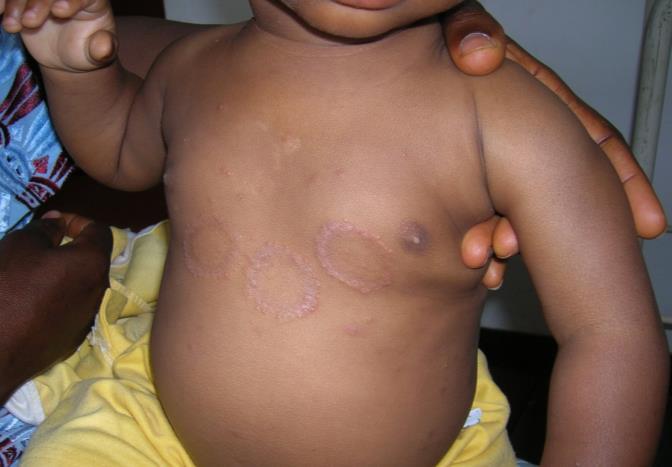
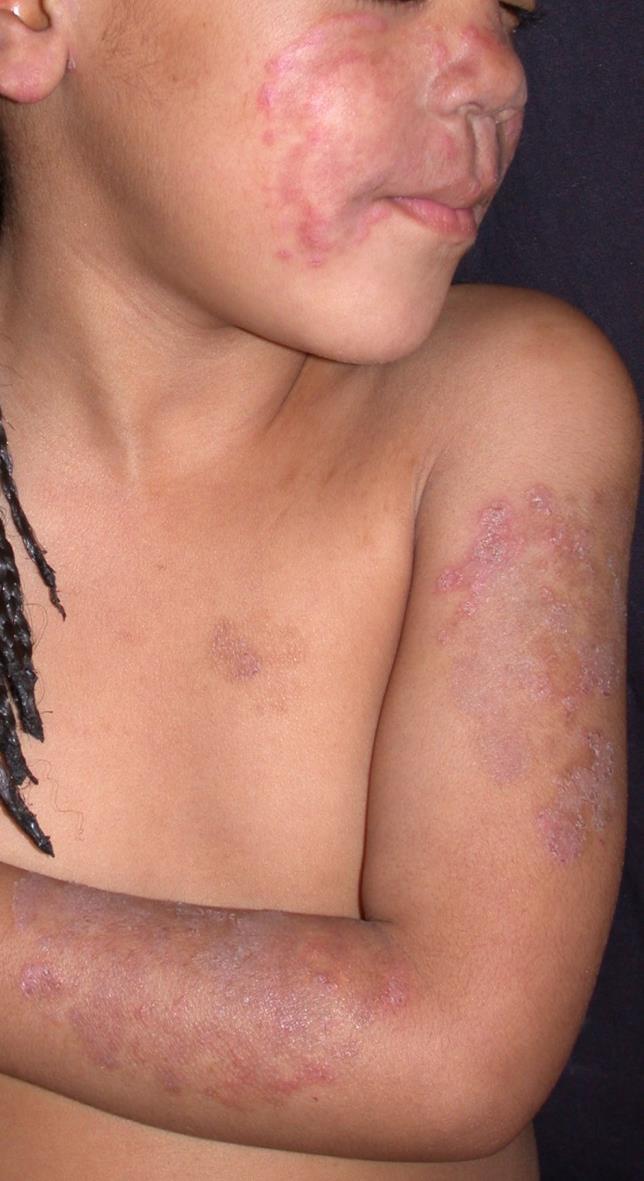
Annular pink-red plaque with a raised scaly advancing edge and central clearing, itchy, enlarging slowly.
The ring may appear grey, dark brown, violaceous or simply hyperpigmented rather than pink, and the central clearing can be much less obvious, so the classic ring is often not seen. The scale and the palpable raised active edge are the tone-independent findings - look obliquely across the skin for scale and run a finger over the border. Tinea in brown and black skin is frequently misdiagnosed as eczema and treated with a topical steroid, which produces tinea incognito: the scale and the edge disappear, the rash spreads, and the true diagnosis is obscured. Post-inflammatory hyperpigmentation after successful treatment is common and does not mean failure.
- A raised, scaly, active edge with relative central clearing
- Itchy, and usually asymmetrical or unilateral - unlike eczema and psoriasis
- Slowly enlarging over weeks
- Check the feet and the toe webs in every patient with cellulitis - interdigital tinea is a common portal of entry
- A history of a steroid cream that made it worse, or made it better then worse - suspect tinea incognito
Distribution
Photographs
Mimics
- Atopic eczema and infected eczema — The commonest misdiagnosis in both directions. Eczema is symmetrical and has no active scaly edge; treating tinea with steroid produces tinea incognito
- Tinea capitis and kerion — Scalp disease needs oral treatment and is a different management problem
- Cutaneous candidiasis — Candida involves the folds with satellite lesions; tinea cruris spares the scrotum and has an active edge
- Cellulitis — Not a mimic - a consequence. Interdigital tinea is a portal of entry for recurrent lower-limb cellulitis
- Granuloma annulare — The mistake that actually happens. Both are annular with a raised edge, but granuloma annulare has no scale and does not itch - months of antifungal for it is a common history
- Pityriasis versicolor — Both are superficial fungal infections that scale, but versicolor gives confluent macules on the upper trunk rather than an advancing annular edge
What to do in the ED
- Treat with a topical antifungal, following local policy on the preparation. In an adult, oral treatment is for severe or extensive disease and CKS ties it to sampling - a positive mycology result, a strong clinical suspicion before results are back, or a negative result with strongly suggestive features plus repeat sampling. In a child with severe or extensive disease, CKS arranges referral to a paediatric dermatologist rather than oral treatment in primary care. Scalp and nail disease needs oral therapy either way
- Do not prescribe a topical steroid or a combined steroid-antifungal on the assumption it is eczema where the edge is scaly and active
- Examine the toe webs, and treat interdigital tinea in anyone presenting with lower-limb cellulitis
- Take skin scrapings for mycology before committing to an oral course - CKS makes sampling part of that decision rather than optional - and also where the diagnosis is uncertain or topical treatment has failed
- Advise on reducing recurrence: dry thoroughly between the toes, change socks, avoid sharing towels, treat footwear
- Look for and treat other sites in the same patient, including nails, since untreated nail disease reinfects the skin
Disposition
Topical treatment and discharge with GP follow-up. Refer for mycology and oral treatment where extensive, resistant, or involving scalp or nails.
Safety-netting
Sources
- NICE CKS - Fungal skin infection - body and groin
- NICE CKS - Fungal skin infection - foot
- NICE NG141 - Cellulitis and erysipelas: antimicrobial prescribing
- Lim HW et al. International Expert Consensus on Knowledge Gaps in Care for Dermatologic Disorders in Skin of Color. Int J Dermatol 2026
- UKHSA - A to Z of infectious diseases in children and young people's settings: Ringworm
- NICE CG153 1.2.1.5 - erythema may be underestimated in skin types V-VI (stated in the psoriasis guideline; cited here for that general point about assessing erythema, not for this condition)