Pityriasis lichenoides, including PLEVA
Recurring crops of papules that crust, erode and scar over months - benign, frequently misdiagnosed as chickenpox or scabies, and a dermatology referral rather than an ED problem.
Red flags
- Febrile ulceronecrotic Mucha-Habermann disease - high fever with rapidly extending necrotic ulcers and systemic illness. It is rare and it is a genuine emergency; admit and involve dermatology urgently
- Extensive ulceration with secondary infection
Recognise
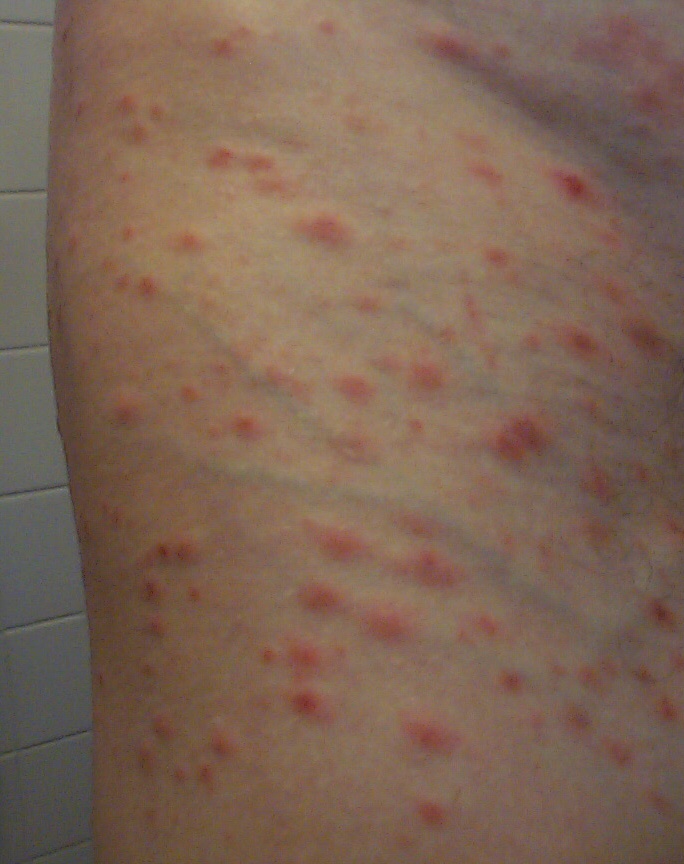
Pink to red-brown papules that develop a central scale, then a dark adherent crust, sometimes eroding to leave a varioliform scar. In the chronic form, smaller scaly papules with a mica-like scale that lifts off whole.
The erythema of the fresh papule is poorly visible, but this condition is unusually well suited to recognition in darker skin because its diagnostic features are structural rather than coloured - the central scale, the adherent dark crust, the erosion, the varioliform scar and the coexistence of several lesion ages are all tone-independent. The pigmentary aftermath is more prominent and more distressing than in pale skin: marked post-inflammatory hyperpigmentation, and in the chronic form hypopigmented macules that are conspicuous against brown and black skin and may persist long after the disease is inactive. That dyspigmentation is often the presenting complaint rather than the papules, and it reflects pigment lability rather than active disease - say so, because families frequently read it as the condition spreading. No skin-of-colour-specific series was identified for pityriasis lichenoides; this draws on general sources.
- Crops of lesions at different stages at the same time - the most useful single feature
- A central adherent crust, and varioliform (pock-like) scars where lesions have healed
- Months-long course with recurring crops, not a single self-limited eruption
- The patient is systemically well
- Acute (PLEVA) and chronic (PLC) forms occur with roughly equal frequency and frequently overlap in one patient
Distribution
Photographs
Mimics
- Chickenpox (varicella) — The commonest misdiagnosis. Both show lesions at different stages simultaneously. Chickenpox resolves in two weeks and the child is unwell; pityriasis lichenoides recurs over months in a well child
- Scabies, including crusted scabies — Also itchy papules with crusting; scabies has burrows, a nocturnal itch and affected contacts
- Psoriasis, including guttate — Guttate psoriasis is also small scaly papules on the trunk after infection, but with silvery scale and no crusting, erosion or scarring
- Pityriasis rosea — Also truncal and scaly, but with a herald patch, a collarette of scale and a single six-to-eight-week course
- IgA vasculitis (Henoch-Schonlein purpura) — Both can look purpuric on the legs; IgA vasculitis is palpable purpura over days with joint, gut and renal features
- Molluscum contagiosum — Also discrete papules in a well child, but umbilicated and pearly, without scale, crust or scarring
What to do in the ED
- Recognise it and say what it is not - most of these children arrive labelled as recurrent chickenpox or as scabies that will not clear, and have been treated repeatedly for both
- Examine for lesions of several different ages, and look for varioliform scars from earlier crops - that history is often visible on the skin even when the parents have not noticed it
- Do not treat with permethrin or aciclovir on spec
- Refer to dermatology. Diagnosis is usually clinical but biopsy is sometimes needed, and the treatment evidence base sits entirely outside the ED - a systematic review puts narrowband UVB first line and oral erythromycin second
- Be straight that the course is months and that it comes in crops; the recurrence is the disease, not a treatment failure
Disposition
Routine dermatology referral. The course is benign in the great majority, but long-term follow-up is recommended because transformation to cutaneous T-cell lymphoma, while rare, has been reported - that is a reason for dermatology to hold the patient, not a reason to alarm the family in the ED.
Safety-netting
Local variation
Sources
- Geller L, Antonov NK, Lauren CT, Morel KD, Garzon MC. Pityriasis lichenoides in childhood: review of clinical presentation and treatment options. Pediatr Dermatol 2015;32(5):579-92
- Bellinato F, Maurelli M, Gisondi P, Girolomoni G. A systematic review of treatments for pityriasis lichenoides. J Eur Acad Dermatol Venereol 2019;33(11):2039-49
- Laude TA. Approach to dermatologic disorders in black children. Semin Dermatol 1995;14(1):15-20 - cited here for pigment lability, not for this condition