Scabies, including crusted scabies
Relentless itch, worse at night, in more than one member of the household - treat the contacts or it comes straight back.
Red flags
- Crusted scabies - highly contagious, a common source of outbreaks, needing specialist advice, isolation precautions and combined oral and topical treatment
- Two or more linked cases in one setting - UKHSA asks for health protection team contact where two or more people at a setting have scabies and are linked, for example by being in the same class, group or location. This is not confined to care homes, and a nursery with two cases qualifies
- Secondary bacterial infection, particularly group A streptococcal, which can lead to post-streptococcal complications
- Failure of treatment after correctly applied therapy and simultaneous contact treatment - reconsider the diagnosis or resistance
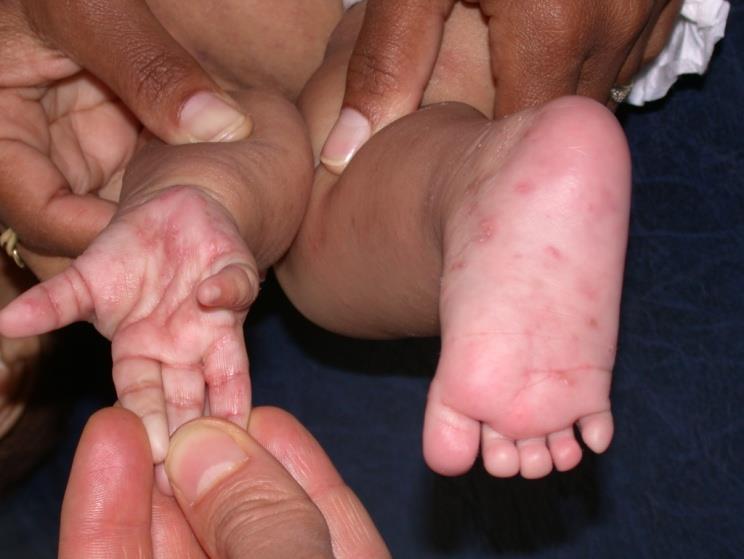
- Scabies in a baby under 2 months - rare at this age, and permethrin 5% cream is licensed only from 2 months, so CKS says seek specialist advice before treating, for example from a paediatric dermatologist. In infants the distribution also includes the palms, soles, scalp and face
Recognise
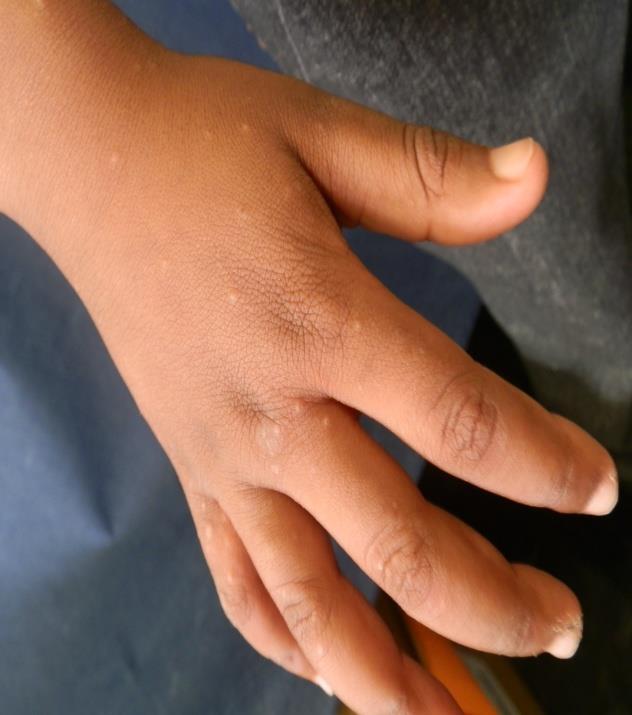
Small red excoriated papules with fine grey burrows a few millimetres long in the finger webs and on the wrists, and inflamed nodules on the genitals or axillae.
Burrows are difficult to see against brown and black skin, and the secondary papules appear as skin-coloured, darker or violaceous rather than red, so scabies is frequently missed or misdiagnosed as eczema. Rely on the history and the distribution, which are tone-independent: severe itch that is worse at night, and other affected household members. Examine the finger webs and wrists in good light, stretch the skin to bring burrows into relief, and consider dermoscopy if available. Scabies in darker skin more often produces prominent nodular lesions and marked post-inflammatory hyperpigmentation that persists long after successful treatment - which is a common reason for repeated, unnecessary re-treatment.
- Itch that is worse at night and disturbs sleep - the defining symptom
- Other people in the household itching - ask directly, because this is often the strongest evidence
- Burrows in the finger webs and on the wrists
- Sparing of the head and neck in adults, but not in infants or the elderly
- Itch persists for two to four weeks after successful treatment and is not treatment failure
- Crusted scabies: thick, widespread, scaly crusted plaques, often with surprisingly little itch, in the elderly, immunosuppressed or institutionalised - carrying an enormous mite burden and extremely infectious
Distribution
Photographs
Mimics
- Atopic eczema and infected eczema — The usual misdiagnosis. Eczema does not spare the head in a pattern like this, and does not make the whole household itch
- Acute urticaria — Itchy but weals are transient and migratory; scabies lesions are fixed
- Impetigo — Secondary infection of excoriated scabies is common and both need treating
- Head lice — Another infestation to ask about in a household with itch, though the distribution is entirely different
- Pompholyx — Both itch intensely and both involve the finger webs, but scabies has burrows, affects contacts and is worst at night
What to do in the ED
- Treat with topical permethrin 5% per the BNF and local policy, applied over the whole body including the face, neck, scalp and ears - in every patient, adult and child. The BNF is explicit that although the manufacturer recommends excluding the head and neck, application should be extended to the scalp, neck, face and ears. Leaving the head untreated is a recognised cause of apparent treatment failure. Larger patients may need up to two 30 g packs
- Treat every household member, every close personal contact and every sexual partner from the past month at the same time, whether or not they itch. Not doing this is the commonest cause of apparent treatment failure - and a partner outside the household is neither a household member nor an obvious 'close contact' to a hurried reader. CKS notes that referral to genito-urinary medicine may be needed for partner notification
- Explain the application properly: cool dry skin, under the nails, left on for the specified duration, repeated after a week
- Warn explicitly that itch continues for two to four weeks after successful treatment - otherwise the patient re-attends or re-treats unnecessarily
- Wash clothing, bedding and towels at a hot wash on the day of treatment
- Treat secondary bacterial infection where present
- Give UKHSA's setting advice, because it is what the parent or employer will ask about. A child of 5 or under, or any child who cannot follow the contact advice, stays away from nursery or school until 24 hours after completing their first treatment. Older children and young people attend as usual but must avoid close skin contact until the first treatment is complete. Close contacts, including household members, are treated but do not need to stay away
- For crusted scabies, or any institutional outbreak, seek specialist and health protection advice rather than managing it as an individual case
Disposition
Treat and discharge with contact treatment arranged. Specialist and health protection involvement for crusted scabies or an institutional outbreak.
Safety-netting
Local variation
Sources
- NICE CKS - Scabies
- UKHSA - Health protection in children and young people's settings, including education
- Lim HW et al. International Expert Consensus on Knowledge Gaps in Care for Dermatologic Disorders in Skin of Color. Int J Dermatol 2026
- NICE CKS - Scabies, Scenario: Management of scabies
- UKHSA - A to Z of infectious diseases in children and young people's settings: Scabies
- NICE CG153 1.2.1.5 - erythema may be underestimated in skin types V-VI (stated in the psoriasis guideline; cited here for that general point about assessing erythema, not for this condition)