Chickenpox (varicella)
Usually mild in a healthy child, and dangerous in the neonate, the immunosuppressed, the pregnant and the adult.
Red flags
- Any area of skin that becomes painful, hot, swollen or discoloured - invasive group A streptococcal infection, including necrotising fasciitis, is a recognised and lethal complication of chickenpox
- A neonate, an immunosuppressed patient, or a pregnant woman - all need urgent specialist discussion and consideration of aciclovir or immunoglobulin
- An adult or adolescent - substantially higher risk of varicella pneumonia, especially in smokers and in pregnancy
- Breathlessness or cough - varicella pneumonia
- Drowsiness, unsteadiness or seizures - cerebellitis or encephalitis
- Dehydration from painful oral lesions
Recognise
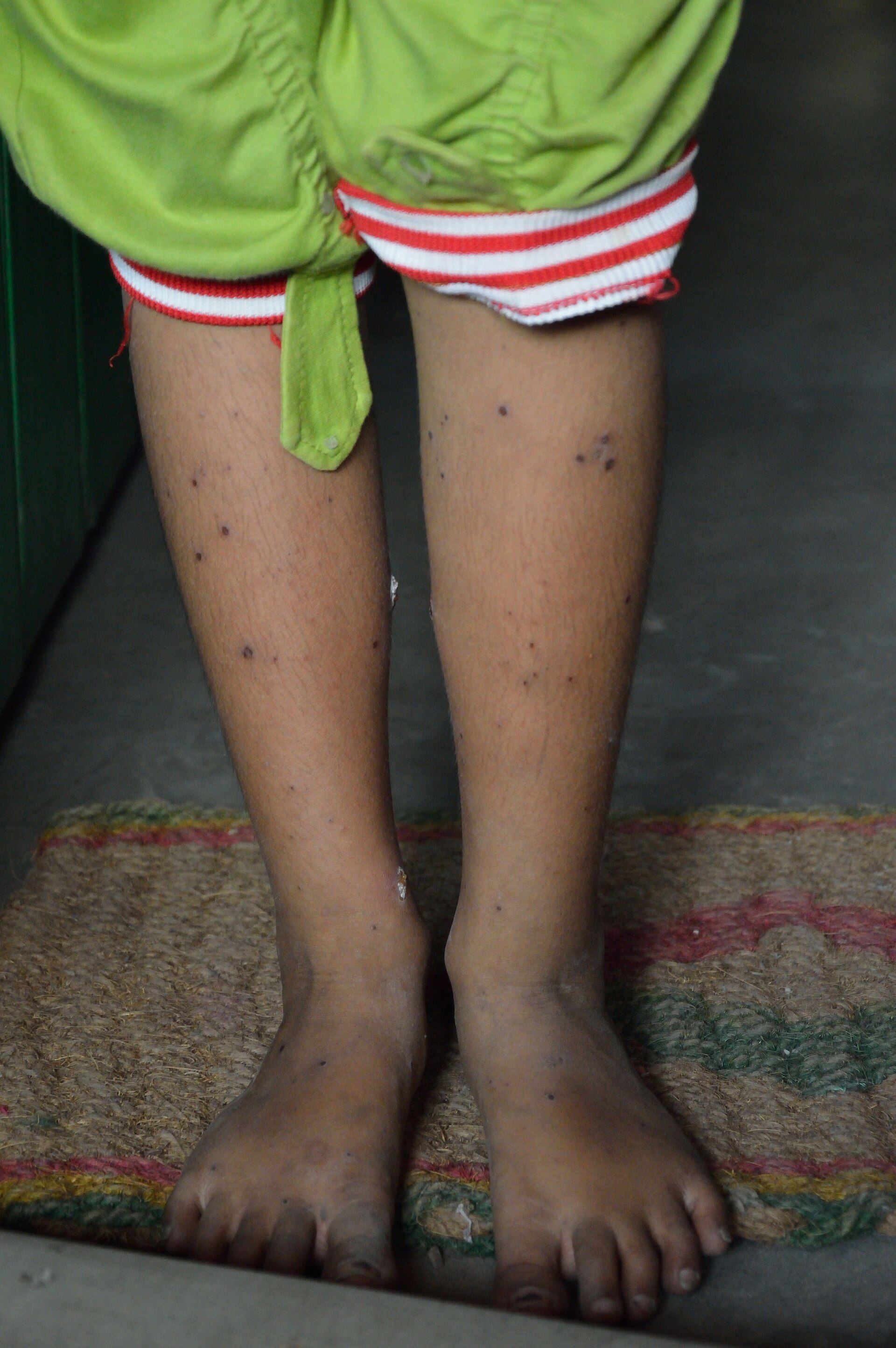
Crops of itchy red macules becoming papules then thin-walled 'dewdrop' vesicles on a red base, pustulating and crusting, all stages coexisting.
The red base around each vesicle is frequently not visible, so the eruption appears as scattered skin-coloured or grey vesicles and darker crusted papules against unremarkable skin, and it can look far less impressive than it is. The coexistence of lesions at different stages is the diagnostic feature and is entirely tone-independent - look for macules, vesicles and crusts side by side. Chickenpox in brown and black skin much more often leaves prolonged post-inflammatory hypopigmentation or hyperpigmentation, sometimes for many months, and families should be warned about this specifically, since it is distressing and frequently mistaken for scarring.
- Lesions at several different stages at the same time - the single most useful sign
- Intensely itchy, centrally distributed, and involving the scalp
- Mild fever and malaise, typically a well child
- New crops for three to five days; no longer infectious once all lesions have crusted
- Ask about pregnant, immunosuppressed and neonatal contacts
Distribution
Photographs
Mimics
- Hand, foot and mouth disease — Concentrated on hands, feet and mouth with oval lesions, rather than a centrally distributed crop at mixed stages
- Eczema herpeticum — In a child with eczema, monomorphic punched-out erosions on eczematous skin point to herpes simplex, not varicella
- Impetigo — Bullous impetigo can resemble a localised crop, but lacks the widespread mixed-stage distribution
- Staphylococcal scalded skin syndrome — Both blister in children; SSSS shears, spares mucosa and has perioral radial fissuring
What to do in the ED
- Identify who this patient is: healthy child, adult, pregnant, immunosuppressed, or neonate. That question, not the rash, determines management
- Examine every lesion site for secondary bacterial infection and specifically for disproportionate pain, which is the earliest sign of invasive group A streptococcal disease
- Aciclovir is not routine in an otherwise healthy child. CKS suggests considering oral aciclovir for an immunocompetent, non-pregnant adolescent aged 14 or older, or adult, presenting within 24 hours of rash onset - not for younger children. Discuss urgently in pregnancy, immunosuppression and the neonate
- Identify pregnant and immunosuppressed contacts; post-exposure prophylaxis is time-critical
- Symptomatic treatment: paracetamol rather than ibuprofen, because non-steroidal use in chickenpox is associated with severe skin and soft tissue infection; oral antihistamine and emollient for itch
- Exclusion advice: the two UK sources differ and you should give both. UKHSA's education guidance says stay away from the setting until 5 days after the rash first appears; NICE CKS says until all vesicles have crusted over. CKS reconciles them by noting infectivity continues until lesions are dry and crusted, usually about 5 days after rash onset. In practice, advise 5 days as the minimum and until crusting if that takes longer
- Warn explicitly about the pigment changes that follow in darker skin, which are not scarring
Disposition
Supportive care at home for a healthy child. Urgent specialist discussion for neonates, pregnancy, immunosuppression, and for any complication; admit for invasive infection, pneumonia or neurological features.
Safety-netting
Sources
- NICE CKS - Chickenpox
- UKHSA - Invasive group A streptococcal disease: managing close contacts in community settings
- UKHSA - Health protection in children and young people's settings, including education
- Lim HW et al. International Expert Consensus on Knowledge Gaps in Care for Dermatologic Disorders in Skin of Color. Int J Dermatol 2026
- Mukwende M, Tamony P, Turner M. Mind the Gap: A handbook of clinical signs in Black and Brown skin. St George’s, University of London (2020)