Viral warts and verrucae
Human papillomavirus growths that mostly clear on their own - the hard part is resisting treatment that is more damaging than the wart.
Red flags
- An atypical, rapidly growing, bleeding or ulcerated lesion assumed to be a wart - refer for specialist assessment rather than treating. A squamous cell carcinoma or amelanotic melanoma can be mistaken for a wart
- Extensive or resistant warts in someone severely immunosuppressed, for example after organ or bone marrow transplant
Recognise
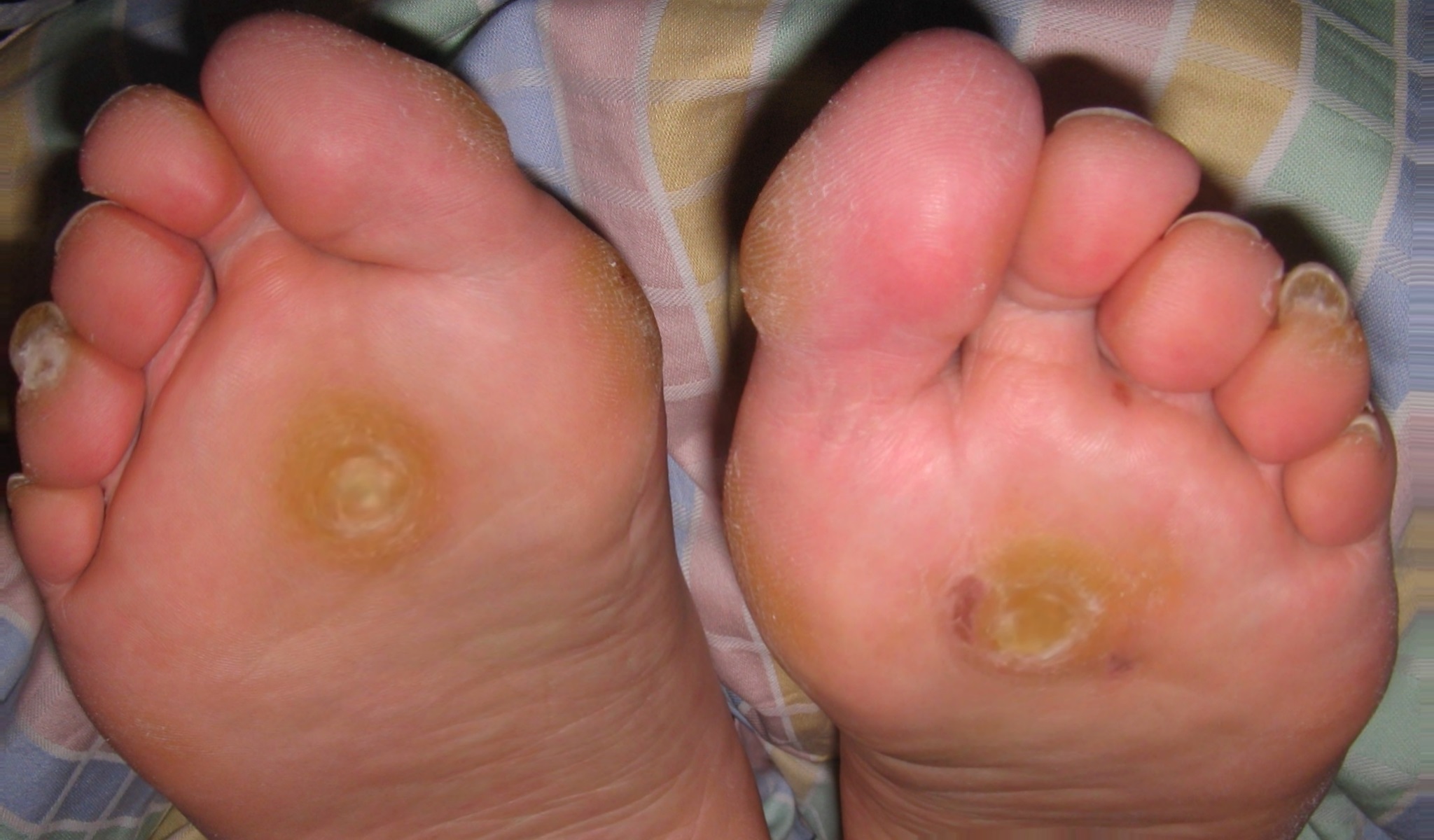
Firm raised papules with a rough, cauliflower-like surface. Plane warts are round, flat-topped and skin-coloured or greyish-yellow. Plantar warts are flattened by weight-bearing and often show central dark dots - thrombosed capillaries.
Warts are a structural diagnosis rather than a colour one - the rough keratotic surface, the flat-topped plane wart and the thrombosed capillary dots are all visible across the Fitzpatrick range - so recognition is not usually the problem here. The problem is the treatment. NICE CKS lists depigmentation among the adverse effects of cryotherapy, alongside pain, blistering, infection and scarring. On brown and black skin a depigmented or hyperpigmented patch left behind by cryotherapy is far more conspicuous and far more lasting than it would be on pale skin, and it can be more disfiguring than the wart that was frozen. That is a reason to weigh the strong case for not treating more heavily, not less, in darker skin - and to say so to the patient rather than deciding for them. Post-inflammatory pigment change after any destructive treatment is more prominent in skin of colour. CKS lists depigmentation among cryotherapy's adverse effects, and a depigmented patch is more conspicuous and longer-lasting on brown or black skin than on pale skin - so the already strong case for not treating is stronger here, not weaker.
- A rough keratotic surface that interrupts normal skin lines - a corn or callus does not
- Central dark dots on paring - thrombosed capillaries. Be aware that bleeding may spread warts
- Usually asymptomatic; painful mainly on the sole or beside a nail
- In children around a quarter resolve within 2-3 months, half within a year, two-thirds by 2 years and 90% within 5 years. Adults are slower, and warts may persist 5-10 years
- Large, extensive, treatment-resistant warts in someone severely immunosuppressed are a different problem
Distribution
Photographs
Mimics
- Molluscum contagiosum — Also viral papules in children, but smooth, pearly and umbilicated rather than rough and keratotic
- Basal cell and squamous cell carcinoma - recognise and refer — The one that matters. A squamous cell carcinoma can present as a keratotic growing lesion; an atypical or non-healing lesion is not a wart until a specialist says so
- Melanoma - recognise and refer — Amelanotic or acral melanoma on the sole can be mistaken for a verruca - acral melanoma is the subtype most relevant in darker skin
- Lichen planus — Hypertrophic lichen planus on the shins can look warty, but is violaceous, itchy and usually accompanied by lesions elsewhere
- Granuloma annulare — Also firm skin-coloured papules, but annular, smooth-surfaced and not keratotic
What to do in the ED
- Make the case for not treating. NICE CKS states there is a strong case for not treating most warts, particularly in children, in whom they are more likely to resolve and treatment is uncomfortable or poorly tolerated. Give the resolution figures - they are the most useful thing you can offer
- Treat only if the wart is painful, cosmetically unsightly, or persistent and the person wants it treated
- Facial warts should not routinely be treated in primary care - refer to dermatology if treatment is indicated
- Where treatment is chosen, topical salicylic acid (most preparations 12-26%) applied daily for up to 12 weeks is the best-evidenced option. A Cochrane review of 85 trials found salicylic acid better than placebo (RR 1.56, 95% CI 1.20-2.03), with the effect stronger on hands than feet, and found salicylic acid plus cryotherapy better than salicylic acid alone (RR 1.24, 1.07-1.43). Check CKS's contraindications before recommending it, because several are easy to walk into here: not on the face, not on intertriginous or anogenital skin, not on mucous membranes, not on moles or birthmarks, not on a wart with hair growing from it or with red edges or an unusual colour, not on broken, irritated or infected skin, not on large areas, not in a child under 2 years, and not on neuropathic feet or in a person with diabetes - the last of which is the same foot this band's `diabetic-foot-ulcer` entry is about
- Be honest about cryotherapy. The same review found no significant difference between cryotherapy and placebo across all sites (RR 1.45, 95% CI 0.65-3.23), and adverse effects - pain, blistering, infection, scarring and depigmentation - are probably more common with it. CKS says plainly not to use cryotherapy in younger children
- Duct tape does not work. Two trials of clear duct tape showed no advantage over placebo. Say so when it is raised, because it usually is
- This is almost never an ED presentation in its own right - if a wart is the reason for attendance, the useful output is an explanation and a GP route, not a procedure
Disposition
GP management. Refer to dermatology for facial warts requiring treatment, for diagnostic doubt or atypical lesions, and for extensive or resistant warts in immunosuppression.
Safety-netting
Local variation
Sources
- NICE CKS. Warts and verrucae. Last revised October 2024 - prognosis, diagnosis and management scenarios
- Kwok CS, Gibbs S, Bennett C, Holland R, Abbott R. Topical treatments for cutaneous warts. Cochrane Database Syst Rev 2012;(9):CD001781 - 85 trials, 8815 participants
- Rao M, Young K, Jackson-Cowan L, Kourosh A, Theodosakis N. Post-inflammatory hypopigmentation: review of the etiology, clinical manifestations, and treatment options. J Clin Med 2023;12(3):1243 - more prominent in skin of colour