Lichen planus
Itchy flat-topped violaceous papules with white streaks - and the mouth, genitals and nails need looking at because they change the management.
Red flags
- Erosive or ulcerative oral or genital disease - painful, needs specialist management, and carries a small long-term risk of squamous cell carcinoma requiring ongoing surveillance
- Scalp involvement with scarring (lichen planopilaris) - hair loss becomes permanent, so refer urgently
- Nail involvement with destruction of the nail plate - also permanent, and also urgent
- A lichenoid eruption after a new drug - a lichenoid drug eruption behaves differently and the drug should be reviewed
- Widespread disease or failure to respond to topical treatment
Recognise
Small, flat-topped, shiny, purple-violaceous polygonal papules with fine white lacy lines (Wickham striae) across the surface, intensely itchy.
Lichen planus is one of the few conditions whose classic description already uses a violaceous colour, so it translates better than most - but in brown and black skin the papules often appear dark brown, grey or almost black, and the disease more commonly takes hypertrophic forms with thick warty plaques, especially on the shins. Wickham striae, the flat shiny top and the polygonal shape are the reliable features; wet the skin or use dermoscopy to bring the striae out. The residual pigmentation is severe and long-lasting - lichen planus pigmentosus, a distinct variant producing extensive dark brown or slate-grey patches on the face and flexures, is reported predominantly in people with brown skin and is frequently the reason for presentation - though no prevalence figure is given here, because none could be traced to a source read in full. Warn patients that this pigmentation outlasts the disease by many months and is not scarring.
- The six Ps: purple, polygonal, planar (flat-topped), pruritic papules and plaques
- Wickham striae - fine white lacy lines on the surface
- Koebner phenomenon - new lesions along scratches
- Check the mouth, the genitals, the nails and the scalp - all are commonly involved and all are commonly not asked about
- Oral disease appears as bilateral white lacy patches on the buccal mucosa, and erosive oral disease is painful and needs specialist care
- Usually self-limiting over months to a couple of years, but oral and genital disease can be far more persistent. Note that no UK guideline underwrites a specific timescale here - see Local practice
Distribution
Photographs
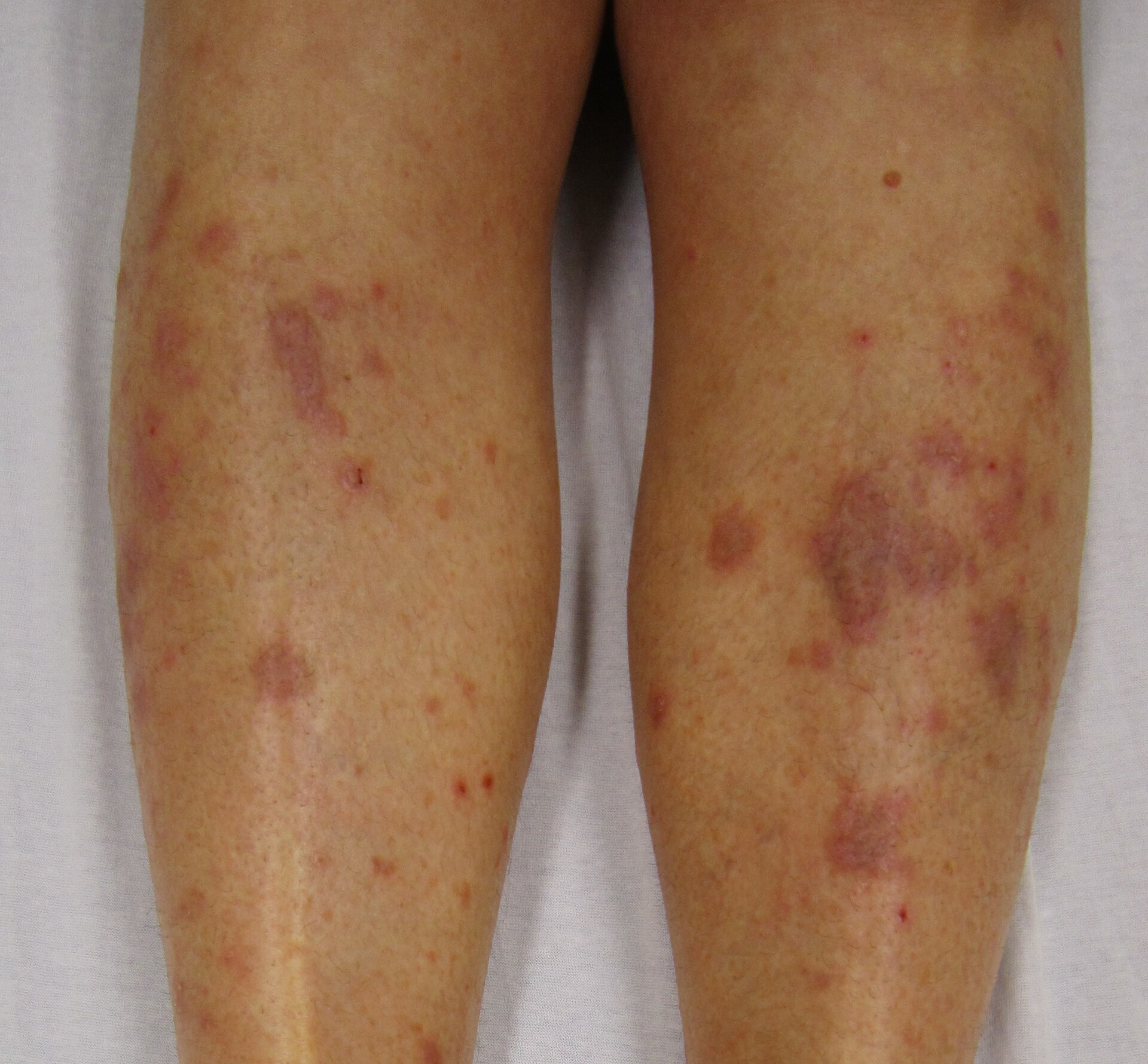
Mimics
- Drug eruptions - morbilliform and fixed — Lichenoid drug eruptions look very similar and are commoner in older patients - review the drug history
- Psoriasis, including guttate — Psoriasis is scaly and salmon or violaceous with sharp margins; lichen planus is flat-topped, shiny and violaceous with striae
- Atopic eczema and infected eczema — Both itch intensely; lichen planus has distinct polygonal flat-topped papules
- Syphilis - the secondary rash — Secondary syphilis can be lichenoid and affects palms and soles
- Polymorphic light eruption — The pinpoint papular variant of polymorphic light eruption is characteristically mistaken for lichen nitidus - the sun-exposed distribution and the seasonal timing separate them
What to do in the ED
- Make the diagnosis on morphology and examine the mouth, genitals, nails and scalp before concluding it is skin-limited
- Treat cutaneous disease with a potent topical corticosteroid and an emollient, with an antihistamine for itch
- Review the drug history for a lichenoid eruption, particularly in older patients
- Refer to dermatology for erosive, scalp, nail or genital involvement, extensive disease, or diagnostic uncertainty; oral disease may need oral medicine input
- Explain the expected course and, particularly in brown and black skin, warn about the prolonged pigmentation that follows
- Where there is erosive oral or genital disease, explain the need for long-term follow-up rather than one-off treatment
Disposition
Topical treatment with dermatology referral for erosive, mucosal, nail or scalp disease, and for anything extensive or uncertain. Not an admission.
Safety-netting
Local variation
Sources
- British Association of Dermatologists - Lichen planus (patient information leaflet)
- NICE CKS - Syphilis
- Lim HW et al. International Expert Consensus on Knowledge Gaps in Care for Dermatologic Disorders in Skin of Color. Int J Dermatol 2026
- NICE CG153 1.2.1.5 - erythema may be underestimated in skin types V-VI (stated in the psoriasis guideline; cited here for that general point about assessing erythema, not for this condition)