Urticarial vasculitis
The weal that outlasts a day, hurts rather than itches and bruises as it fades - not ordinary urticaria, and it needs investigating.
Red flags
- Any airway symptom, wheeze, stridor, vomiting or hypotension - this is anaphylaxis, not urticaria, and needs intramuscular adrenaline now
- Associated angio-oedema, particularly of the tongue, lips or throat
- Individual lesions lasting more than 24 hours, painful or burning lesions, or bruising as they fade - urticarial vasculitis, which warrants investigation for an underlying cause
- Fever, joint pain or systemic upset with the rash
- Urticaria with abdominal pain in a child - consider IgA vasculitis in its early phase
Recognise
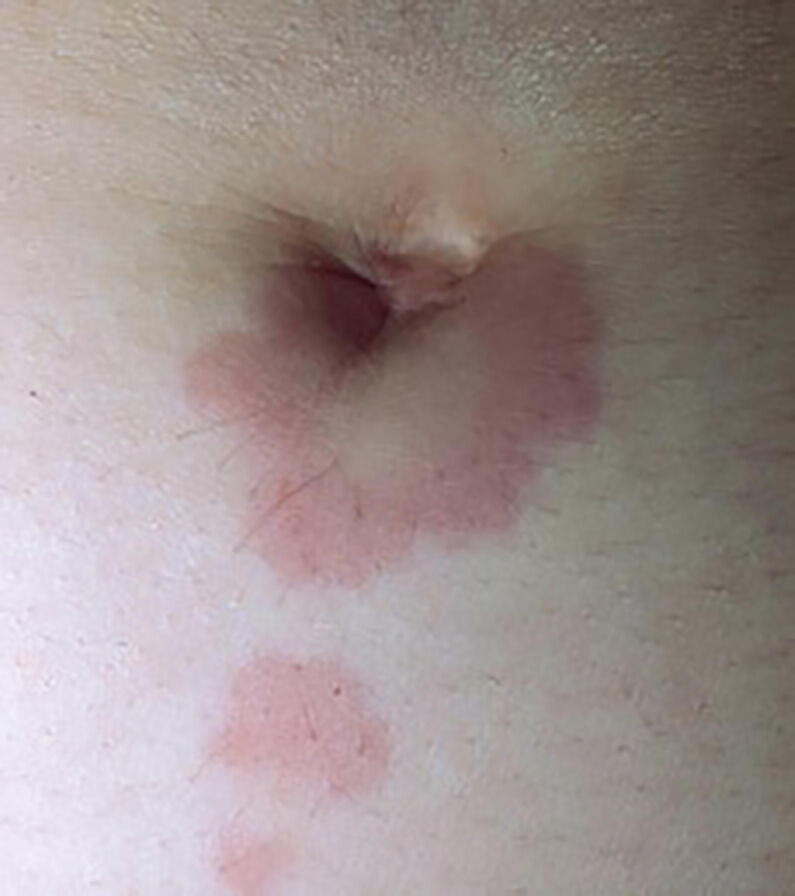
Raised red or pink weals with pale centres and surrounding flare, intensely itchy, each lesion resolving within 24 hours without a trace.
Weals in brown and black skin are often skin-coloured, paler than the surrounding skin, or faintly violaceous rather than red, and the surrounding flare is usually invisible - so the classic red hives may be entirely absent while the patient is covered in them. Urticaria here is felt and elicited rather than seen: palpate for raised, warm, oedematous lesions, and ask about itch. This matters well beyond dermatology, because the presence or absence of urticaria is one of the things that distinguishes histamine-mediated from bradykinin-mediated angio-oedema, and missing it changes emergency management. Post-inflammatory hyperpigmentation after resolution is common and, confusingly, can make ordinary urticaria look as though lesions have persisted.
- Individual weals last less than 24 hours and leave no mark - mark one with a pen and re-examine
- Intensely itchy
- Migratory - new lesions in new places while old ones fade
- May accompany angio-oedema, which is the deeper swelling of the same process
- Urticarial vasculitis: individual lesions persist beyond 24 hours, burn or hurt rather than itch, and leave bruising or pigment behind - and that needs investigation, not antihistamines alone
Distribution
Photographs
Mimics
- Angio-oedema - allergic, ACE-inhibitor and hereditary — The same process in deeper tissue - and whether urticaria is present is precisely what points to the mechanism
- IgA vasculitis (Henoch-Schonlein purpura) — IgA vasculitis frequently begins with an urticarial phase before the purpura appears
- Erythema multiforme major — Early target lesions can look urticarial, but they are fixed, not migratory
- DRESS - drug reaction with eosinophilia and systemic symptoms — A drug reaction may begin with urticarial lesions; fever, facial oedema and eosinophilia point away from simple urticaria
- Acute urticaria — Ordinary acute urticaria is the far commoner diagnosis - weals that are fleeting, itchy and leave no mark. Vasculitis is the exception you are excluding
What to do in the ED
- Exclude anaphylaxis first - airway, breathing, circulation. Urticaria plus any systemic feature is anaphylaxis until proven otherwise
- Decide first which of the two conditions this is, because only one of them belongs on this page. Ordinary acute urticaria - fleeting, itchy, leaving no mark - is covered by the acute urticaria entry. This page is for the weal that lasts beyond 24 hours, burns or hurts, is non-blanching or palpable, and leaves bruising or pigment behind
- Mark an individual lesion and record the time, so that whoever reviews can tell whether lesions are migratory or fixed. This single act distinguishes urticaria from urticarial vasculitis
- Non-sedating antihistamine as first-line treatment; a short course of oral corticosteroid for severe acute urticaria
- Look for a trigger - drugs, foods, infection - but accept that in most acute urticaria none is found, and say so rather than implying a missed allergy
- Refer for investigation if lesions are fixed, painful or leave bruising
- Advise that acute urticaria commonly continues in waves for days to weeks and that this is not treatment failure
Disposition
Refer urticarial vasculitis for investigation of an underlying cause - it is not treated as ordinary urticaria and antihistamines alone are not the answer. Any airway or systemic involvement is managed as anaphylaxis first. For ordinary acute urticaria, use the acute urticaria entry, which carries the CKS diagnostic criteria and treatment in full.
Safety-netting
Sources
- NICE CKS - Urticaria
- NICE CKS - Angio-oedema and anaphylaxis
- Resuscitation Council UK - Guidance: Anaphylaxis
- Lim HW et al. International Expert Consensus on Knowledge Gaps in Care for Dermatologic Disorders in Skin of Color. Int J Dermatol 2026
- NICE CG153 1.2.1.5 - erythema may be underestimated in skin types V-VI (stated in the psoriasis guideline; cited here for that general point about assessing erythema, not for this condition)