Head lice
Diagnosed only by finding a living louse - eggs alone do not justify treatment.
Red flags
- Secondary bacterial infection of the scalp with spreading cellulitis or lymphadenopathy
- Extensive infestation with anaemia in a very neglected presentation - consider a safeguarding assessment of the wider picture
- Repeated treatment failure - usually incorrect application or untreated contacts rather than resistance
- Treatment being given repeatedly with no louse ever found
Recognise
Itchy scalp with excoriation, live lice visible on wet combing, and whitish egg cases firmly attached to hair shafts near the scalp.
The louse itself and the egg case are the findings, and both are objects on the hair shaft rather than changes in the skin, so pigment is largely irrelevant to the diagnosis. Two practical points do differ: scalp excoriation and secondary infection may not appear red, and detection combing is harder in tightly coiled or braided hair, where wet combing with plenty of conditioner, worked in sections, is more reliable than inspection. Do not let difficulty combing become a reason to treat without confirmation.
- A living, moving louse must be found - this is what confirms the diagnosis
- Egg cases attached firmly to the hair shaft; empty white cases further from the scalp indicate a past infestation, not an active one
- Itch is variable and many people have none
- Detection combing on wet, conditioned hair is more sensitive than looking
- Ask about affected household members and classmates
Distribution
Photographs
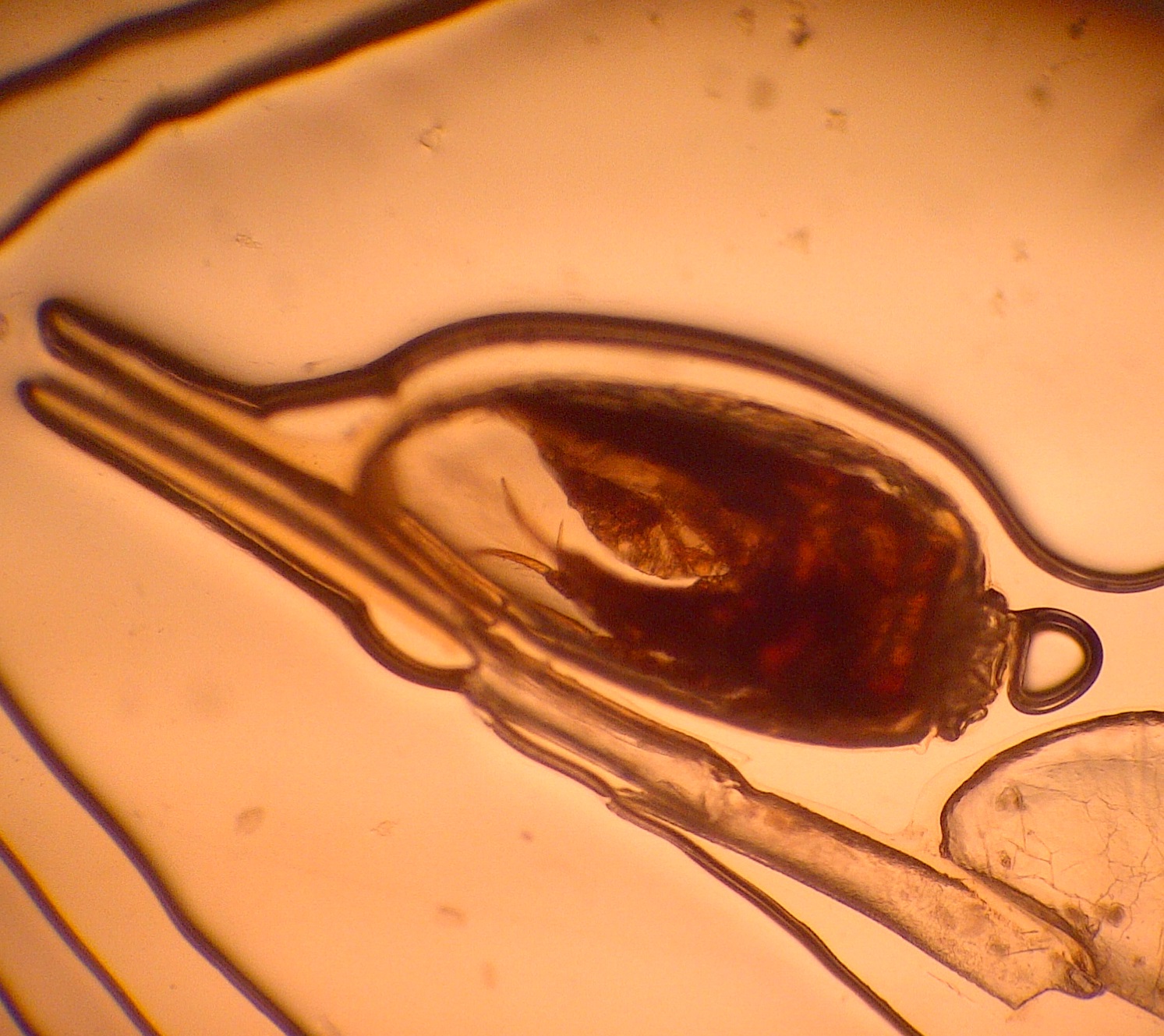
Mimics
- Scabies, including crusted scabies — Also an itchy infestation spreading in households, but with an entirely different distribution
- Tinea capitis and kerion — Scalp scale with hair loss and lymphadenopathy is fungal, not lice, and needs oral antifungal treatment
- Atopic eczema and infected eczema — Seborrhoeic scale can be mistaken for egg cases; scale flicks off the hair, egg cases do not
What to do in the ED
- Confirm with a living louse before treating. Treating on the basis of egg cases alone is the commonest error and leads to unnecessary repeated treatment
- Treat with a physical insecticide such as dimeticone, or by wet combing, under local policy. Four groups are not a free choice: in pregnancy or breastfeeding, in children aged 6 months to 2 years, and in asthma or eczema, CKS puts wet combing or dimeticone 4% lotion first - in those groups it is not a free choice between products. Shampoos are not recommended: they are diluted too much and have too short a contact time to kill eggs
- Repeat the treatment after the interval specified for the product, to catch lice hatching after the first application
- Check household contacts and treat only those with live lice found
- No exclusion from school is required - children should not be sent home for head lice
- Explain that empty egg cases remain attached as the hair grows and do not indicate ongoing infestation
Disposition
Treat and discharge. This rarely needs an ED attendance at all, and reassurance plus correct technique is the intervention.
Safety-netting
Sources
- NICE CKS - Head lice
- UKHSA - Health protection in children and young people's settings, including education
- Lim HW et al. International Expert Consensus on Knowledge Gaps in Care for Dermatologic Disorders in Skin of Color. Int J Dermatol 2026
- NICE CG153 1.2.1.5 - erythema may be underestimated in skin types V-VI (stated in the psoriasis guideline; cited here for that general point about assessing erythema, not for this condition)