Pompholyx
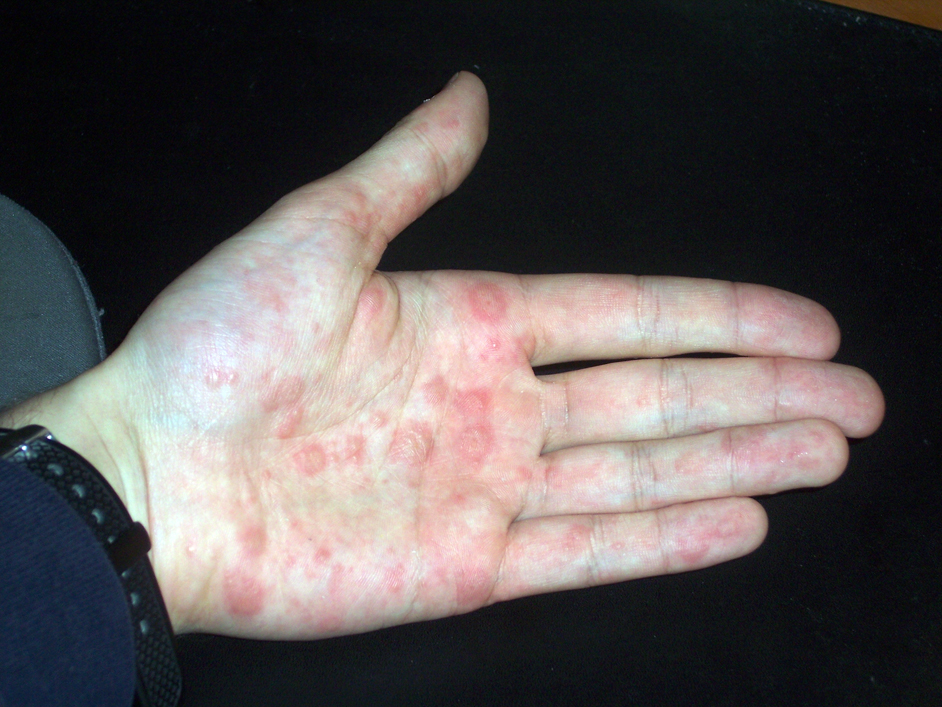
Crops of deep, intensely itchy vesicles on the palms and sides of the fingers - a pattern of eczema, routinely mistaken for infection.
Red flags
- Pustules rather than clear vesicles, spreading redness, pain, fever or lymphangitis - secondary bacterial infection, which needs antibiotics
- Grouped vesicles with a burning prodrome, especially unilateral - consider herpes simplex rather than pompholyx
- Widespread bullae, mucosal involvement or systemic upset - this is not pompholyx and needs the blistering pathway
- A single hand only, with no history of recurrence - reconsider tinea manuum, contact dermatitis and scabies before settling on pompholyx
Recognise
Crops of small, deep-seated, tense vesicles on the palms and the sides of the fingers, classically described as looking like sago grains, on a background that may be only mildly red, later drying to collarettes of peeling.
The background erythema is often invisible, which removes the feature that makes this look inflammatory in pale skin and makes the eruption look more like a collection of clear blisters on normal skin. The vesicles themselves are the diagnosis and they are tone-independent - they are deep-set, tense and best appreciated by feeling the surface and viewing the skin obliquely against the light rather than face-on. The later peeling and collarette formation are also tone-independent. Post-inflammatory hyperpigmentation on the palms and fingers afterwards is prominent and long-lasting, and is a common reason for re-presentation in the belief that the condition is still active.
- Deep-seated, tense vesicles on the palms and the sides of the fingers, in crops, and symmetrical
- Intense itch, often preceding the vesicles, and a burning or prickling sensation
- Vesicles do not rupture easily because the palmar skin is thick - they resolve by drying and peeling in collarettes
- Recurrent and episodic, often for months to years - a median duration of around two years is reported in hand eczema registry data
- Look at the feet too - the same process affects the soles in about one in six, so their absence does not count against the diagnosis
- Ask about contact exposures: at least one positive patch test was found in 43% of dyshidrotic eczema in a Spanish registry - slightly lower than the 52% in other hand eczema, and positivity is not the same as clinical relevance. The registry authors read the dyshidrotic phenotype as relatively more endogenously driven
Distribution
Photographs
Mimics
- Tinea corporis, cruris and pedis — Tinea manuum classically affects one hand and both feet, scales rather than vesiculates at the edge, and is made worse by a topical steroid - so it is the mistake with consequences
- Contact dermatitis - allergic and irritant — Allergic contact dermatitis can be vesicular and can look identical; the distribution follows the exposure, and patch testing is what separates them
- Scabies, including crusted scabies — Also intensely itchy with finger-web involvement, but scabies has burrows, affects contacts and itches worst at night
- Herpes simplex — Herpetic whitlow gives grouped vesicles on a digit with a burning prodrome, is usually unilateral and is exquisitely painful rather than itchy
- Atopic eczema and infected eczema — Pompholyx is a pattern of eczema rather than a separate disease, and many patients have atopic eczema elsewhere
What to do in the ED
- Establish that this is eczema rather than infection, because the two treatments oppose each other - a topical steroid on tinea makes it worse, and an antifungal does nothing for pompholyx
- Treat as eczema: generous emollient and a topical corticosteroid. Palmar skin is thick and conventionally takes a more potent preparation than the face or flexures - check the potency against your local formulary, because no NICE CKS topic covers this phenotype and the advice here is general eczema practice rather than guideline
- Treat secondary bacterial infection where there are pustules, crusting, spreading redness or systemic features
- Ask what the hands are exposed to at work and at home - registry data show a relevant contact allergy in a substantial minority, and occupational factors in a smaller proportion than for other hand eczema
- Advise soap substitutes, cotton liners under occlusive gloves, and avoidance of the identified irritant - hand protection is as much of the treatment as the steroid
- Refer to dermatology for patch testing where it recurs, and warn that the course is typically measured in months to years rather than weeks
Disposition
Treat and discharge with GP follow-up. Dermatology referral for recurrent disease, for patch testing, or where control is not achieved with topical therapy.
Safety-netting
Sources
- Sánchez-Gilo A et al. Epidemiological, Clinical and Allergic Profile of Patients With Dyshidrotic Eczema (Acute and Recurrent Vesicular Dermatitis): Evaluation of the Spanish Registry (REIDAC). Contact Dermatitis 2026
- Lim HW et al. International Expert Consensus on Knowledge Gaps in Care for Dermatologic Disorders in Skin of Color. Int J Dermatol 2026
- NICE CG153 1.2.1.5 - erythema may be underestimated in skin types V-VI (stated in the psoriasis guideline; cited here for that general point about assessing erythema, not for this condition)