Contact dermatitis - allergic and irritant
The distribution is the diagnosis - if a rash has a shape that matches an object, look for what touched it.
Red flags
- Facial or eyelid involvement with significant swelling - consider angio-oedema as an alternative
- Widespread spread beyond the contact area with systemic upset - reconsider a drug eruption
- Secondary bacterial infection with weeping, crusting or cellulitis
- Occupational disease that is threatening someone's employment - needs proper patch testing and occupational health input, not repeated steroid creams
- Severe blistering after plant exposure and sun - phytophotodermatitis, which can be extensive
Recognise
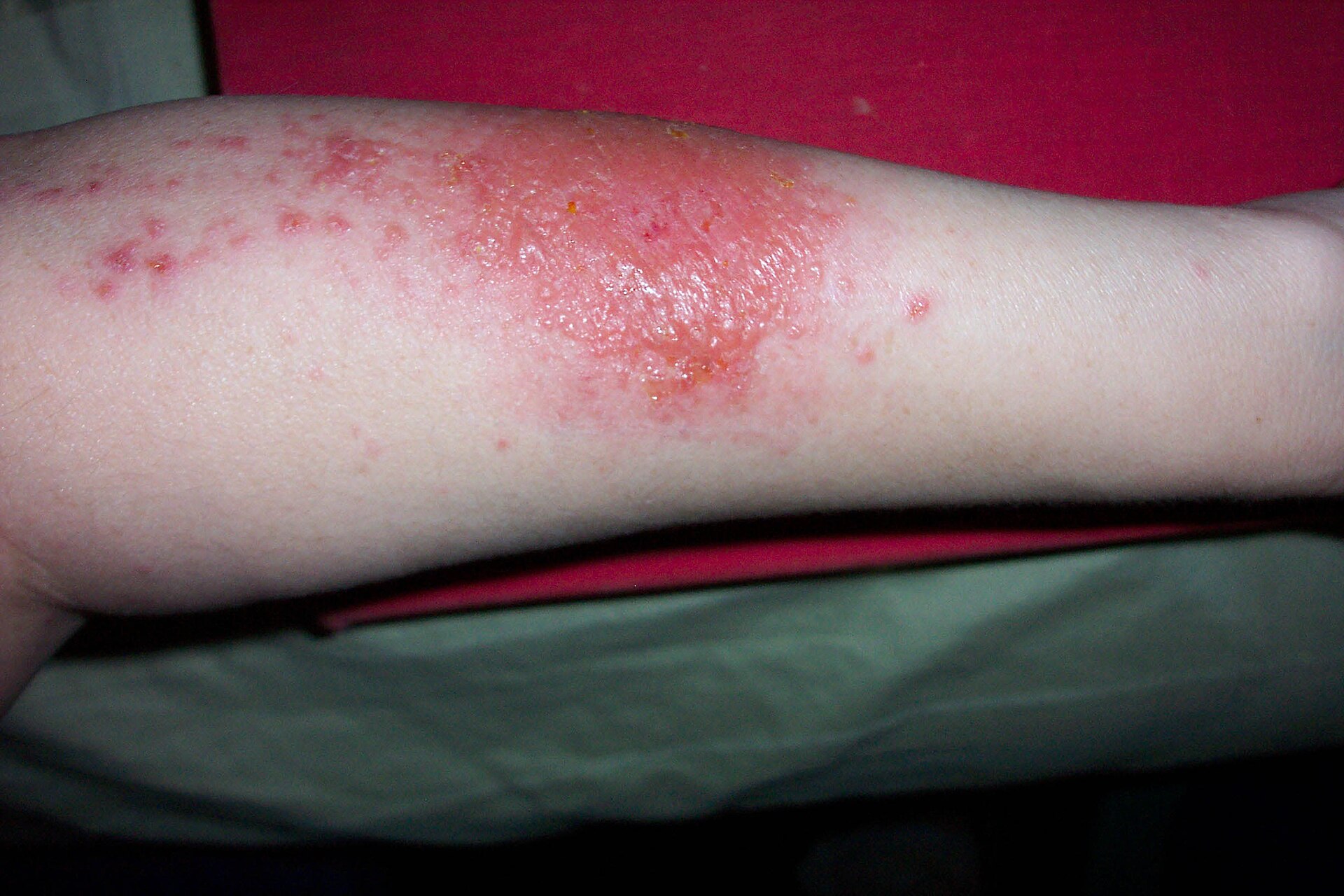
Red, scaly, itchy patches with a geometric or object-shaped outline; acute allergic disease may vesiculate and weep, irritant disease tends to be drier and fissured.
Erythema is again unavailable, and affected skin may look darker, violaceous or ashen. The shape is the diagnosis and shape is independent of pigment - look for a sharply outlined area that matches a watch strap, a waistband, a glove line, a nickel stud or a cosmetic application. Follicular and papular patterns are commoner in brown and black skin and may not look like the scaly plaque expected. Post-inflammatory hyperpigmentation in the exact shape of the contact is a frequent and useful residual clue, and it persists for months - patients often present because of the pigmentation rather than the dermatitis.
- A rash with an outline that matches an object or an exposure pattern
- Itch dominates in allergic disease; soreness, dryness and fissuring in irritant disease
- Allergic disease has a delayed onset - typically one to three days after exposure - which is why the culprit is often missed
- Irritant disease is dose-dependent and improves away from the exposure; ask about weekends and holidays
- Hand dermatitis in a healthcare, catering, cleaning or hairdressing worker is occupational until proven otherwise
Distribution
Photographs
Mimics
- Atopic eczema and infected eczema — The two coexist frequently; atopic disease is flexural and lifelong, contact disease matches an exposure
- Tinea corporis, cruris and pedis — An asymmetrical scaly patch may be fungal - check for a raised active edge before prescribing a steroid
- Angio-oedema - allergic, ACE-inhibitor and hereditary — Facial swelling without scaling is angio-oedema, not dermatitis
- Drug eruptions - morbilliform and fixed — A widespread symmetrical eruption after a new drug is a drug eruption, not contact dermatitis
- Pompholyx — Allergic contact dermatitis of the hands can be vesicular and look identical; distribution follows the exposure, and patch testing is what separates them
What to do in the ED
- Take the exposure history properly - work, hobbies, cosmetics, jewellery, topical medicines including over-the-counter preparations, and plants
- Identify and remove the cause; this is the treatment, and no topical will overcome continued exposure
- Topical corticosteroid of potency matched to the site and severity, plus generous emollient
- Treat secondary bacterial infection if present
- Refer for patch testing where allergic contact dermatitis is suspected, particularly occupational disease - this is the only way to identify the allergen and it is frequently never arranged
- Advise on barrier measures and hand care for irritant disease, including glove use and soap substitutes
- Document the occupational link clearly if there is one, because it matters for the patient's employment and for any claim
Disposition
Topical treatment and avoidance advice with GP follow-up. Dermatology referral for patch testing where an allergen is suspected, and occupational health involvement for work-related disease.