Herpes simplex
Recurrent grouped vesicles in the same place - simple in most, serious in the neonate, the immunosuppressed and the eczematous.
Red flags
- A neonate - neonatal herpes is a time-critical emergency, and most cases occur with no maternal history, so its absence excludes nothing
- Anogenital herpes in a prepubertal child - treat this as a safeguarding matter, not a sexual health referral. Discuss with paediatrics and follow the local child protection process the same day
- Eczema - disseminated herpes on eczematous skin is eczema herpeticum and needs aciclovir urgently
- Eye involvement - herpetic keratitis threatens sight and needs same-day ophthalmology; never give topical steroid to a red eye that might be herpetic
- Immunosuppression - risk of severe, prolonged or disseminated disease
- Primary genital herpes in the third trimester - urgent obstetric discussion, as it affects delivery planning
- Inability to drink in a child with primary gingivostomatitis - dehydration is the reason they are admitted
Recognise
Grouped small vesicles on a red base that ulcerate and crust, preceded by tingling, recurring at the same site.
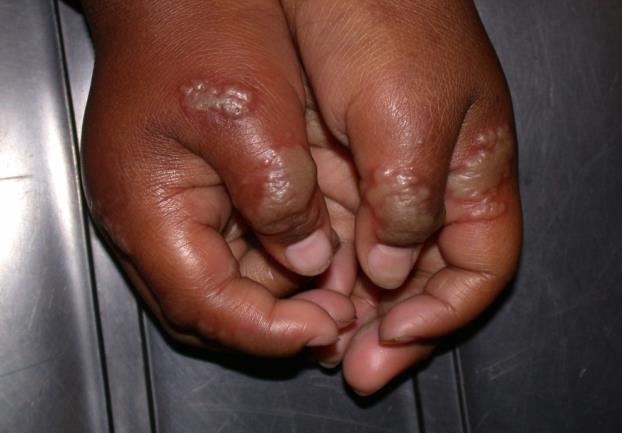
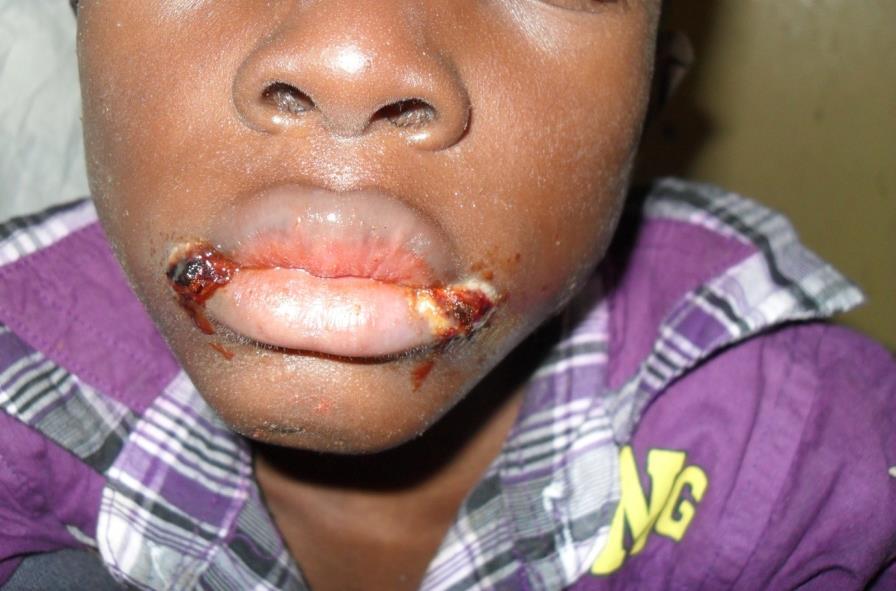
As with zoster, the erythematous base is frequently invisible and lesions appear as discrete grey-white vesicles or shallow punched-out ulcers on unremarkable skin. The grouping, the recurrence at the identical site and the prodromal tingling are the reliable features. Healing leaves conspicuous post-inflammatory hyperpigmentation at the site, which recurs in the same place each time and can make a patient believe the lesion never cleared.
- Prodromal tingling or burning before visible lesions
- Grouped vesicles that ulcerate, all at the same stage
- Recurrence at the same site - the hallmark
- Primary infection is far more severe than recurrences: widespread painful oral ulceration, fever and inability to eat or drink, especially in young children
- Ask about eczema, immunosuppression, pregnancy near term, and neonatal contact
Distribution
Photographs
Mimics
- Herpes zoster (shingles), including ophthalmic and Ramsay Hunt — Zoster is dermatomal, unilateral to the midline, and usually a single episode
- Hand, foot and mouth disease — Oval lesions on hands, feet and mouth rather than grouped recurrent vesicles at one site
- Impetigo — Crusted perioral lesions are often assumed bacterial; herpes recurs at the same site and begins with vesicles
- Syphilis - the secondary rash — A genital ulcer may be syphilitic - a painless indurated ulcer is not herpes and needs testing
- Pompholyx — Herpetic whitlow gives grouped vesicles on one digit with a burning prodrome and is painful; pompholyx is symmetrical, itchy and on the palms
What to do in the ED
- Oral aciclovir for significant primary infection, severe recurrence or immunosuppression; topical treatment has limited value. For anogenital disease the UK national guideline is BASHH 2024 (below), which covers first episode, recurrence, suppression and transmission; CKS is the primary-care reference. Follow local policy on the regimen
- Ask about eczema in every patient with herpes, and examine eczematous skin if present
- Refer genital herpes in an adult or a sexually active young person to sexual health services for testing, partner notification and counselling - an ED diagnosis is not the end of the pathway
- In pregnancy near term, discuss with obstetrics the same day
- For primary gingivostomatitis in a child, prioritise analgesia and assess hydration - that decides disposition
- Refer any suspected ocular involvement to ophthalmology the same day
- Advise on transmission, including that it can occur without visible lesions
Disposition
Treat and discharge for most presentations, with sexual health referral for genital disease. Admit neonates, the immunosuppressed with severe disease, children unable to maintain hydration, and anyone with suspected eczema herpeticum and systemic upset.
Safety-netting
Sources
- NICE CKS - Herpes simplex - oral
- NICE CKS - Herpes simplex - genital
- Lim HW et al. International Expert Consensus on Knowledge Gaps in Care for Dermatologic Disorders in Skin of Color. Int J Dermatol 2026
- NICE CG153 1.2.1.5 - erythema may be underestimated in skin types V-VI (stated in the psoriasis guideline; cited here for that general point about assessing erythema, not for this condition)
- Patel R et al. British Association of Sexual Health and HIV UK national guideline for the management of anogenital herpes, 2024. Int J STD AIDS 2025;36(2):90-105