Kawasaki disease
Persistent fever in a young child with red eyes, red mouth and a rash - the diagnosis to make before day 10, because treatment prevents coronary aneurysms.
Red flags
- Fever of five days or more in any child without a clear source - think of this diagnosis explicitly and document that you did. Incidence peaks under 5, but Kawasaki disease occurs in older children and adolescents, in whom the diagnosis is more often delayed
- Incomplete Kawasaki disease is common in infants under 1, who present with fewer features and have the highest aneurysm risk - a prolonged unexplained fever in an infant needs specialist discussion even with almost no rash
- Any shock or haemodynamic instability - Kawasaki disease shock syndrome exists and is easily mistaken for sepsis
- Presentation at or beyond day 10 - urgent, because the treatment window for preventing coronary damage is closing
- Peeling of the fingers and toes in a child with a recent prolonged fever - a retrospective clue that must trigger review, not reassurance
Recognise
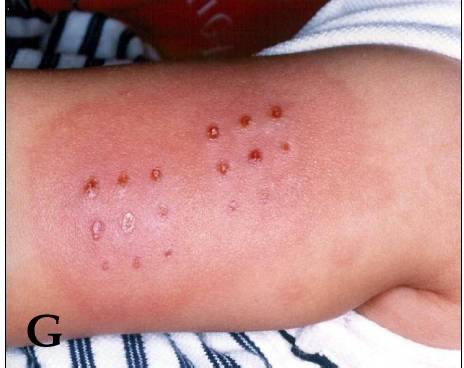
Bright red non-vesicular polymorphous rash, cracked red lips, strawberry tongue, bilateral non-purulent conjunctival injection, and red swollen hands and feet with later peeling.
The rash and the palmar erythema are much harder to appreciate in brown and black skin, and the conjunctival injection and lip changes carry more of the diagnostic weight as a result - both are readily visible whatever the skin tone, because they are mucosal. Look at the eyes and the mouth first. Swelling and induration of the hands and feet can be felt even where redness cannot be seen, and the later periungual and perineal desquamation is tone-independent. A child of any ethnicity can have Kawasaki disease, and incidence is in fact highest in children of east Asian ancestry, so a rash that looks unimpressive must not lower your suspicion.
- Fever persisting five days or more is the entry point - and the fever is typically high and unresponsive to antipyretics
- Bilateral non-purulent conjunctival injection, usually sparing the limbus
- Mucosal change: cracked red lips, strawberry tongue, diffuse oral erythema
- Changes in the extremities: swelling, erythema, then periungual peeling in the second week
- Polymorphous rash - it has no single characteristic appearance
- Cervical lymphadenopathy, usually unilateral and over 1.5 cm - the least often present of the principal features
- An extremely irritable child, out of proportion to how they look
Distribution
Photographs
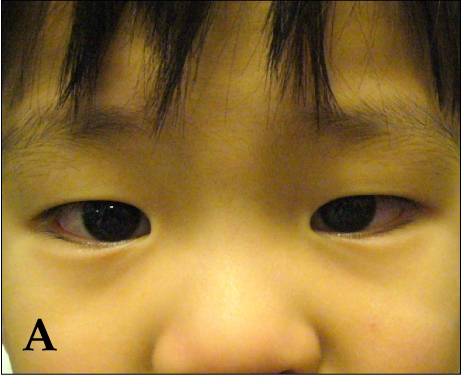
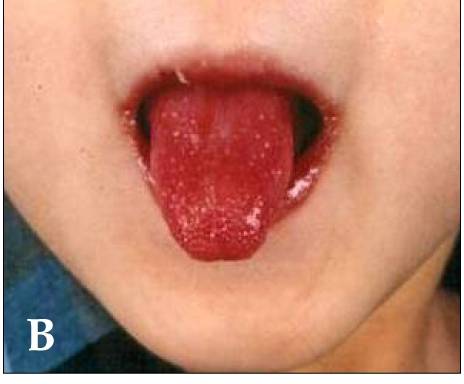
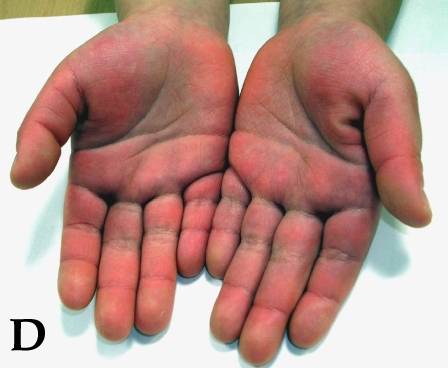
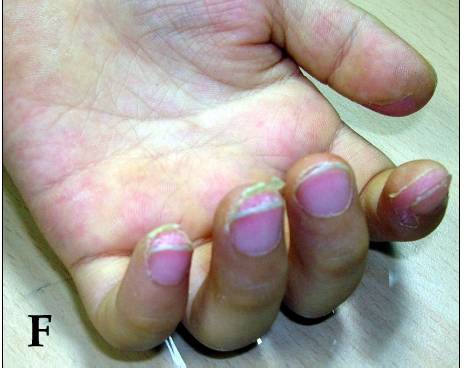
Mimics
- Scarlet fever — Both give strawberry tongue, rash and desquamation; scarlet fever has a sandpaper rash, responds to penicillin and lacks conjunctival injection
- Measles — Both give fever, rash and red eyes; measles has coryza, cough and Koplik spots, and the child is miserable with a descending rash
- Toxic shock syndrome — Both give fever, diffuse erythema, mucosal change and later desquamation; TSS is shocked from the outset
- DRESS - drug reaction with eosinophilia and systemic symptoms — Both give prolonged fever with a widespread eruption; DRESS follows a drug by weeks and has eosinophilia
What to do in the ED
- Count the fever days explicitly and record the number - the diagnosis is built on duration
- Examine the eyes, the mouth, the hands and feet, and the groin deliberately, and document each principal feature as present or absent
- Take FBC, CRP, ESR, liver function, albumin and urinalysis - sterile pyuria and a raised inflammatory response support the diagnosis
- Discuss with paediatrics the same day. Do not discharge a child with five days of unexplained fever on the basis that the rash is unimpressive
- Where the picture is incomplete, the AHA statement sets out a specific laboratory and echocardiographic algorithm - read it at the source rather than reconstructing the thresholds from memory. Note two published errata (Circulation 2025;151(8):e677-e679 and 2025;151(13):e863): check them before quoting any threshold. The limbal sparing, the 1.5 cm nodal threshold and the incomplete-disease statement below are the conventional AHA criteria, but we have only been able to read the statement's abstract - treat them as a prompt to examine and to discuss, not as reproduced guideline text
- Echocardiography and immunoglobulin are specialist decisions, but the ED decision is simply whether this child is discussed today
- Warn against giving ibuprofen routinely if aspirin is started; analgesic choices are for the treating team
Disposition
Same-day paediatric assessment for any child with five or more days of unexplained fever and any principal feature; admit for treatment where the diagnosis is made. Untreated, coronary artery dilation or aneurysm develops in about 25% of patients, which is what makes this a time-critical diagnosis.
Sources
- Jone PN et al. Update on Diagnosis and Management of Kawasaki Disease: A Scientific Statement From the American Heart Association. Circulation 2024
- NICE NG143 - Fever in under 5s: assessment and initial management (applies to children under 5 only)
- Lim HW et al. International Expert Consensus on Knowledge Gaps in Care for Dermatologic Disorders in Skin of Color. Int J Dermatol 2026
- NICE CG153 1.2.1.5 - erythema may be underestimated in skin types V-VI (stated in the psoriasis guideline; cited here for that general point about assessing erythema, not for this condition)