Lichen striatus
A single line of small papules running down a child's limb along the lines of Blaschko - self-resolving over months, and a diagnosis made entirely from its shape.
Recognise
Small pink or skin-coloured flat-topped papules, sometimes slightly scaly, coalescing into a narrow band. Erythematous in about 70% of reported cases.
The hypopigmented form matters far more here. Around a quarter of reported cases are hypopigmented rather than erythematous, and on brown and black skin a hypopigmented Blaschko line is strikingly visible - frequently the presenting complaint, and frequently mistaken for vitiligo or for a fungal infection. Two practical consequences. First, in darker skin this condition may present as a pale line rather than a pink one, so do not wait to see redness. Second, the pigmentary change commonly outlasts the papules by many months, which is pigment lability rather than persistent disease, and families need telling that clearly or they will return repeatedly for a line that is already resolving. The line itself - unilateral, following Blaschko, not crossing the midline - is tone-independent and is the diagnosis.
- A linear band along the lines of Blaschko - this is the diagnosis and nothing else looks quite like it
- Unilateral, and does not cross the midline
- The child is well and the line is usually asymptomatic, or only mildly itchy
- Diagnosed clinically in around 80% of reported cases - biopsy is rarely needed
- Nail involvement can occur where the band reaches a digit
- Mean duration about 9.5 months, and treatment was used in only 20% of reported cases
Distribution
Photographs
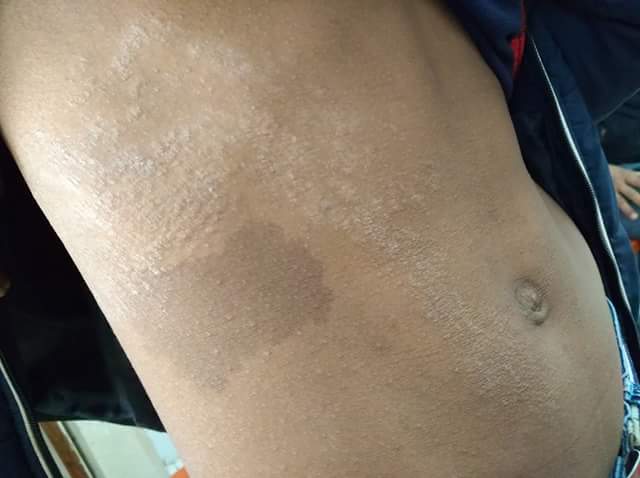
Mimics
- Lichen planus — Linear lichen planus also follows Blaschko lines but is intensely itchy, violaceous and far more persistent, and is a disease of adults more than children
- Psoriasis, including guttate — Linear psoriasis also forms bands, but with thick silvery scale and a typical course elsewhere on the body
- Vitiligo — The one families fear. Segmental vitiligo is depigmented - completely white - while lichen striatus is hypopigmented, retains some pigment, and resolves
- Tinea corporis, cruris and pedis — Also scaly and asymmetrical and often treated as such; tinea is annular with an active edge, not a Blaschko line
- Contact dermatitis - allergic and irritant — Also linear - a plant or a dribble of something - but acutely inflamed, itchy and matching a plausible contact rather than an embryological line
What to do in the ED
- Make the diagnosis from the shape. Trace the line - if it runs down a limb, stays on one side and does not cross the midline, and the child is well, the diagnosis is usually this
- Do not prescribe an antifungal, which is the commonest wrong treatment here
- Reassure actively, with a timescale: resolution averages about nine and a half months, and most reported cases were never treated at all
- Warn about the pigmentary tail. The pale or dark line left behind can persist for many months after the papules have gone, especially in darker skin, and is not the condition continuing
- Offer a short course of a topical corticosteroid or emollient only if it is itchy; otherwise treat nothing
Disposition
Discharge with the diagnosis and the timescale. No investigation and no dermatology referral are needed for a typical case in a well child.
Safety-netting
Sources
- Herzum A, Viglizzo G, Occella C, Gariazzo L, Vellone VG, Orsi SM, Ciccarese G. Lichen striatus: a review. Ital J Dermatol Venerol 2025;160(3):242-7 - 440 patients across 27 articles
- Laude TA. Approach to dermatologic disorders in black children. Semin Dermatol 1995;14(1):15-20 - pigment lability, and disorders that vary in appearance rather than incidence