Keratosis pilaris
Rough follicular bumps on the outer upper arms - harmless, extremely common, and worth naming properly because the usual treatments disappoint.
Recognise
Small, rough, skin-coloured or pink follicular papules giving a sandpaper or goosebump texture, sometimes with surrounding erythema (keratosis pilaris rubra) over the cheeks and upper arms.
The erythematous halo that frames each follicular plug on pale skin is absent or invisible, so the condition presents as follicular prominence and texture alone, or as discrete hyperpigmented follicular papules that can be mistaken for acne, folliculitis or scarring. Follicular predominance in disorders of darker skin is one of the classical structural differences described in paediatric skin-of-colour literature, and keratosis pilaris is a straightforward example. Run a hand over the outer upper arm: the diagnosis is a texture, and texture is tone-independent. Two practical points. The pigmented form is cosmetically more conspicuous and more persistent in brown and black skin, so dismissing it as trivial misreads what the patient is asking about. And aggressive physical exfoliation or destructive treatment risks post-inflammatory hyperpigmentation that looks worse than the original - a reason to keep treatment gentle.
- Follicular - every papule sits on a hair follicle, which is what distinguishes it from acne or a viral exanthem
- A sandpaper or permanent-goosebump texture on the outer upper arms
- Symmetrical and chronic, often with a family history
- Associated with atopy - in one series keratosis pilaris was associated with a history of atopy with an odds ratio of 2.80 (1.36-5.75)
- Asymptomatic; the complaint is appearance or texture, not symptoms
- Often improves through adulthood but rarely disappears
Distribution
Photographs
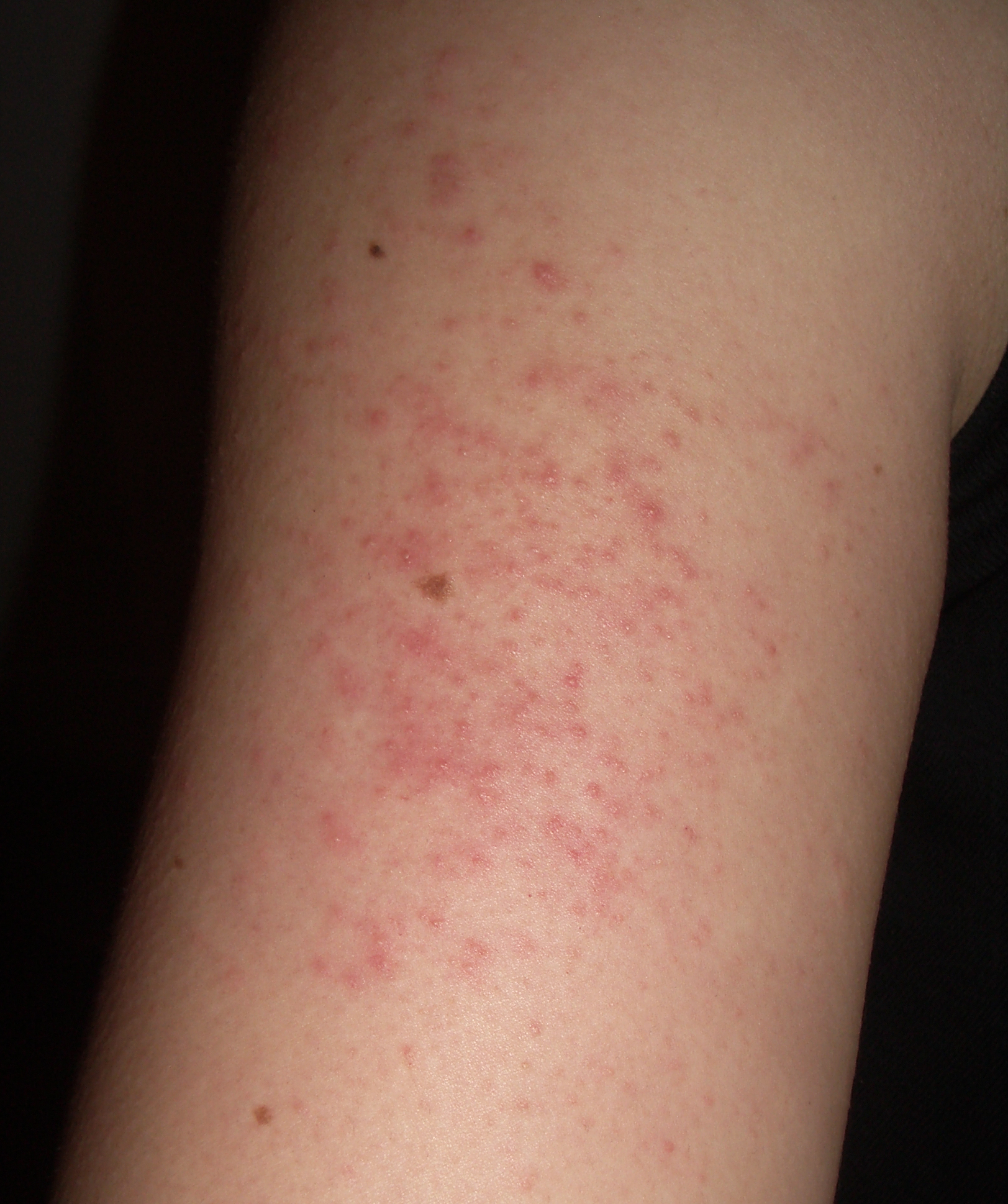
Mimics
- Acne vulgaris, and acne fulminans — Also follicular papules, but with comedones, on the face, chest and back rather than outer upper arms, and inflammatory rather than purely keratotic. One series found keratosis pilaris associated with LESS acne, not more
- Skin abscess, boils and folliculitis — Folliculitis is also follicular but pustular, tender and acute; keratosis pilaris is chronic, dry and asymptomatic
- Atopic eczema and infected eczema — Frequently coexists rather than mimics - keratosis pilaris is a marker of atopic skin and both need the same emollient
- Molluscum contagiosum — Also papules on the arms in children, but pearly and umbilicated, not follicular, and they appear and spread over months
- Scabies, including crusted scabies — Also papular and sometimes widespread, but intensely itchy with burrows and affected contacts
What to do in the ED
- Recognise it by site and by texture and say the name - most patients have never been given one, and a name is most of what they came for
- Be straight about the evidence: a systematic review of 47 studies found the best-supported treatment is laser, particularly the QS:Nd-YAG, which is not an ED or primary-care intervention. The same review found topical treatment effective too - mineral oil/petrolatum, tacrolimus, azelaic acid and salicylic acid all improved the appearance - so topical care is worth offering; it simply is not the strongest evidence
- Advise emollient and gentle keratolytic care - urea- or lactic-acid-containing moisturisers are what UK primary care actually stocks, though note the systematic review above assessed neither, and the agents it did assess were salicylic acid, azelaic acid, tacrolimus and mineral oil/petrolatum - and set expectations low. This improves texture; it does not clear the condition
- Advise against aggressive scrubbing and against destructive home treatments, which risk post-inflammatory pigment change, particularly in darker skin
- Look for and treat the associated atopic dry skin, which is the part that actually responds
- Do not refer to dermatology for a typical case; do discuss the impact honestly if the patient is distressed by it
Disposition
Discharge with an explanation and emollient advice. GP for ongoing management of associated atopic skin. Dermatology only where the appearance is causing significant distress and the patient wants to discuss options that are not available in primary care.
Safety-netting
Sources
- Tay YK, Kong KH, Khoo L, Goh CL, Giam YC. The prevalence and descriptive epidemiology of atopic dermatitis in Singapore school children. Br J Dermatol 2002;146(1):101-6 - keratosis pilaris in 13% of 12,323 children examined
- Schmitt JV, Lima BZ, Souza MC, Miot HA. Keratosis pilaris and prevalence of acne vulgaris: a cross-sectional study. An Bras Dermatol 2014;89(1):91-5 - 26% prevalence, atopy OR 2.80
- Maghfour J, Ly S, Haidari W, Taylor SL, Feldman SR. Treatment of keratosis pilaris and its variants: a systematic review. J Dermatolog Treat 2022;33(3):1231-42 - 47 studies
- Laude TA. Approach to dermatologic disorders in black children. Semin Dermatol 1995;14(1):15-20 - follicular predominance as a structural difference