Skin abscess, boils and folliculitis
If there is pus, it needs draining - antibiotics alone do not treat a collection.
Red flags
- Facial abscess in the danger triangle around the nose and upper lip - risk of intracranial spread
- Perianal, perineal or scrotal infection - consider Fournier gangrene, which is a surgical emergency
- Systemic sepsis, or surrounding spreading cellulitis
- Immunosuppression, diabetes, or injecting drug use - lower threshold for imaging, admission and surgical involvement
- An abscess over a joint, a prosthesis or the hand - specialist territory, not an ED bedside incision
Recognise
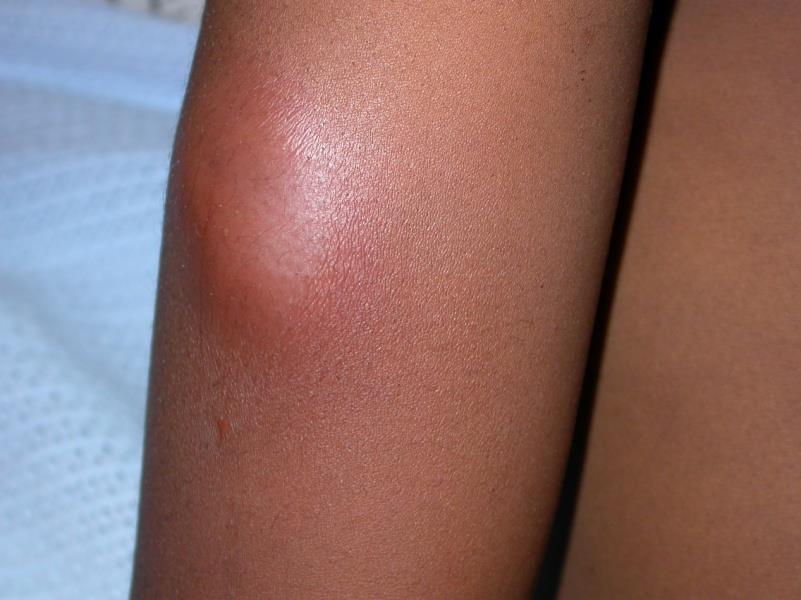
Tender red fluctuant swelling, sometimes pointing with visible yellow pus; folliculitis shows small red papules and pustules centred on hair follicles.
The surrounding erythema is often invisible, so an abscess may present simply as a tender, warm, firm or fluctuant lump with darker or unchanged overlying skin. Fluctuance, tenderness and warmth are the tone-independent findings - palpate rather than inspect, and consider bedside ultrasound where available, which is unaffected by skin tone: pooled across 14 studies and 2,656 patients, point-of-care ultrasound was 94.6% sensitive and 85.4% specific for a skin or soft-tissue abscess, and changed management correctly in 10.3% of cases against incorrectly in 0.7%. That is a reason to reach for the probe, not a claim that it beats examination - the meta-analysis did not test it head to head. Two other points matter here specifically: pseudofolliculitis barbae (razor bumps from ingrowing curly hair) is common in people with Afro-textured hair and is frequently misdiagnosed and treated as bacterial folliculitis, and keloid and hypertrophic scarring after incision is substantially more likely in brown and black skin - a 2026 network meta-analysis of 31,964 keloids put the pooled odds ratio at 6.14 (95% CI 3.75 to 10.07) in Black compared with White individuals, and 3.70 (2.16 to 6.34) in Asian individuals. That should inform where and how you cut and what you tell the patient. Keloids may be skin-coloured or darker than the surrounding skin, raised, firm and hairless, and cluster on the earlobes, cheeks and upper chest - so warn about those sites specifically.
- Fluctuance means pus, and pus needs drainage - antibiotics alone will not resolve a collection
- Localised, tender, warm swelling that may point
- Folliculitis: small pustules centred on follicles, usually superficial and self-limiting
- Carbuncle: several adjacent follicles involved with multiple draining points, and the patient is often systemically unwell
- Recurrent boils - consider staphylococcal carriage, diabetes, or hidradenitis suppurativa rather than repeated courses of antibiotics
Distribution
Photographs
Mimics
- Hidradenitis suppurativa — Recurrent 'boils' in the axillae, groin or under the breasts are usually hidradenitis, and repeated incision makes it worse
- Necrotising fasciitis and necrotising soft tissue infection — Disproportionate pain with a soft tissue focus, especially perineal, is a surgical emergency
- Cellulitis — Cellulitis without a collection does not need drainage - ultrasound distinguishes them better than examination
What to do in the ED
- Decide whether there is a drainable collection - examine for fluctuance and use bedside ultrasound where available
- Incise and drain adequately under good analgesia; drainage is the treatment and antibiotics are adjunctive
- Take a pus swab at drainage - this is how local resistance patterns and MRSA are picked up
- Antibiotics are not required for every simple drained abscess; follow NICE and local policy, and treat where there is surrounding cellulitis, systemic upset, or significant comorbidity
- Do not incise on the face in the danger triangle, over the hand, over a joint or prosthesis, or in the perineum without senior or specialist involvement
- For recurrent boils, look for the cause - decolonisation, diabetes screening, or a hidradenitis diagnosis - rather than repeating antibiotics
- Warn about keloid and hypertrophic scarring risk where relevant, and plan the incision accordingly
Disposition
Drain and discharge with wound care advice for a simple abscess in a well patient. Refer for surgical management where the site is high-risk, the patient is septic or immunosuppressed, or the collection is deep.
Safety-netting
Local variation
Sources
- NICE CKS - Boils, carbuncles, and staphylococcal carriage
- NICE NG141 - Cellulitis and erysipelas: antimicrobial prescribing
- Gwen Farm HJ et al. The Association Between Race/Ethnicity and Keloid Formation: A Network Meta-Analysis. Plast Surg (Oakv) 2026
- Mukwende M, Tamony P, Turner M. Mind the Gap: A handbook of clinical signs in Black and Brown skin. St George’s, University of London (2020)
- Gottlieb M, Avila J, Chottiner M, Peksa GD. Point-of-Care Ultrasonography for the Diagnosis of Skin and Soft Tissue Abscesses: A Systematic Review and Meta-analysis. Ann Emerg Med 2020