Acne vulgaris, and acne fulminans
Extremely common and rarely urgent - except acne fulminans, and except the scarring that is entirely preventable by treating early.
Red flags
- Acne fulminans - abrupt severe ulcerating and crusted acne with fever, arthralgia and systemic upset; needs urgent dermatology and is not managed with routine acne treatment
- Scarring of any degree - a reason for prompt effective treatment and referral, not reassurance
- Severe psychological distress or suicidal ideation - ask directly, and treat this as the urgent problem it is
- Sudden severe acne with virilisation, or in a young child - consider an endocrine cause
- Acne that has worsened abruptly after starting isotretinoin - a recognised trigger for fulminans, needing specialist advice
Recognise
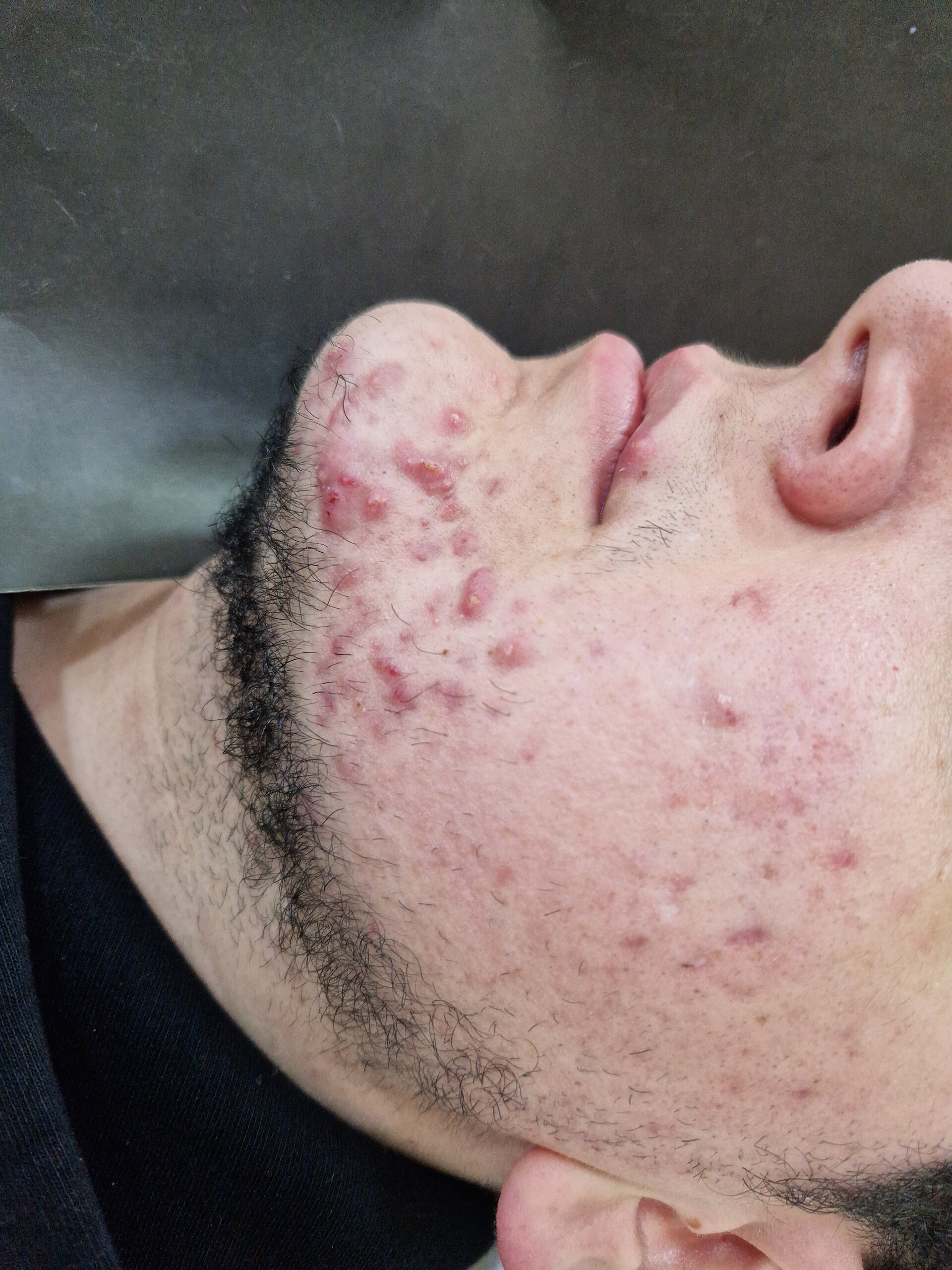
Comedones with inflammatory red papules and pustules, and nodules or cysts in severe disease, with erythematous macules and scarring after lesions resolve.
Inflammatory lesions appear darker, violaceous or hyperpigmented rather than red, so severity is routinely under-scored. Two consequences dominate practice here. First, post-inflammatory hyperpigmentation is often the patient's main complaint and is frequently more distressing and longer-lasting than the acne itself - dismissing it as cosmetic is a common way to lose a patient's trust, and treating the acne promptly is what prevents it. Second, keloid and hypertrophic scarring is substantially more likely - pooled odds ratio 6.14 (95% CI 3.75 to 10.07) in Black compared with White individuals, and 3.70 in Asian individuals, in a 2026 network meta-analysis - especially on the chest, back and jawline, which raises the urgency of effective early treatment rather than watchful waiting. Pomade acne along the hairline and forehead, from oil-based hair products, is a specific and easily missed pattern, and is listed among the disorders commoner in Black patients.
- Comedones - blackheads and whiteheads - distinguish acne from other papulopustular rashes
- Distribution on face, chest and upper back
- Grade by the presence of nodules, cysts and scarring, not by how red it looks
- Any scarring means treat actively now - scarring is permanent and preventable
- Ask about mood; the psychological impact is substantial and under-asked
- Acne fulminans: sudden severe ulcerating acne with fever, joint pain and malaise - an emergency
Distribution
Photographs
Mimics
- Rosacea — Rosacea has no comedones, spares nothing in the central face, and features flushing and telangiectasia
- Skin abscess, boils and folliculitis — Folliculitis is follicular pustules without comedones, often on the trunk or thighs
- Hidradenitis suppurativa — Nodules in the flexures with sinus tracts are hidradenitis, not acne, though they coexist
- Seborrhoeic dermatitis — Both affect sebaceous areas, but seborrhoeic disease scales and has no comedones
What to do in the ED
- Recognise that most acne is not an ED problem - but that a patient who has come to the ED about it is usually distressed, and dismissing them is the wrong response
- Treat acne fulminans as urgent: NG198 1.4.1 asks for same-day referral to the on-call hospital dermatology team to be assessed within 24 hours - not simply a standard acne regimen
- Signpost to the GP for NICE NG198-guided treatment, and say clearly that effective treatment exists and that scarring is preventable
- Ask about mood and about the impact on school, work and social life
- Where there is scarring or severe disease, say explicitly that this warrants dermatology referral rather than repeated courses of antibiotics
- Know which NG198 referrals are unconditional. 1.4.2 says refer - not consider - for diagnostic uncertainty, acne conglobata or nodulo-cystic acne. 1.4.4 adds acne of any severity causing persistent psychological distress or a mental health disorder
- In patients with brown or black skin, address the post-inflammatory hyperpigmentation directly - explain that treating the acne is what treats the marks. And say that it is a referral criterion in its own right: NG198 1.4.3 lists 'acne with persistent pigmentary changes' alongside scarring and treatment failure. The pigmentation is not only a counselling point, it is a route to dermatology
- Ask about hair products in hairline acne
Disposition
GP management per NICE NG198. Referral is unconditional (1.4.2) for diagnostic uncertainty, acne conglobata or nodulo-cystic acne, and is considered (1.4.3, 1.4.4) for scarring, persistent pigmentary changes, treatment failure, or acne of any severity causing persistent psychological distress. Acne fulminans is a same-day referral to the on-call dermatology team for assessment within 24 hours (1.4.1).
Safety-netting
Sources
- NICE NG198 - Acne vulgaris: management
- NICE CKS - Acne vulgaris
- Lim HW et al. International Expert Consensus on Knowledge Gaps in Care for Dermatologic Disorders in Skin of Color. Int J Dermatol 2026
- Gwen Farm HJ et al. The Association Between Race/Ethnicity and Keloid Formation: A Network Meta-Analysis. Plast Surg (Oakv) 2026
- Laude TA. Approach to dermatologic disorders in black children. Semin Dermatol 1995