Hand, foot and mouth disease
A self-limiting enteroviral illness where the mouth ulcers, not the rash, decide whether the child can go home.
Red flags
- Dehydration from refusal to drink - this, not the rash, is the reason children are admitted
- Drowsiness, irritability, limb jerks or unsteadiness - enteroviral meningoencephalitis, rare but described
- A neonate or very young infant - lower threshold for admission
- Immunosuppression, or eczema with widespread involvement - consider eczema coxsackium and reassess for eczema herpeticum
- Severe or atypical widespread blistering - reconsider the diagnosis
Recognise
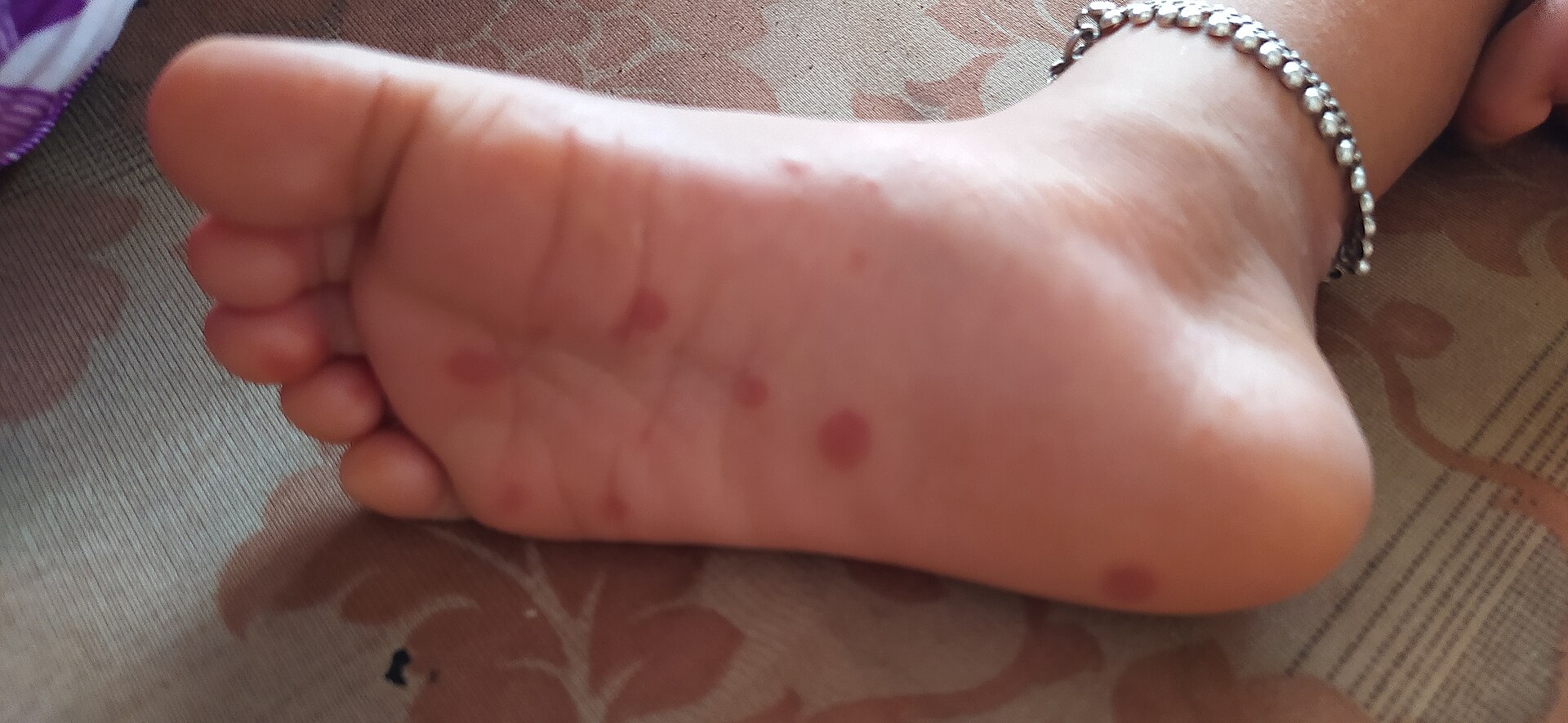
Small grey-white oval vesicles on an erythematous base on the hands, feet and buttocks, with shallow yellow-grey mouth ulcers surrounded by a red halo.
The erythematous halo around each vesicle is often not visible in brown and black skin, so the lesions may read simply as pale grey-white or skin-coloured oval blisters on an unremarkable background. The vesicle itself and its distinctive oval shape are tone-independent - look for the shape and the site rather than for surrounding redness, and examine the sides of the fingers and toes where lesions are easy to overlook. Mouth ulcers are unaffected by skin pigment. Post-inflammatory hyperpigmentation at the sites is common afterwards, as is nail shedding weeks later, and neither indicates ongoing infection.
- Distribution is the diagnosis: hands, feet, mouth and often the nappy area
- Lesions are characteristically oval rather than round
- Painful mouth ulcers, which are usually what limits drinking
- Mild fever and a generally well child
- Nail shedding may follow weeks later and is harmless - warn parents
Distribution
Photographs
Mimics
- Chickenpox (varicella) — Chickenpox lesions are in crops at different stages across the whole body, not concentrated on hands, feet and mouth
- Eczema herpeticum — In a child with eczema, widespread vesicles must raise eczema herpeticum, which needs aciclovir urgently
- Erythema multiforme major — Both give acral lesions with mouth involvement; EM major has target lesions and is more unwell
- Impetigo — Perioral lesions can look similar, but impetigo crusts with a golden appearance and is not vesicular in the same distribution
What to do in the ED
- Assess hydration and the ability to drink - this determines disposition
- Analgesia before anything else; adequate pain relief is what allows a child to drink and go home
- In a child with eczema, examine the eczematous skin specifically and consider eczema herpeticum, which is a different and urgent diagnosis
- No antibiotics and no antivirals - this is a self-limiting viral illness
- Advise on fluids: cold drinks, ice lollies, and small frequent volumes
- Exclusion from school or nursery is not routinely required once the child is well enough to attend; follow UKHSA advice
- Warn about nail shedding and post-inflammatory pigment change so that neither prompts a re-attendance
Disposition
Discharge with analgesia and fluid advice. Admit for dehydration, inability to drink despite adequate analgesia, or any neurological feature.
Safety-netting
Sources
- UKHSA - Health protection in children and young people's settings, including education
- NICE NG143 - Fever in under 5s: assessment and initial management (applies to children under 5 only)
- Lim HW et al. International Expert Consensus on Knowledge Gaps in Care for Dermatologic Disorders in Skin of Color. Int J Dermatol 2026
- NICE CG153 1.2.1.5 - erythema may be underestimated in skin types V-VI (stated in the psoriasis guideline; cited here for that general point about assessing erythema, not for this condition)