Herpes zoster (shingles), including ophthalmic and Ramsay Hunt
A unilateral dermatomal vesicular rash - and the two variants that matter are the eye and the ear.
Red flags
- Any ophthalmic involvement - refer for same-day ophthalmology assessment; sight is at risk
- Facial palsy with ear or palatal vesicles - Ramsay Hunt syndrome, needing urgent treatment and ENT involvement, with a worse recovery than Bell palsy
- Immunosuppression, or lesions outside the affected dermatome - disseminated zoster needs admission and intravenous treatment
- Zoster in a young adult with no obvious cause - consider undiagnosed immunosuppression including HIV
- Severe pain that is not controlled - a predictor of post-herpetic neuralgia and a reason to treat aggressively early
Recognise
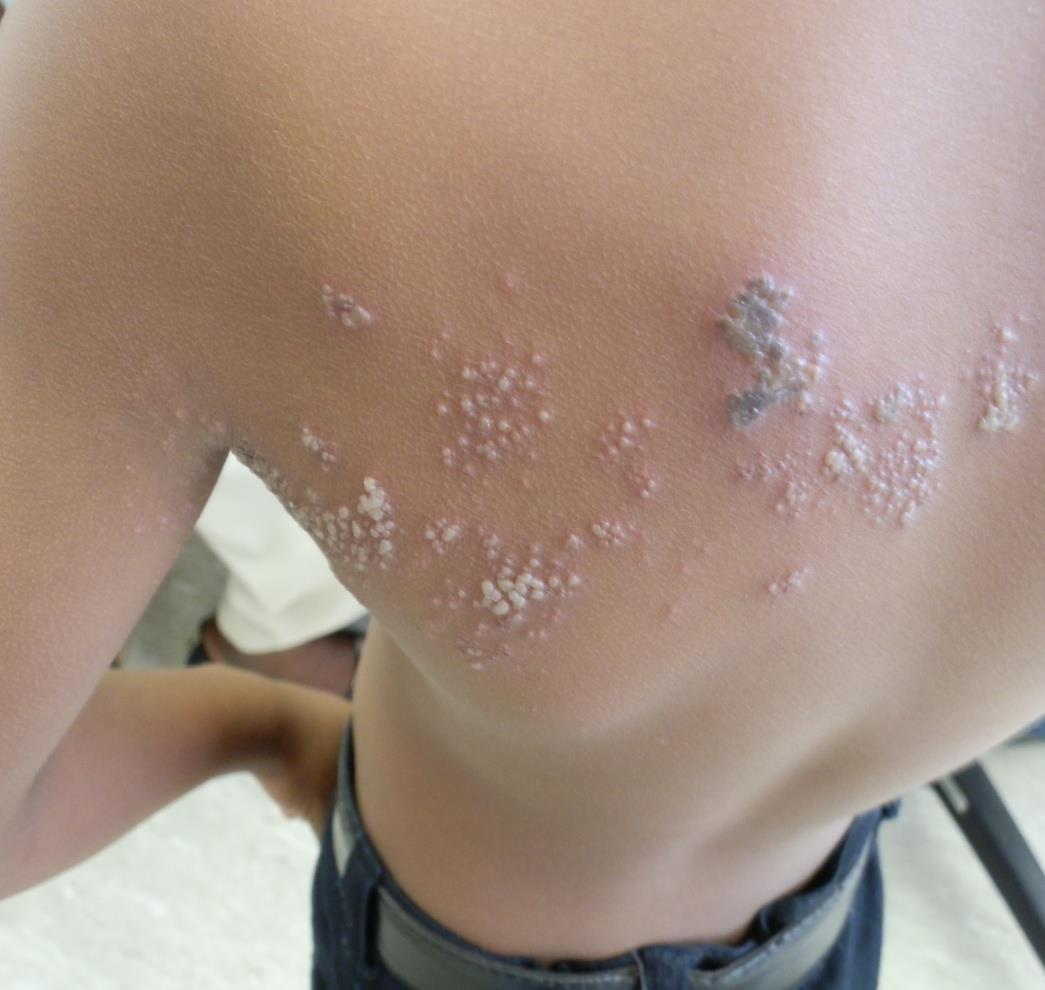
Grouped vesicles on an erythematous base in a dermatomal band, evolving to pustules and crusts, preceded by burning or shooting pain for days.
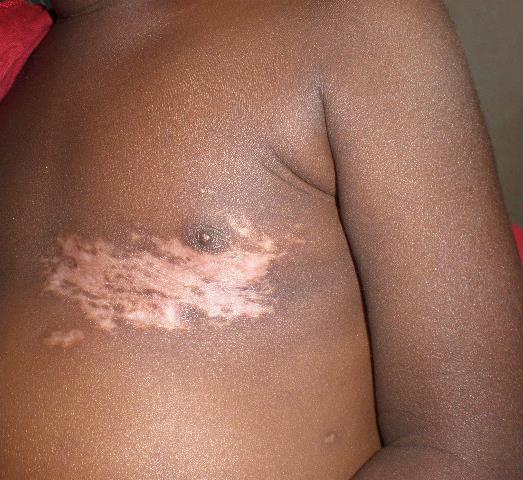
The erythematous base is often not visible, so the eruption reads as grouped grey-white vesicles or darker crusted papules on unremarkable skin - and early, before vesicles form, there may be nothing visible at all, only pain. The dermatomal distribution with a sharp midline cut-off is the diagnosis and is entirely tone-independent - map it against a dermatome chart rather than looking for redness. Post-inflammatory hyperpigmentation along the dermatome afterwards is prominent and long-lasting, and can be mistaken for continuing disease or for scarring.
- Unilateral, dermatomal, stopping at the midline - if it crosses the midline, think again
- Prodromal pain, burning or itch for two to three days before any rash
- Grouped vesicles at the same stage within a dermatome, unlike the mixed stages of chickenpox
- Ophthalmic zoster: any involvement of the forehead, upper eyelid or nose. A lesion on the tip or side of the nose (Hutchinson sign) predicts eye involvement
- Ramsay Hunt: ear pain with vesicles in the ear canal or on the pinna and a facial nerve palsy
- Disseminated disease - lesions well outside the dermatome - suggests immunosuppression
Distribution
Photographs
Mimics
- Herpes simplex — Recurrent grouped vesicles that are NOT dermatomal and recur in the same small area are simplex, not zoster
- Chickenpox (varicella) — Widespread lesions at mixed stages rather than a single dermatome at one stage
- Eczema herpeticum — Widespread monomorphic erosions on eczematous skin, not dermatomal
- Cellulitis — Early zoster before vesicles appear can be mistaken for cellulitis, but the pain and the dermatomal limit fit neither
What to do in the ED
- Offer an oral antiviral within 72 hours of rash onset to the groups CKS names: anyone immunocompromised, aged 50 or over, with non-truncal involvement, with moderate or severe pain or rash, or with a predisposing skin condition. Consider it on clinical judgement in others under 50. CKS does not recommend antiviral treatment for immunocompetent children, and in pregnancy or breastfeeding it says to seek specialist advice before prescribing. CKS adds that where treatment within 72 hours is not possible, antiviral treatment can be considered up to one week after rash onset, especially in those at higher risk of severe disease or complications - so a late presentation is not automatically a no
- Examine the eye and the nose in every facial presentation. Refer same-day to ophthalmology for any ophthalmic division involvement
- Examine the ear canal and test the facial nerve in any patient with ear pain - Ramsay Hunt is missed by not looking
- Analgesia matched to severity, and treat neuropathic pain as neuropathic pain rather than with simple analgesics alone
- Advise that the patient is infectious to anyone without immunity to varicella until all the vesicles have crusted over, approximately 7 days after rash onset (CKS), and that contact with pregnant women, neonates and the immunosuppressed should be avoided until then
- Cover the rash; transmission is by contact with vesicle fluid rather than airborne in localised zoster
- Consider immunosuppression in disseminated or recurrent disease, or in a young patient
Disposition
Antiviral and analgesia with GP follow-up for uncomplicated dermatomal zoster. Same-day ophthalmology for ophthalmic involvement, urgent ENT for Ramsay Hunt, and admission for disseminated disease or immunosuppression.
Safety-netting
Sources
- NICE CKS - Shingles
- UKHSA - Health protection in children and young people's settings, including education
- Lim HW et al. International Expert Consensus on Knowledge Gaps in Care for Dermatologic Disorders in Skin of Color. Int J Dermatol 2026
- NICE CG153 1.2.1.5 - erythema may be underestimated in skin types V-VI (stated in the psoriasis guideline; cited here for that general point about assessing erythema, not for this condition)