Gianotti-Crosti syndrome
A symmetrical papular eruption on the cheeks, buttocks and extensor limbs of a well child, sparing the trunk - a post-viral rash that needs recognition, not treatment.
Red flags
- Jaundice, dark urine or hepatomegaly - the syndrome's historical association is with hepatitis B, and that association is the reason the rash is worth naming rather than shrugging at
- A child who is systemically unwell: Gianotti-Crosti itself does not make a child ill, so look for another diagnosis
Recognise
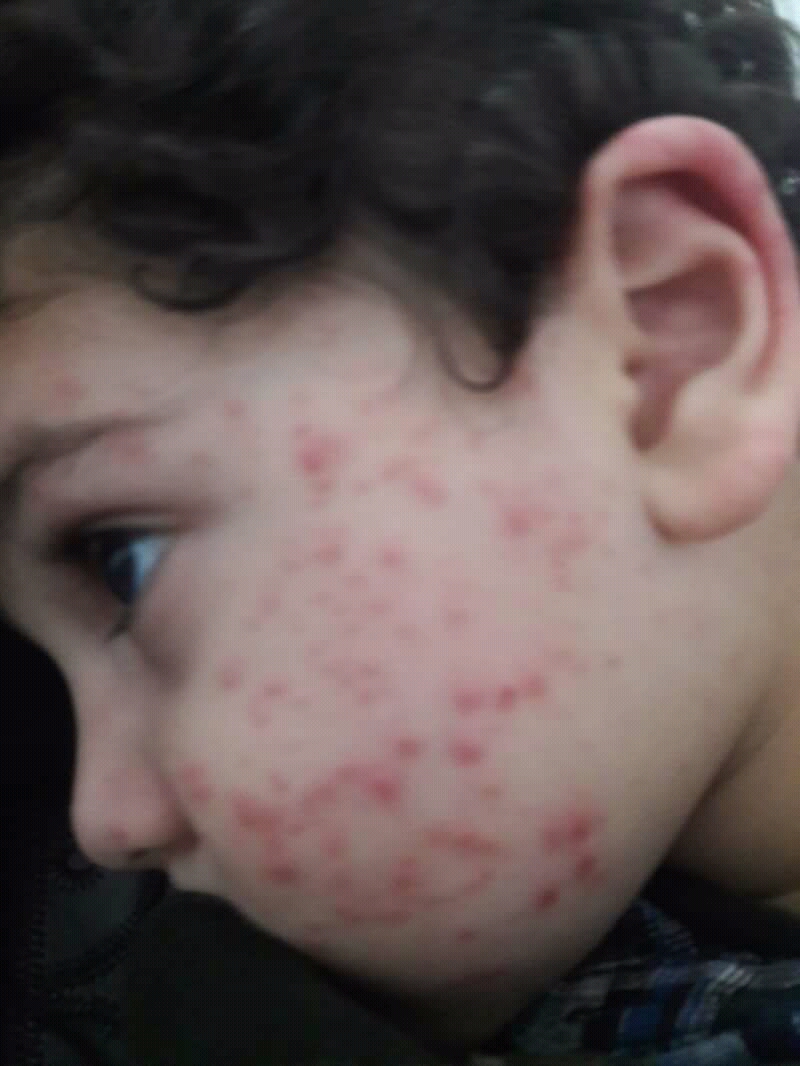
Monomorphous, flat-topped, pink to pink-brown papules or papulovesicles 1-10 mm across. They are notably uniform - a field of lesions that all look the same age and the same size, rather than the mixed crops of chickenpox.
The pink component of the described pink-brown papule is simply not visible, so the eruption reads as skin-coloured, brown or violaceous flat-topped papules and is easy to dismiss as unremarkable. Diagnose this one by touch and by distribution rather than by colour - run a hand over the cheeks, buttocks and extensor limbs, because monomorphous papules are palpable across the whole Fitzpatrick range even when they are barely visible. Expect prominent and long-lasting post-inflammatory hyperpigmentation as it settles, which is a feature of pigment lability in darker skin rather than of this disease, and warn the family so the marks are not read as the rash failing to clear. No skin-of-colour series specific to Gianotti-Crosti syndrome was found - that statement is drawn from general sources on paediatric skin of colour, not from a study of this condition.
- Monomorphous flat-topped papules or papulovesicles, 1-10 mm, all of one type
- Symmetrical, on at least three of: cheeks, buttocks, extensor forearms, extensor legs
- Extensive truncal lesions argue against the diagnosis, and so do scaly lesions
- Present for at least ten days - a rash of two days that fits otherwise does not yet qualify
- The child is systemically well; this is a reaction to a virus, not the illness itself
Distribution
Photographs
Mimics
- Hand, foot and mouth disease — Coxsackievirus A6 produces a Gianotti-Crosti-like pattern in around a third of atypical cases, so the two genuinely overlap
- Eczema coxsackium and atypical hand, foot and mouth disease — The same outbreak strain; eczema coxsackium is vesiculobullous and erosive and settles on eczematous skin, rather than monomorphous and acral
- Molluscum contagiosum — Also discrete papules in a well child, but umbilicated, asymmetrical, and appearing over months rather than in one crop
- Scabies, including crusted scabies — Also papular and itchy in a small child, but with burrows, a different distribution and usually an affected household
- Lichen planus — Also flat-topped papules, but violaceous, intensely itchy, typically flexural and with Wickham striae
What to do in the ED
- Make the diagnosis on the distribution and the monomorphous lesions, and say so clearly - the value of this entry is a confident name, because the parents have usually been told it is an allergy
- Examine for hepatomegaly and jaundice and ask about household hepatitis B. Test for hepatitis B where there is any risk factor or any hepatic sign, and consider Epstein-Barr virus serology where the history fits
- Do not prescribe an antihistamine or a topical steroid reflexively. Neither changes the course; treat only if the child is genuinely itchy
- Tell the family the expected duration explicitly: around three weeks is typical, but it can run much longer. A rash still present at six weeks is not a failure of treatment
Disposition
Discharge with a named diagnosis and GP follow-up. The rash itself needs nothing; the follow-up exists for the hepatitis B question and for the reassurance, which is the real intervention here.
Safety-netting
Sources
- Chuh AA. Diagnostic criteria for Gianotti-Crosti syndrome: a prospective case-control study for validity assessment. Cutis 2001;68(3):207-13
- Chuh A, Zawar V, Law M, Sciallis G. Gianotti-Crosti syndrome, pityriasis rosea, asymmetrical periflexural exanthem, unilateral mediothoracic exanthem, eruptive pseudoangiomatosis, and papular-purpuric gloves and socks syndrome: a brief review and arguments for diagnostic criteria. Infect Dis Rep 2012;4(1):e12
- Mathes EF et al. Eczema coxsackium and unusual cutaneous findings in an enterovirus outbreak. Pediatrics 2013;132(1):e149-57 - Gianotti-Crosti-like morphology in 37% of atypical HFMD
- Laude TA. Approach to dermatologic disorders in black children. Semin Dermatol 1995;14(1):15-20 - cited here for pigment lability, not for this condition