Eczema coxsackium and atypical hand, foot and mouth disease
A coxsackievirus A6 eruption that blisters and erodes over eczematous skin - the commonest thing that is mistaken for eczema herpeticum, and the one you must not mistake it for.
Red flags
- You cannot distinguish this from eczema herpeticum on appearance alone, and eczema herpeticum is the diagnosis that kills. Punched-out monomorphic erosions, a child who is febrile, toxic or in pain out of proportion, or any doubt at all, means treat as eczema herpeticum until proven otherwise
- Secondary bacterial infection of extensive eroded skin
- Reduced oral intake from a painful enanthem, particularly in a small child
Recognise
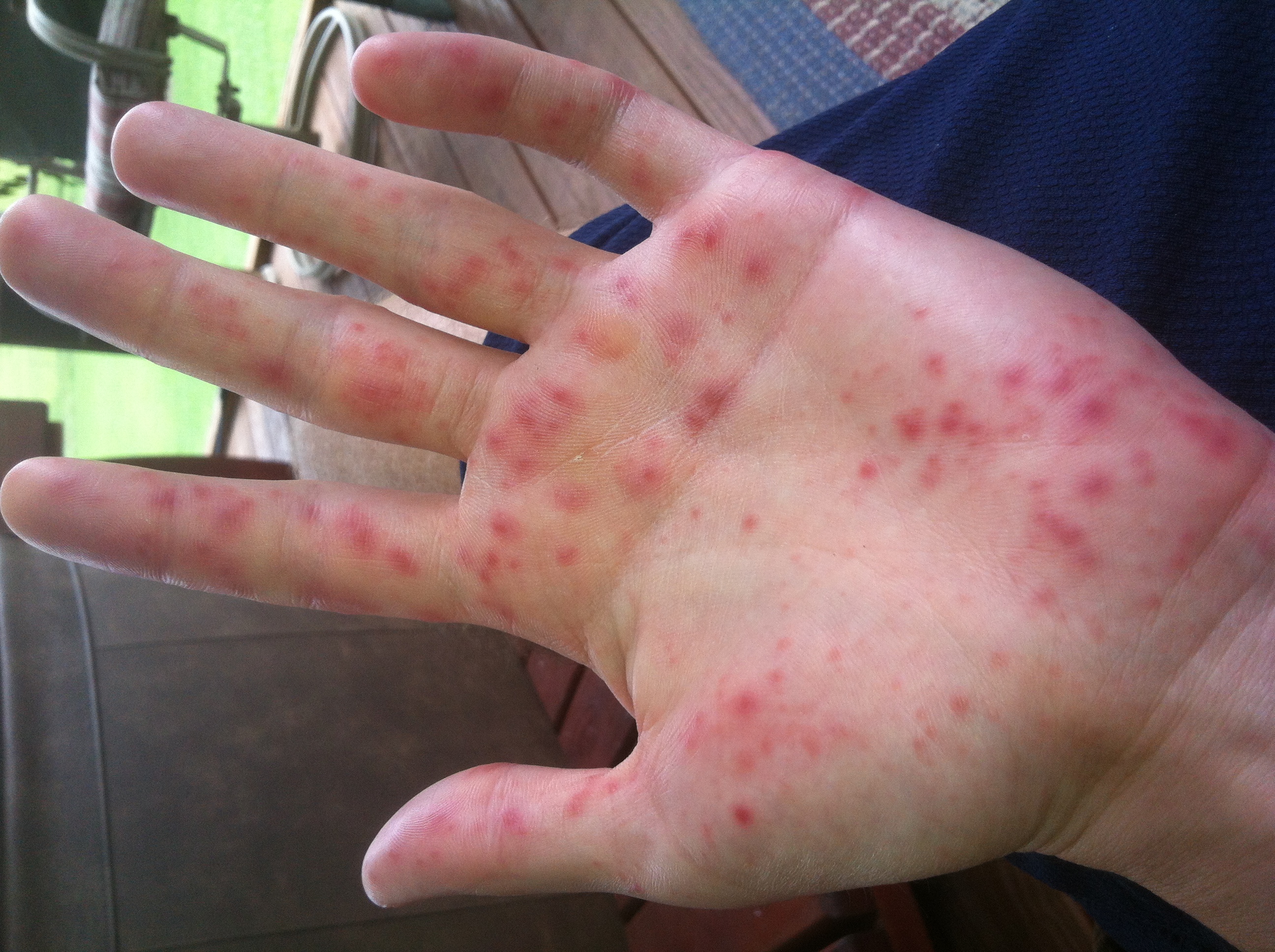
Vesicles and bullae on an erythematous base that rupture to leave erosions and crusts, heaviest where eczema already was. Around the mouth, on the limbs and on the trunk as well as the usual sites. A petechial or purpuric component appears in about one in six.
The erythematous base is the part that disappears, so the eruption presents as the blisters, the erosions and the crusts alone - and those are tone-independent, which makes this one of the easier atypical exanthems to recognise across the Fitzpatrick range. Two cautions. The purpuric component, present in 17%, is considerably harder to see on brown and black skin, so palpate and examine the palms, soles and conjunctivae where pigment interferes least. And the eczematous skin that the eruption settles on is itself often hyperpigmented or lichenified rather than red in darker skin, so identify it by texture and by the history rather than by looking for a red patch. No skin-of-colour analysis of the CVA6 outbreak series was found; the series does not report skin type.
- Vesiculobullous and erosive in 99% - blisters and raw areas, not the small firm papules of classic HFMD
- Accentuated where eczema is or has been - that pattern is the single most useful clue
- Perioral, limb and truncal involvement beyond the classic palm, sole and buttock sites
- A Gianotti-Crosti-like papular pattern in 37%, and petechiae or purpura in 17%
- Delayed onychomadesis - nails shed weeks later - and desquamation of palms and soles, both late and both reassuring
- No serious systemic complications occurred in the 80-patient series
Distribution
Photographs
Mimics
- Eczema herpeticum — The critical one. Both blister and erode on eczematous skin. Eczema herpeticum is aciclovir and usually admission; if you cannot separate them, treat for eczema herpeticum
- Hand, foot and mouth disease — The same family of viruses - this is the atypical end of the same spectrum, more extensive and more blistering
- Impetigo — Bullous impetigo also blisters and crusts; it is usually more localised and golden-crusted, and the series names it as a documented source of confusion
- Chickenpox (varicella) — Also vesicular in crops, but centripetal and at different stages simultaneously, and it does not favour eczematous skin
- Stevens-Johnson syndrome / toxic epidermal necrolysis — Both erode. Epidermal necrolysis involves mucosae at two or more sites, has a drug history, and the child is severely unwell
What to do in the ED
- Decide first whether this could be eczema herpeticum. If there is any real doubt, send viral swabs for HSV and start aciclovir rather than waiting - the cost of treating eczema coxsackium with aciclovir is trivial next to the cost of missing eczema herpeticum
- Assess hydration and oral intake, especially in a toddler with a painful mouth
- Treat the skin as you would an eczema flare: emollient generously, and continue the child's usual topical steroid on eczematous areas unless you are treating for herpes
- Give simple analgesia and advise on fluids. Do not prescribe an antibiotic unless there is genuine secondary bacterial infection
- Warn explicitly about onychomadesis and palm and sole peeling weeks later, so the nails falling off does not produce a frightened return visit
Disposition
Discharge where the child is drinking, eczema herpeticum has been excluded or treated, and the family understand the course. Admit for fluids where oral intake has failed, and admit on the eczema herpeticum pathway where that remains a possibility.
Safety-netting
Sources
- Mathes EF, Oza V, Frieden IJ, Cordoro KM, Yagi S, Howard R, Kristal L, Ginocchio CC, Schaffer J, Maguiness S, Bayliss S, Lara-Corrales I, Garcia-Romero MT, Kelly D, Salas M, Oberste MS, Nix WA, Glaser C, Antaya R. Eczema coxsackium and unusual cutaneous findings in an enterovirus outbreak. Pediatrics 2013;132(1):e149-57
- NICE NG240 - rashes may be harder to detect on brown and black skin