Eczema herpeticum
Herpes simplex disseminating across eczematous skin - an eczema flare that has become an infection, and an ophthalmic risk.
Red flags
- Any periocular or eyelid involvement - same-day ophthalmology and dermatology, because herpetic keratitis threatens sight
- Systemic upset, fever, or a child who is not feeding or is lethargic
- Extensive or rapidly spreading involvement
- A neonate or an immunosuppressed patient - admit and treat intravenously
- Secondary bacterial infection with cellulitis or sepsis through a broken barrier
Recognise
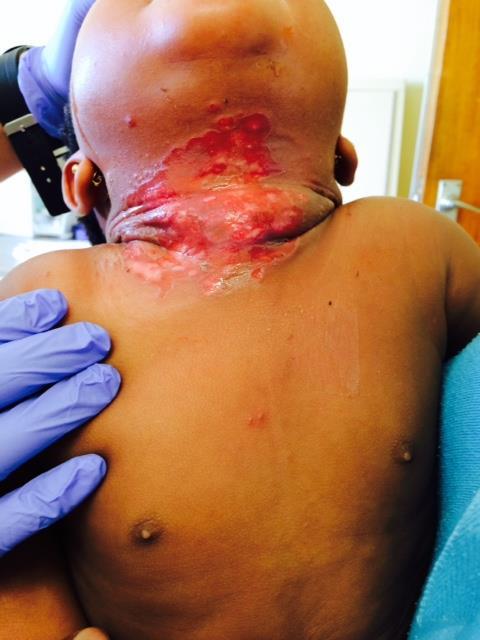
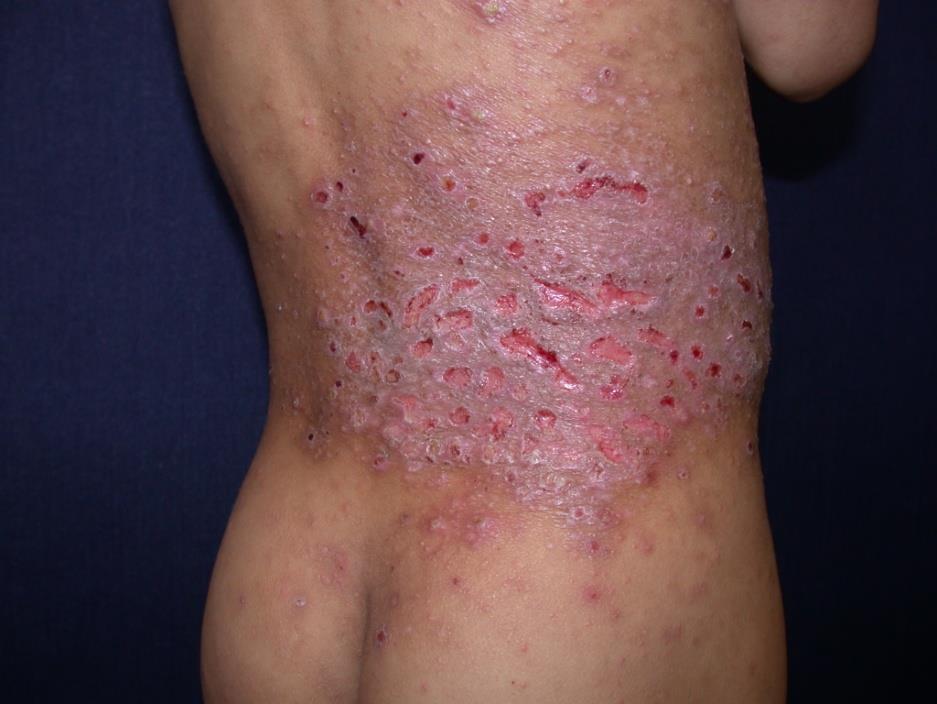
Crops of monomorphic punched-out erosions, usually 1 to 3 mm across, often with intact vesicles at the edge, on a background of red weeping eczema, with crusting and sometimes haemorrhagic centres.
The underlying eczema is often lichenified and hyperpigmented rather than red, and follicular or papular eczema patterns are commoner in brown and black skin, so the familiar backdrop of red weeping skin may be absent. The monomorphic punched-out erosions themselves are the tone-independent finding: uniform, shallow, sharply circular, all the same age. Look for their uniformity and their sharp round edge rather than for surrounding redness. Mind the Gap adds that in darker skin tones the underlying atopic eczema may leave grey or silver patches and plaques, and that healed herpeticum lesions leave depigmented, pale pinkish-brown marks that darken slowly - neither is active infection. Post-inflammatory pigment change afterwards may be marked and prolonged, and can be mistaken for continuing infection.
- Monomorphic, punched-out, uniformly sized round erosions - the shape and the sameness are the diagnosis
- An eczema flare that is painful rather than itchy
- Fever and malaise, and a flare that is not responding to the usual topical treatment
- Rapid spread over one to two days onto skin that was previously clear - the speed is the point rather than the exact interval, which is conventional and not stated in CG57
- A history of cold sores in the patient or a close contact
Distribution
Photographs
Mimics
- Staphylococcal scalded skin syndrome — Both give a crusted, painful, weeping eruption in a child; SSSS shears and has perioral radial fissuring rather than discrete punched-out erosions
- Erythema multiforme major — Both herpes-associated; EM major shows target lesions and mucosal erosions rather than disseminated monomorphic vesicles on eczema
What to do in the ED
- Start aciclovir - do not wait for confirmatory swabs. Oral if well and localised, intravenous if systemically unwell, extensive, periocular, neonatal or immunosuppressed
- Take a viral swab from the base of a de-roofed vesicle for herpes simplex PCR
- Examine the eyes explicitly. If there is any periocular involvement, treat with systemic aciclovir and refer for same-day ophthalmological and dermatological advice - NICE CG57 asks for both, not just the eye
- Continue emollients; a topical steroid may be continued on dermatologist advice but is not the treatment for the infection
- Swab for bacterial superinfection and treat if present, since impetiginised eczema often coexists
- Refer to paediatrics or dermatology; admit any child who is systemically unwell, any neonate, and anyone immunosuppressed
Disposition
Admit if systemically unwell, extensive, periocular, neonatal or immunosuppressed. A well child with limited disease may be managed on oral aciclovir, but CG57 1.5.1.40 and 1.7.1.1 ask for same-day specialist dermatological advice in every suspected case - a paediatric review is not a substitute for it. Where the eruption involves the skin around the eyes, CG57 1.5.1.41 asks for same-day ophthalmological and dermatological advice. Arrange explicit next-day follow-up as well.
Safety-netting
Local variation
Sources
- NICE CG57 - Atopic eczema in under 12s: diagnosis and management
- NICE CKS - Eczema - atopic
- Liang BX et al. Outpatient and Inpatient Management of Infants and Children With Eczema Herpeticum Diagnosed in the Emergency Department. Pediatr Dermatol 2025
- Sarkar R, Verma D. Atopic Dermatitis in Skin of Colour: A Review. Indian J Dermatol 2026
- Mukwende M, Tamony P, Turner M. Mind the Gap: A handbook of clinical signs in Black and Brown skin. St George’s, University of London (2020)