Roseola infantum
High fever for three to four days in an infant who then improves as a rash appears - the sequence is the diagnosis.
Red flags
- A child who remains febrile after the rash appears - this is not the roseola pattern, so look for another cause
- Any non-blanching element to the rash - reassess as meningococcal disease
- A prolonged or focal seizure, or incomplete recovery after a seizure
- An ill-looking or drowsy infant - the well appearance is what makes the diagnosis, and its absence unmakes it
- Fever without a source in an infant under 3 months - a different pathway entirely, per NICE NG143
Recognise
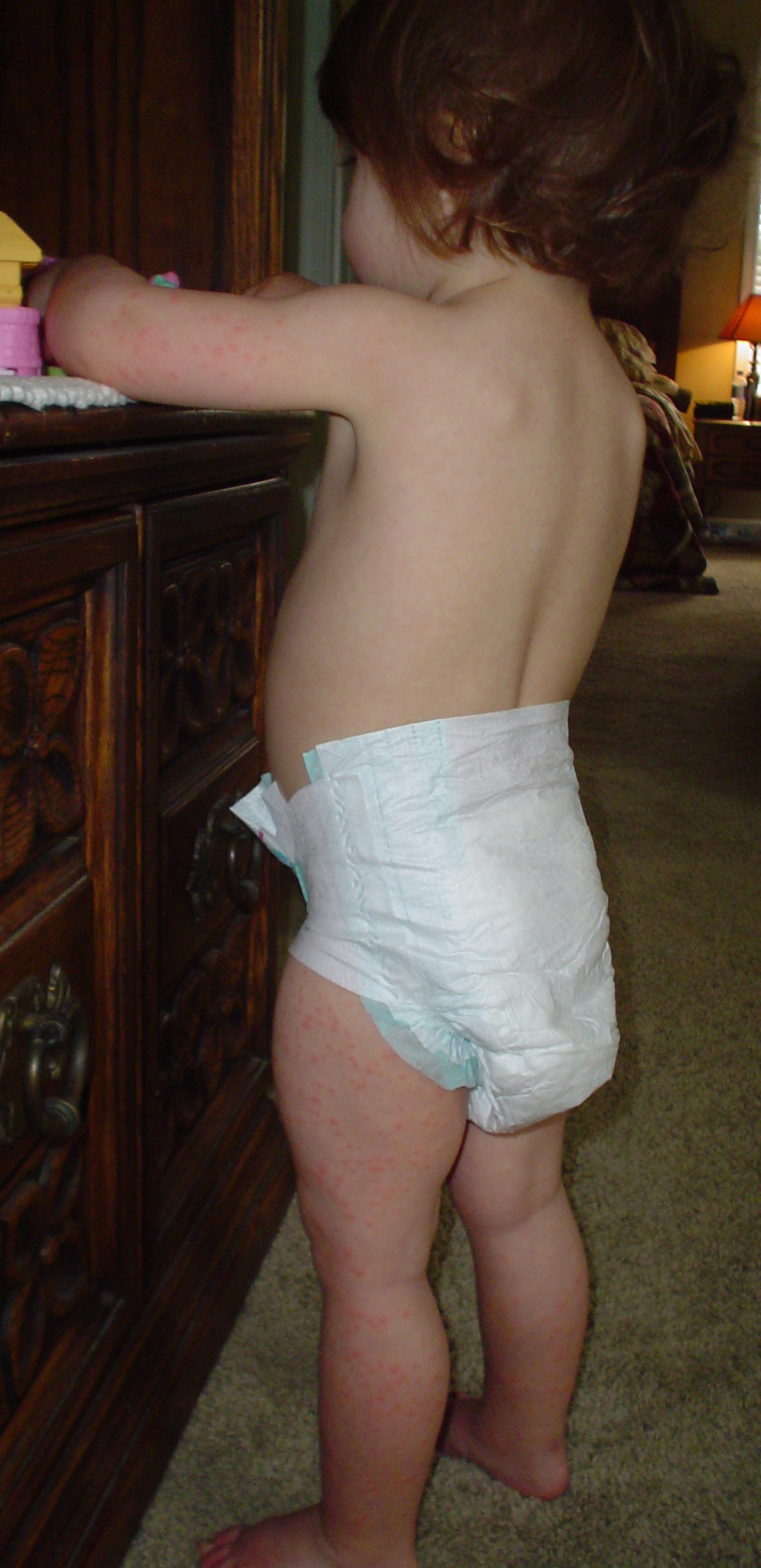
Discrete rose-pink macules and papules on the trunk, sometimes with a pale halo, in an infant who is now well and afebrile.
A faint pink rash is among the hardest findings to see in brown and black skin and may be entirely undetectable, so the diagnosis rests on the sequence rather than the appearance: several days of high fever in an infant, then abrupt defervescence, then the child looks well. Where a rash cannot be seen, this history in a well, afebrile infant is still the likely explanation - but the reasoning must be explicit, and a rash you cannot see must never be used to reassure yourself about a child who is still febrile or unwell.
- The order matters: high fever lasting three to four days first, then the sudden appearance of the rash at defervescence, as the fever breaks
- The child is characteristically well and playful despite a high temperature
- Commonest between 6 months and 2 years old. HHV-6 is the major cause, followed by HHV-7
- The rash is discrete, rose-pink, circular or elliptical, macular or maculopapular and 2 to 3 mm across - first on the trunk, then the neck and proximal limbs. It blanches on pressure and subsides over two to four days
- Febrile seizures occur in 10 to 15% of children with roseola during the febrile period, and are a frequent reason for the ED attendance
Distribution
Photographs
Mimics
- Measles — Measles has a prodrome and the rash appears while the child is still febrile and unwell
- Rubella — Rubella has postauricular and suboccipital lymphadenopathy and a different fever pattern
- Meningococcal septicaemia and purpura fulminans — The one that must not be missed - a febrile infant with a rash requires the rash to be confirmed as blanching
- Acute urticaria — A viral urticarial rash in a febrile infant looks similar but weals are raised and itchy
What to do in the ED
- Confirm the sequence explicitly: was the child febrile before the rash, and are they afebrile now
- Confirm the rash blanches. Press it, and document that you did
- Assess against NICE NG143 traffic-light criteria - the diagnosis depends on a well child
- If a febrile convulsion brought them in, manage that on its own merits and explain the recurrence risk
- No investigations or treatment are needed in a well, afebrile infant with a typical sequence
- Explain the illness so that the rash, which alarms parents precisely because it appears when the child is recovering, is understood
Disposition
Discharge a well, afebrile infant with a typical sequence and a blanching rash. Any deviation from that picture is a paediatric assessment.
Safety-netting
Sources
- NICE NG143 - Fever in under 5s: assessment and initial management (applies to children under 5 only)
- UKHSA - Health protection in children and young people's settings, including education
- Lim HW et al. International Expert Consensus on Knowledge Gaps in Care for Dermatologic Disorders in Skin of Color. Int J Dermatol 2026
- Leung AK, Lam JM, Barankin B, Leong KF, Hon KL. Roseola Infantum: An Updated Review. Curr Pediatr Rev 2024
- NICE CG153 1.2.1.5 - erythema may be underestimated in skin types V-VI (stated in the psoriasis guideline; cited here for that general point about assessing erythema, not for this condition)