Meningococcal septicaemia and purpura fulminans
A non-blanching rash in an unwell patient is meningococcal disease until proved otherwise - antibiotics before anything else.
Red flags
- Any non-blanching rash in a febrile or unwell patient - give antibiotics immediately, do not wait for investigations. NG240 flags purpura with lesions larger than 2 mm, and any rapidly progressive or spreading petechial or purpuric rash, as red flags for meningococcal disease
- A rash that is spreading while you watch
- Cold peripheries, mottling or prolonged capillary refill in a child with fever
- Drowsiness, confusion or a reducing conscious level
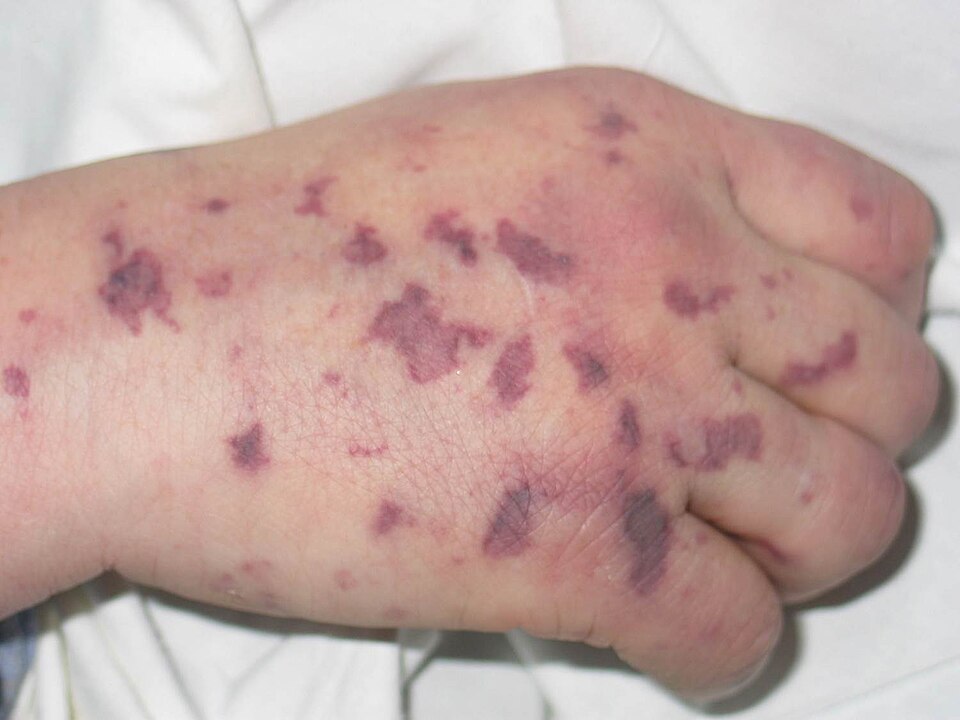
- Sudden extensive ecchymoses with necrosis - purpura fulminans, indicating disseminated intravascular coagulation
Recognise
Petechiae and purpura that do not blanch under pressure, progressing to larger dusky ecchymoses with central necrosis.
This is the single most dangerous recognition gap in emergency dermatology. Petechiae and purpura are considerably harder to see in brown and black skin and the classic teaching of a red non-blanching rash does not transfer. Examine the sites where pigment interferes least and where the estate-wide advice is to look first: the conjunctivae, the palms and soles, the oral mucosa and the sclerae. NG240 says so directly, and Mind the Gap gives the same instruction with an added practical step: pay particular attention to dark skin because lesions may be subtle, ensure adequate lighting, and ask the parents whether they have noticed any new marks: rashes can be hard to detect on brown, black or tanned skin, and it instructs you to look for petechiae in the conjunctiva. Check the whole body including the nappy area, use good light, and palpate - purpura is often just palpable. The absence of a visible rash must never reassure you in a patient who looks septic, and in darker skin that caveat carries more weight, not less.
- A rash that does not blanch under pressure. A glass or tumbler helps you see blanching, but a rash that blanches, or no rash at all, rules nothing out - it is a positive finding only
- Rapid progression: re-examine and re-count, because new lesions appearing over minutes is the diagnosis
- Cold hands and feet, mottling, prolonged capillary refill and leg pain - early features in children, often before the rash
- Fever with an ill, drowsy or irritable patient
- Neck stiffness or photophobia may be absent in septicaemia without meningitis - their absence excludes nothing
Distribution
Photographs
Mimics
- Necrotising fasciitis and necrotising soft tissue infection — Also purpura with shock, but focused on one exquisitely painful area rather than scattered widely
- Toxic shock syndrome — Both present with fever and shock; TSS gives a diffuse blanching erythroderma rather than purpura
- Benign mechanical petechiae — The commonest benign explanation in a child - but only in a WELL child, with a clear mechanical precipitant such as coughing or vomiting and no other features. No anatomical cut-off is offered here: the 'above the nipple line' rule is widely taught but is not in NG240, which was read in full and carries no benign-petechiae carve-out at all - 1.1.10 says not to rule out meningococcal disease just because a person does not have a rash
- IgA vasculitis (Henoch-Schonlein purpura) — IgA vasculitis purpura is palpable, sits on the buttocks and extensor legs, and the child is not toxic
What to do in the ED
- Give parenteral antibiotics immediately on suspicion - NICE NG240 sets the standard as within 1 hour of arrival - before imaging, before lumbar puncture, and before the rash is fully characterised
- Resuscitate for septic shock in parallel; escalate to critical care early
- Take blood cultures and meningococcal PCR, but do not let sampling delay the antibiotic
- Check coagulation and platelets - purpura fulminans means disseminated intravascular coagulation
- Do not perform a lumbar puncture if there is extensive or rapidly spreading purpura, infection at the puncture site, or risk factors for an evolving space-occupying lesion; and never let it delay antibiotics
- Notify public health the same day and arrange contact prophylaxis - this is a notifiable disease
- Reassess the rash repeatedly and document progression with the time
Disposition
Resuscitation area, then critical care. Involve paediatrics or medicine and infection services immediately.
Sources
- NICE NG240 - Meningitis (bacterial) and meningococcal disease: recognition, diagnosis and management
- NICE CKS - Meningitis - bacterial meningitis and meningococcal disease
- NICE NG51 - Suspected sepsis: recognition, diagnosis and early management
- Mukwende M, Tamony P, Turner M. Mind the Gap: A handbook of clinical signs in Black and Brown skin. St George’s, University of London (2020)