Benign mechanical petechiae
The commonest benign cause of a non-blanching rash in a child - but it is a diagnosis of exclusion made on a well child, never on the rash alone.
Red flags
- Any petechiae below the nipple line, or a rash that does not fit an SVC distribution
- Lesions larger than 2 mm in diameter - NICE NG143 lists purpura among the features pointing to meningococcal disease
- Fever, an ill-looking child, capillary refill of 3 seconds or more, or neck stiffness - the other NG143 features
- A rash that is spreading or increasing in number during observation
- Any child you are not sure about - treat as meningococcal and give antibiotics
Recognise
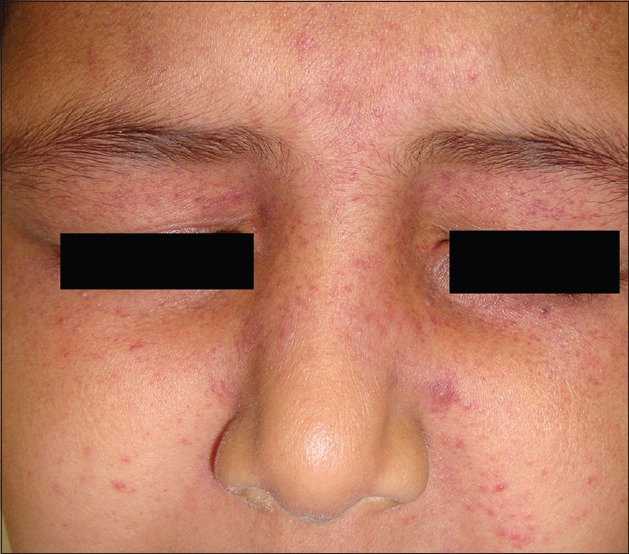
Pinpoint red-purple petechiae that do not blanch, confined above the nipple line in a well child with a history of retching, coughing or prolonged crying.
Petechiae are hard to see in brown and black skin, which cuts both ways: a benign mechanical rash may be missed entirely, and - far more dangerously - a meningococcal rash may be under-appreciated and wrongly filed here. NICE NG240 says directly that rashes can be hard to detect on brown, black or tanned skin and instructs you to look for petechiae in the conjunctiva. Examine the conjunctivae, palms, soles and oral mucosa, undress the child fully including the nappy area, and use good light. Never let a hard-to-see rash become a reassuring one.
- The child is well - this is the load-bearing feature, not the rash
- A clear mechanical history: forceful coughing, vomiting, retching or prolonged crying immediately beforehand
- Strictly confined to the SVC distribution, above the nipple line, with nothing below it. Know where this threshold comes from: a single prospective cohort of 190 febrile children, in which no child with invasive bacterial disease had petechiae only above the nipple line. It is a supportive feature in a well child, not a validated rule, and no UK guideline endorses it
- Lesions are pinpoint petechiae, not purpura - NICE flags lesions larger than 2 mm as concerning
- Not spreading - re-examine after a period of observation and confirm the count has not risen
Distribution
Photographs
Mimics
- Meningococcal septicaemia and purpura fulminans — The reason this entry exists. Meningococcal purpura is not confined to the SVC distribution, the child is unwell, and lesions are often larger than 2 mm
- IgA vasculitis (Henoch-Schonlein purpura) — IgA vasculitis purpura is palpable and sits on the buttocks and extensor legs, not the face and upper chest
What to do in the ED
- Treat every non-blanching rash as meningococcal until the assessment says otherwise - the benign diagnosis is reached by exclusion, not by pattern recognition
- Undress the child completely and examine the whole skin, including the nappy area and the conjunctivae
- Assess against the meningococcal red flags in NICE NG240 1.1.9, which covers babies, children, young people and adults: a haemorrhagic non-blanching rash with lesions larger than 2 mm, a rapidly progressive or spreading non-blanching petechial or purpuric rash, or any signs of bacterial meningitis combined with a non-blanching rash. NG143's version of the same list (ill appearance, lesions over 2 mm, capillary refill of 3 seconds or more, neck stiffness) applies to under 5s only, and this rash is common in school-age children
- If the child is febrile or unwell at all, give antibiotics and investigate - do not attribute the rash to coughing
- If the child is afebrile, well, and the rash fits the SVC distribution exactly, observe and re-examine rather than discharging immediately
- Document the distribution, the largest lesion size, and the count, so that progression can be measured by whoever sees them next
Disposition
A well, afebrile child with petechiae confined above the nipple line and a clear mechanical history may be discharged after a period of observation and re-examination. Anything else is a paediatric assessment.
Safety-netting
Sources
- NICE NG143 - Fever in under 5s: assessment and initial management (applies to children under 5 only)
- NICE NG240 - Meningitis (bacterial) and meningococcal disease: recognition, diagnosis and management
- Baker RC, Seguin JH, Leslie N, Gilchrist MJ, Myers MG. Fever and petechiae in children. Pediatrics 1989;84(6):1051-5
- Mukwende M, Tamony P, Turner M. Mind the Gap: A handbook of clinical signs in Black and Brown skin. St George’s, University of London (2020)