Alopecia areata, and the scarring alopecias
The question that matters is whether the scalp is scarred - because scarring alopecia is a race against permanent hair loss.
Red flags
- Loss of follicular openings, or a smooth shiny scalp - scarring alopecia, in which hair loss becomes permanent. Refer urgently, because treatment preserves what remains rather than restoring what is gone
- Scalp pain, itch, burning or pustules - active inflammation driving scarring
- Rapidly progressive or extensive loss, including loss of eyebrows, eyelashes or body hair
- Hair loss with systemic symptoms - consider thyroid disease, iron deficiency, lupus or a drug cause
- Severe psychological distress - hair loss has a major impact and it should be asked about
- Tinea capitis in a child, which is treatable and is a cause of scarring if missed
Recognise
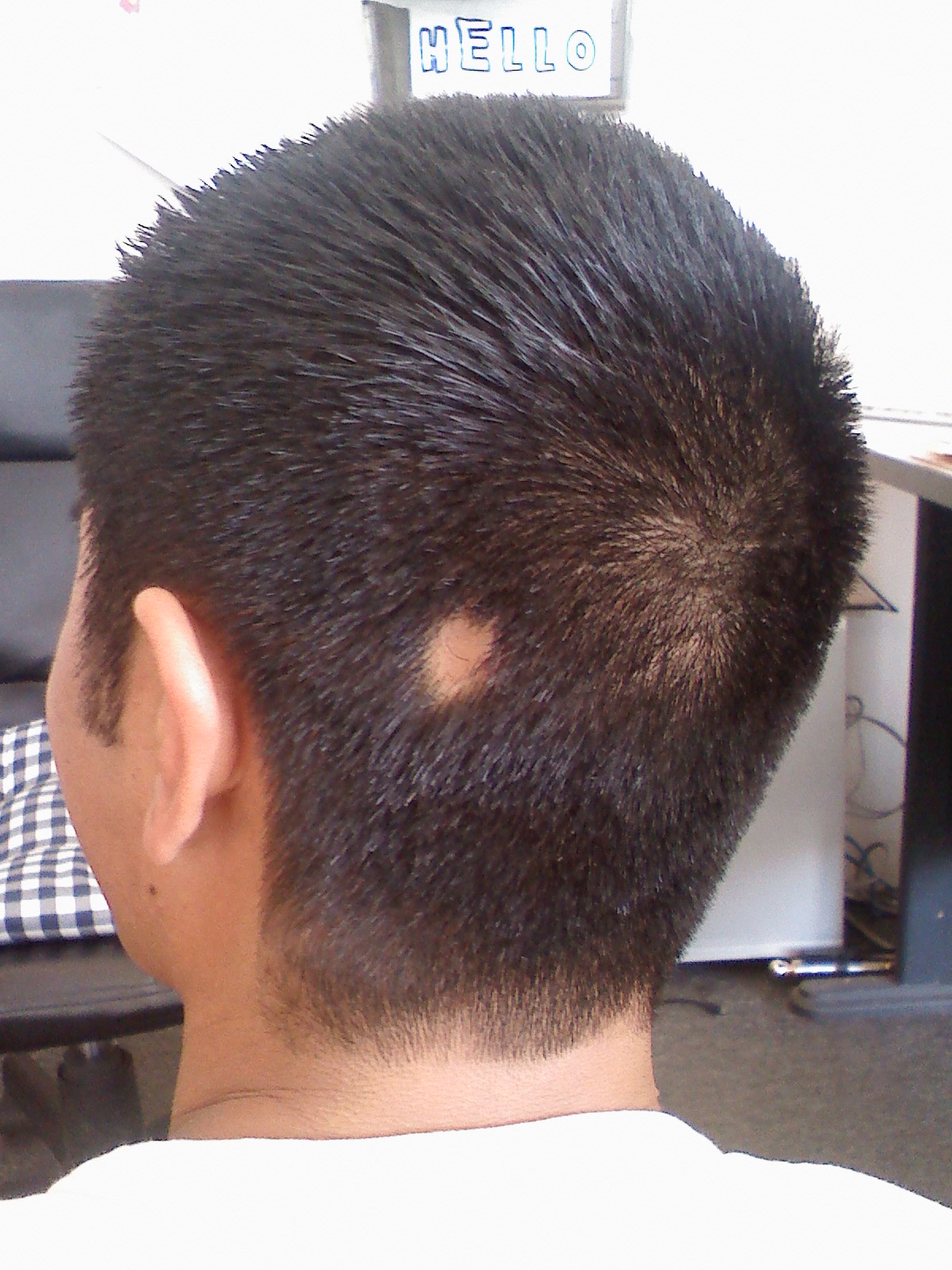
Alopecia areata shows smooth, well-circumscribed patches of complete hair loss with normal underlying skin and visible follicular openings, sometimes with exclamation-mark hairs at the margin.
The appearance of the patches themselves is largely tone-independent, but the differential is substantially different and this is where the clinical risk lies. Two scarring alopecias are much more common in Black women and are routinely misattributed to ordinary hair loss or to hair practices. Traction alopecia is listed among the disorders commoner in Black patients; central centrifugal cicatricial alopecia is the commonest scarring alopecia and most often affects Black women (Green 2023, below), and traction hairstyles and chemical relaxers are among the risk factors that review identifies. Traction alopecia comes from sustained tension through braids, weaves and extensions, which begins at the frontal and temporal hairline and is reversible early but permanent late; and central centrifugal cicatricial alopecia, which begins at the crown and spreads centrifugally, is often itchy or tender, and destroys follicles progressively. The examination that matters is for follicular openings: in alopecia areata they are preserved, and in scarring alopecia they are lost and the scalp looks smooth and shiny. Part the hair and look at the scalp under good light. Attributing hair loss to hairstyling without examining the scalp is how permanent loss goes unrecognised.
- Are the follicular openings still visible? Preserved means non-scarring and potentially reversible; lost, with smooth shiny scalp, means scarring and urgent
- Alopecia areata: smooth, round, well-circumscribed, normal scalp, sudden onset
- Exclamation-mark hairs at the edge of an active patch
- Nail pitting may accompany alopecia areata
- Itch, tenderness or burning of the scalp suggests an inflammatory scarring process
- Ask about hair practices - tension, chemical relaxers, heat - without implying blame
Distribution
Photographs
Mimics
- Tinea capitis and kerion — Scale, broken hairs, black dots and lymphadenopathy mean fungal infection, which is treatable and scars if missed - always consider it in a child
- Psoriasis, including guttate — Scalp psoriasis causes hair loss with thick adherent scale, usually non-scarring
- Seborrhoeic dermatitis — Scalp inflammation with scale, generally without patchy hair loss
- Lichen planus — Lichen planopilaris is a scarring alopecia and needs urgent referral
What to do in the ED
- Part the hair and examine the scalp itself, in good light, looking specifically for follicular openings
- Distinguish non-scarring from scarring - this single distinction determines the urgency of everything that follows
- Refer scarring alopecia urgently to dermatology; refer traction alopecia early, while it is still reversible
- Consider and exclude tinea capitis in any child, and send mycology if there is scale or broken hair
- CKS does not investigate alopecia areata routinely. It says to consider full blood count, ferritin and thyroid function only where there is diagnostic uncertainty or atypical features, and particularly if telogen effluvium is suspected - so diffuse loss is the trigger for bloods, patchy loss is not
- Discuss hair practices constructively - reducing tension can halt traction alopecia - without blaming the patient
- Ask about mood and signpost support; for alopecia areata explain that spontaneous regrowth is common in limited disease but that extensive disease has a less predictable course
Disposition
Dermatology referral, made urgently where the scalp is scarred or actively inflamed, because the window to preserve follicles is limited. Non-scarring patchy loss can be referred routinely.
Safety-netting
Sources
- NICE CKS - Alopecia areata
- NICE CKS - Fungal skin infection - scalp
- Laude TA. Approach to dermatologic disorders in black children. Semin Dermatol 1995
- Green M, Feschuk A, Valdebran M. Risk factors and comorbidities associated with central centrifugal cicatricial alopecia. Int J Womens Dermatol 2023;9(3):e108