Hidradenitis suppurativa
Not recurrent boils - a chronic inflammatory disease, routinely misdiagnosed for years, and repeated incision is not the treatment.
Red flags
- Systemic sepsis or a rapidly expanding abscess on a background of hidradenitis - it can still develop an acute collection needing drainage
- Perianal disease with fistulation - consider coexisting Crohn disease and involve colorectal surgery
- Long-standing untreated perineal or buttock disease - squamous cell carcinoma is a recognised late complication
- Depression or suicidal ideation - the psychological burden of this disease is severe and should be asked about directly
Recognise
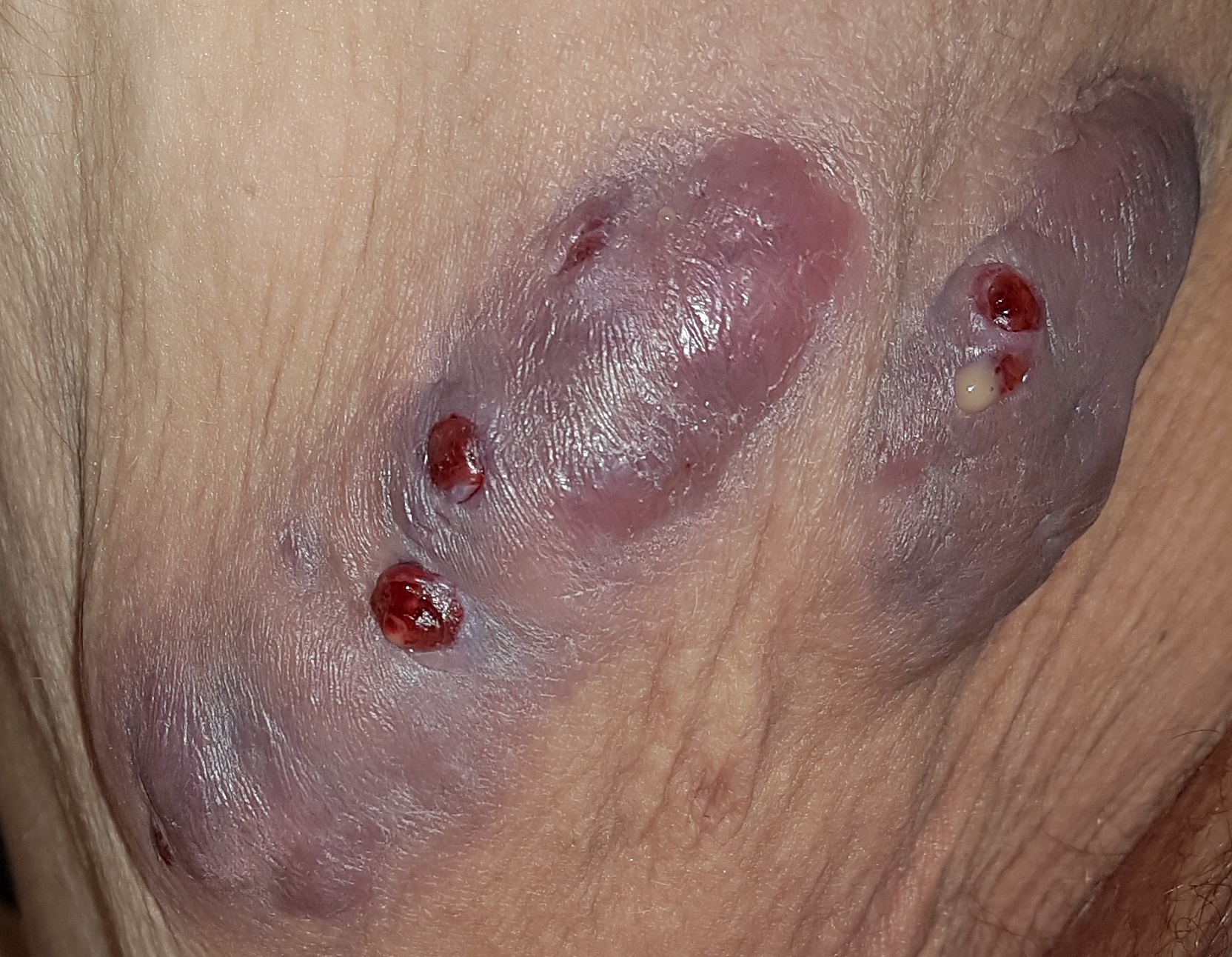
Painful red nodules and abscesses in the flexures, with draining sinus tracts, double-headed comedones and rope-like scarring.
Active lesions may be violaceous, dark brown or hyperpigmented rather than red, and the background post-inflammatory hyperpigmentation can make it hard to tell active disease from old damage. The structural features are what count and they are tone-independent: palpable deep nodules, sinus tracts that can be probed or that discharge on pressure, tethered rope-like scarring, and double-headed (tombstone) comedones. Two further points are clinically important. Hidradenitis is widely reported to be commoner in Black patients. No prevalence figure is cited here because none could be traced to a source read in full - treat it as a reason to raise the index of suspicion, not as a quotable statistic. And keloid and hypertrophic scarring after surgery is substantially more likely - pooled odds ratio 6.14 (95% CI 3.75 to 10.07) in Black compared with White individuals in a 2026 network meta-analysis - so the caution about repeated incision should be higher, not lower.
- Recurrence in the same flexural sites over months or years - this is the diagnosis, and it is what distinguishes it from a simple abscess
- Bilateral involvement of axillae, groin, inframammary or perianal skin
- Sinus tracts and scarring - evidence of chronicity
- Double-headed comedones
- Strong association with smoking and obesity, and a family history is common - no proportion is quoted here because none could be traced to a source read in full, so ask about it rather than relying on a figure
- Severe pain, and a substantial burden of shame and social withdrawal that is regularly missed
Distribution
Photographs
Mimics
- Skin abscess, boils and folliculitis — The usual misdiagnosis. A simple abscess is a single event in one place; hidradenitis recurs in flexures and scars
- Cellulitis — Flares are often treated as cellulitis; the flexural distribution and sinus tracts distinguish them
What to do in the ED
- Name the diagnosis. Most patients have attended repeatedly with 'boils' for years without being told what it is, and naming it is the single most valuable thing an ED visit can do
- Drain a genuine acute collection for pain relief, but understand that incision and drainage does not treat the disease and repeated wide incision causes scarring
- Adequate analgesia - this is a very painful condition and is routinely under-treated
- Antibiotics for an acutely infected flare per local policy, recognising that much of the inflammation is not infective
- Refer to dermatology for disease-modifying treatment; there is no UK national guideline, and the European S2k guidelines are the practical reference
- Offer smoking cessation and weight management support without moralising - both modify the disease
- Ask about mood and about the impact on work and relationships
Disposition
Dermatology referral for disease-modifying treatment, with colorectal involvement for perianal disease. Admit only for systemic sepsis or a collection requiring theatre.
Safety-netting
Local variation
Sources
- Zouboulis CC et al. European S2k guidelines for hidradenitis suppurativa/acne inversa part 2: Treatment. J Eur Acad Dermatol Venereol 2025
- NICE CKS - Boils, carbuncles, and staphylococcal carriage
- Gwen Farm HJ et al. The Association Between Race/Ethnicity and Keloid Formation: A Network Meta-Analysis. Plast Surg (Oakv) 2026
- Mukwende M, Tamony P, Turner M. Mind the Gap: A handbook of clinical signs in Black and Brown skin. St George’s, University of London (2020)