Rosacea
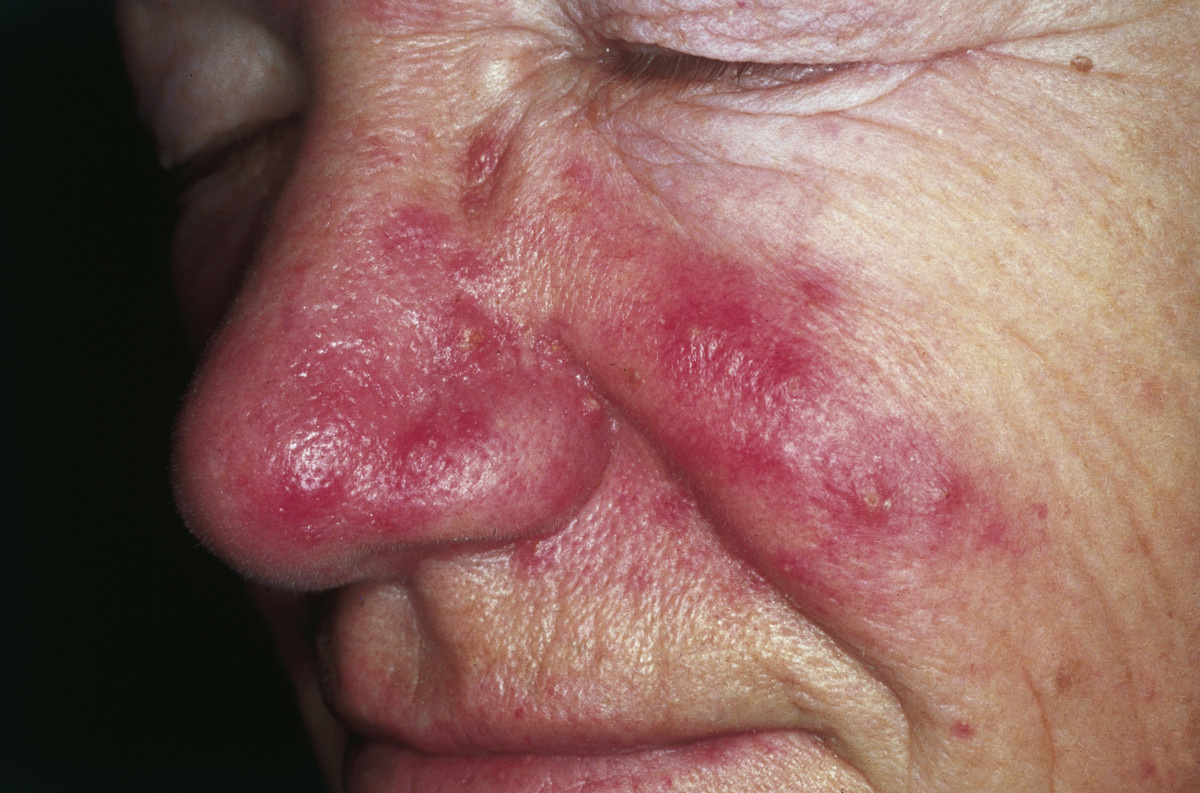
Central facial flushing with papules and no comedones - and the eyes are involved more often than anyone checks.
Red flags
- Eye symptoms - ocular rosacea can cause keratitis and threaten vision; ask about grittiness, dryness and redness in every patient and refer if present
- Rapid onset of facial papules with systemic features - reconsider lupus or a drug eruption
- A butterfly rash sparing the nasolabial folds with systemic symptoms - consider lupus rather than rosacea
- Severe rhinophyma causing airway or psychological problems
- Long-term potent topical corticosteroid use on the face - steroid-induced rosacea, which will worsen while the steroid continues
Recognise
Persistent central facial erythema with flushing, visible telangiectasia, and inflammatory papules and pustules without comedones.
Rosacea may affect 2 to 4% of Black, Asian, Pacific Islander and Hispanic or Latino populations, and its prevalence is likely underestimated precisely because diagnosis relies on phenotypic features - fixed erythema, flushing, telangiectasia - that are difficult to appreciate in more heavily pigmented skin. Its cardinal sign is the one that cannot be seen. Patients may describe flushing, burning and stinging that is entirely invisible to the examiner, and their symptom report should be believed rather than discounted. Look for the tone-independent findings: papules and pustules in a central facial distribution without comedones, a warm and swollen central face, and dryness or roughness. Telangiectasia may be detectable with dermoscopy or on close inspection with good light, or may not be visible at all. Granulomatous rosacea, with firm brown or skin-coloured papules, is described more often in darker skin. Where the visible signs fail, work from the minor and secondary criteria: burning or stinging, oedema, dryness, flushing, poor tolerance of over-the-counter products, symptoms with the classic triggers, family history and ocular symptoms - and ask the patient to help establish their own baseline skin tone during the examination. Post-inflammatory hyperpigmentation may be the presenting complaint.
- No comedones - this separates it from acne
- Central facial distribution, symmetrical, sparing the skin around the eyes
- Flushing and a history of triggers: heat, alcohol, spicy food, sunlight, stress
- Burning or stinging rather than itch
- Ocular rosacea - dry, gritty, red eyes and blepharitis - is common and is routinely missed because nobody asks
- CKS's phenotype rule is what makes a diagnosis possible when you cannot see erythema: diagnose rosacea on at least one diagnostic feature - phymatous change or persistent erythema - or two major features: flushing or transient erythema, inflammatory papules and pustules, telangiectasia, or eye symptoms. Central facial papules and pustules plus ocular symptoms meet it with no visible redness at all
- Rhinophyma - thickening of the nose - in longstanding disease, predominantly in men
Distribution
Photographs
Mimics
- Acne vulgaris, and acne fulminans — Acne has comedones; rosacea does not. Both may coexist
- Seborrhoeic dermatitis — Overlaps on the central face and frequently coexists; seborrhoeic disease scales
- Contact dermatitis - allergic and irritant — A facial reaction to a cosmetic can look similar but follows application areas
What to do in the ED
- Ask about the eyes in every patient with rosacea and examine them; refer to ophthalmology for anything more than mild dryness
- Treat by phenotype, because the treatments are not interchangeable - this is CKS's structure, summarised; take doses from the BNF. Persistent erythema: consider topical brimonidine 0.5% gel once daily as required - it reduces erythema within 30 minutes, peaks at 3 to 6 hours and then wears off, so set that expectation. Transient flushing: consider oral propranolol 20 to 40 mg two or three times daily. Mild-to-moderate papules and pustules: topical ivermectin once daily for 8 to 12 weeks, with metronidazole 0.75% twice daily or azelaic acid 15% twice daily as alternatives where ivermectin is unavailable or inappropriate, for instance in pregnancy or breastfeeding - they are alternatives, not co-equal first-line. Moderate-to-severe: ivermectin plus oral doxycycline 40 mg modified-release once daily for 8 to 12 weeks
- Stop any topical corticosteroid being used on the face - it is a common perpetuating cause
- Advise on trigger avoidance and daily broad-spectrum sun protection, which is part of treatment and not an optional extra
- In patients with brown or black skin, take the reported flushing and burning seriously even where you can see nothing, and treat on the symptoms - CKS says so itself, noting that in darker skin phototypes V and VI erythema may be difficult to detect visually. Use the two-major-feature route rather than waiting for redness you will not see
- Refer to dermatology for resistant disease, rhinophyma, or diagnostic uncertainty
Disposition
Topical treatment and GP follow-up. Ophthalmology for ocular involvement and dermatology for resistant disease or rhinophyma.
Safety-netting
Sources
- NICE CKS - Rosacea
- Lohani D, Marson JW, Baldwin HE. Rosacea in Patients with Skin of Color: Diagnosis and Management. Am J Clin Dermatol 2026
- NICE CKS - Rosacea, Diagnosis (phenotype criteria; notes erythema may be difficult to detect visually in phototypes V and VI)
- NICE CKS - Rosacea, Scenario: Management