Lyme disease and erythema migrans
An expanding rash after a tick bite is Lyme disease - NICE says diagnose and treat it without waiting for a blood test.
Red flags
- Facial nerve palsy, especially bilateral, or other cranial nerve involvement - neuroborreliosis, which needs a different regimen and duration
- Radicular pain, meningitis or focal neurological signs
- Heart block, palpitations or syncope - Lyme carditis
- A swollen joint, usually the knee, weeks to months after exposure
- Pregnancy - discuss antibiotic choice. This is a BNF point, not an NG95 one: NG95 does not name a drug to avoid in pregnancy, it tells you to treat using antibiotics appropriate for the stage of pregnancy and to consult the BNF
Recognise
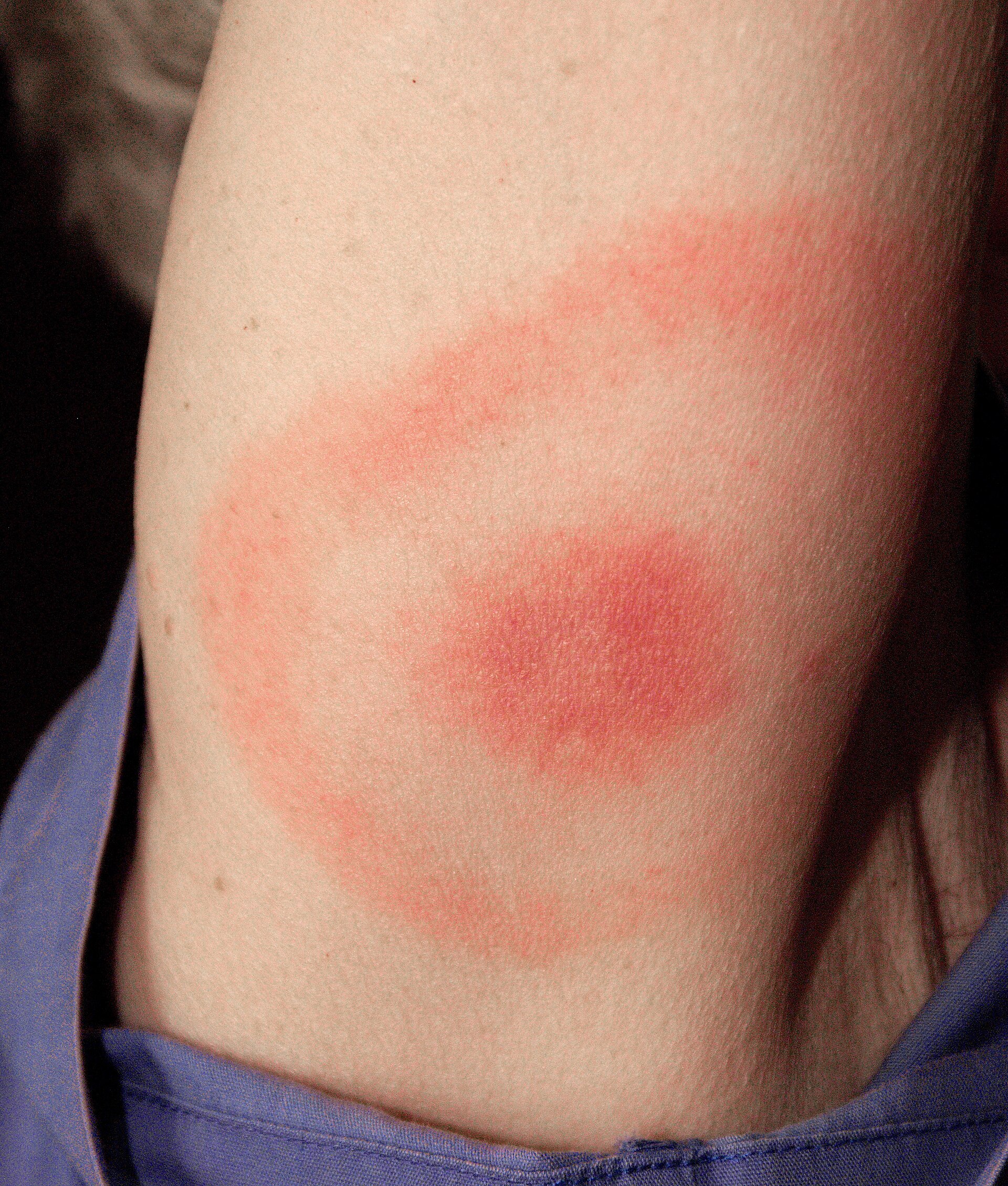
An expanding red or pink patch, sometimes with central clearing giving a target appearance, not usually itchy, hot or painful.
Erythema migrans is defined entirely by redness and is one of the most consistently missed diagnoses in brown and black skin, where it may appear as a darker, dusky, violaceous or hyperpigmented patch, or resemble a bruise, and the central clearing that gives the bullseye its name is often absent. The tone-independent features are the history and the behaviour of the lesion: an expanding patch appearing days to weeks after possible tick exposure, enlarging over time, and not itchy, hot or painful. Measure it and mark it rather than judging by colour, and if there is any doubt in a patient with plausible exposure, treat.
- NICE describes erythema migrans as a rash that increases in size, may sometimes have central clearing, is not usually itchy, hot or painful, becomes visible from 1 to 4 weeks after a tick bite (but can appear from 3 days to 3 months), and lasts several weeks
- A reaction to a tick bite is different: it develops and recedes within about 48 hours of the bite, and is more likely to be hot, itchy or painful
- Often no remembered tick bite - absence of one does not exclude Lyme disease
- Ask about exposure: woodland, moorland, long grass, gardens, and occupational or recreational risk
- Systemic features may accompany it: fever, headache, fatigue, joint and muscle pain
Distribution
Photographs
Mimics
- Cellulitis — Cellulitis is hot, painful and tender; erythema migrans is typically none of these, and antibiotic choice differs
- Tinea corporis, cruris and pedis — Tinea has a scaly raised edge and itches; erythema migrans has neither
- Erythema multiforme major — Both can look targetoid, but EM lesions are multiple, acral and fixed in size
What to do in the ED
- Diagnose and treat Lyme disease without laboratory testing in anyone with erythema migrans - this is an explicit NICE NG95 recommendation, and serology is frequently negative early
- Treat per NG95: for erythema migrans without focal symptoms in adults and young people aged 12 and over, oral doxycycline 100 mg twice daily or 200 mg once daily for 21 days; alternatives are amoxicillin 1 g three times daily for 21 days, or azithromycin 500 mg daily for 17 days - but NG95 says do not use azithromycin in anyone with cardiac abnormalities associated with Lyme disease, because of its effect on the QT interval. Children have separate age and weight-based regimens in NG95 table 2; do not extrapolate the adult doses
- Discuss anyone under 18 with a specialist - NG95 recommendation 1.3.2 makes this a duty, exempting only a child with a single erythema migrans lesion and no other symptoms, so fever, headache or arthralgia takes them out of the exemption. Ask about pregnancy before prescribing, including in young women under 18
- Distinguish it from a simple tick-bite reaction, which appears and settles within about 48 hours of the bite and is hot, itchy or painful
- Measure and record the size, and photograph with consent where policy allows - expansion over time is the diagnostic behaviour
- Examine the cranial nerves and ask about palpitations and syncope, so that focal disease is not treated with the simple regimen
- Remove any attached tick promptly and properly, grasping it close to the skin, and advise on prevention
- Advise that a negative blood test in someone with erythema migrans does not exclude the diagnosis
Disposition
Treat and discharge with GP follow-up for uncomplicated erythema migrans. Refer or admit for neurological, cardiac or joint involvement, which need different regimens and specialist input.
Safety-netting
Sources
- NICE NG95 - Lyme disease
- NICE CKS - Lyme disease
- Lim HW et al. International Expert Consensus on Knowledge Gaps in Care for Dermatologic Disorders in Skin of Color. Int J Dermatol 2026
- NICE CG153 1.2.1.5 - erythema may be underestimated in skin types V-VI (stated in the psoriasis guideline; cited here for that general point about assessing erythema, not for this condition)