Angular cheilitis
Sore, fissured corners of the mouth - usually candidal, staphylococcal or both, and occasionally the visible end of a nutritional or systemic problem.
Red flags
- A child or adult with recurrent or refractory candidal infection - consider undiagnosed diabetes, immunosuppression or HIV, and test rather than simply re-treating
- Weight loss, fatigue, glossitis or pallor alongside it - iron, folate or B12 deficiency is a recognised association and needs bloods rather than another cream
- A persistent, indurated or non-healing lesion at the commissure that does not behave like cheilitis - this needs a lesion-focused referral, not repeated antifungals
- Angular cheilitis in a child with faltering growth or a restricted diet - a nutritional and safeguarding assessment, not a dermatological one
Recognise
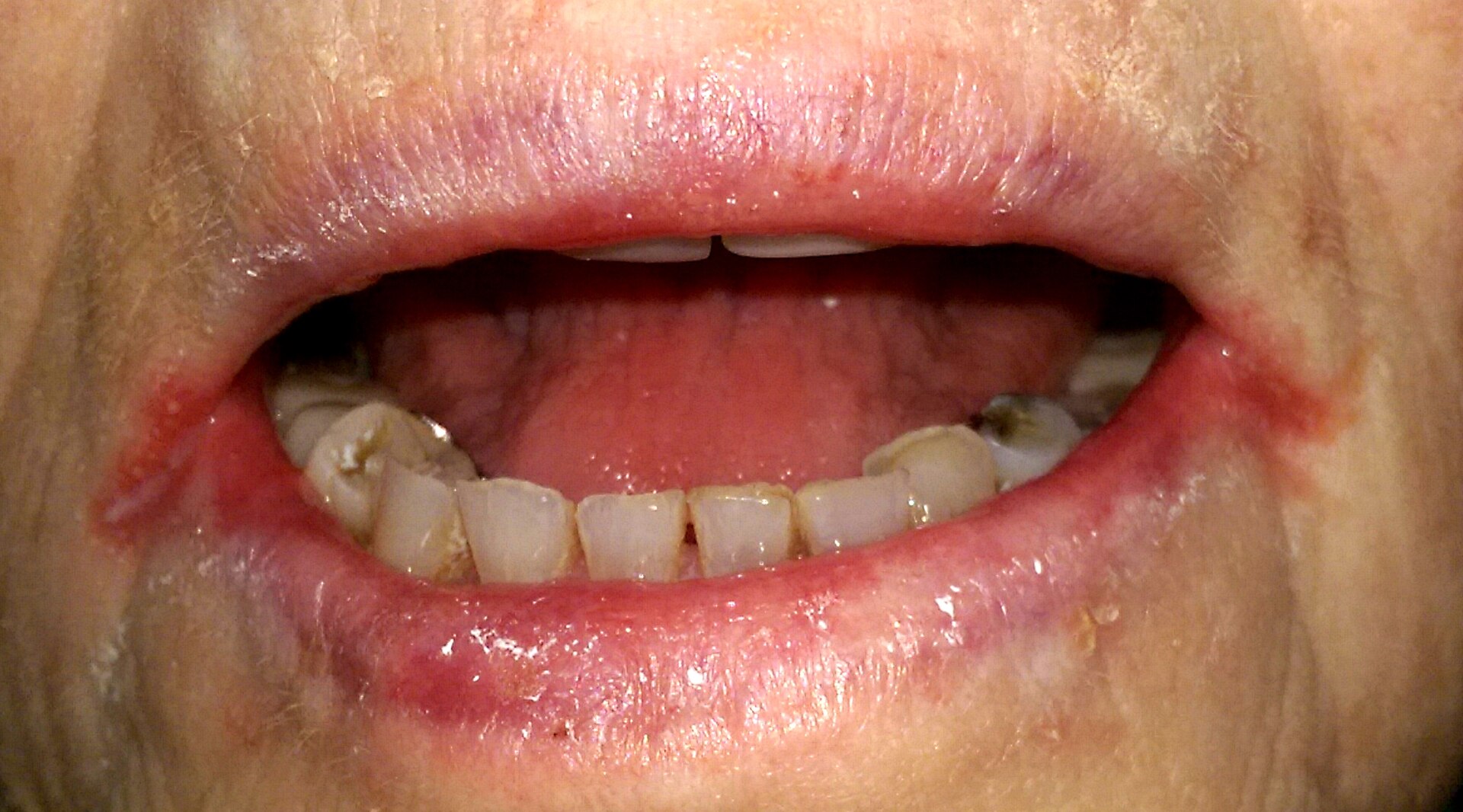
Red, macerated, fissured skin at one or both angles of the mouth, sometimes with crusting, and sore or stinging on opening the mouth or eating.
The erythema that makes this obvious in pale skin is frequently not visible, and the corners of the mouth may instead look darker, violaceous or simply hyperpigmented against surrounding skin - so the condition is easy to under-call as dry lips. The tone-independent findings are structural and symptomatic: maceration and a softened, soggy surface, a visible fissure or split running out from the commissure, crusting, and pain on opening the mouth, smiling or eating acidic food. Ask rather than only look. Post-inflammatory hyperpigmentation at the angles is common afterwards and can take a long time to fade, and patients often present for that rather than for the original soreness - it is not active infection and it is not scarring.
- Both corners of the mouth, more often than one - a strictly unilateral lesion should make you think again
- Maceration, fissuring and crusting at the commissure, sore on mouth opening
- Look inside the mouth: coexisting oral candidiasis points to the commonest cause
- Ask about anything that keeps the corners wet - drooling, lip-licking, a new orthodontic appliance
- In older adults, ask about dentures and the fit of them; in children, about thumb-sucking, dummies and lip-licking
Distribution
Photographs
Mimics
- Cutaneous candidiasis — Candidal infection is the commonest cause rather than a separate diagnosis - look in the mouth for coexisting oral candidiasis
- Herpes simplex — A cold sore can sit at the commissure, but it begins with tingling, is grouped and vesicular, and is usually unilateral
- Atopic eczema and infected eczema — Lip-licker's dermatitis gives a ring of dryness and scaling around the whole mouth rather than disease confined to the angles
- Syphilis - the secondary rash — Split papules at the oral commissures are a recognised, easily missed feature of secondary syphilis - consider it where there is a wider rash, palm and sole involvement or a sexual history
What to do in the ED
- Look in the mouth, not just at the corners - oral candidiasis alongside it settles the likely cause and changes the treatment
- There is no NICE CKS topic for angular cheilitis, and no UK national guideline for it - so treat per local policy and the BNF rather than on a borrowed guideline. Conventional practice is a topical antifungal, with a combined antifungal and antibacterial preparation where crusting suggests staphylococcal involvement. No source is cited for that choice here because none could be traced; name the agent from your own formulary
- Address the mechanical cause or it will recur - denture fit and denture hygiene in older adults, drooling and lip-licking in children, and anything that keeps the angles wet
- Check for and treat an underlying cause where the history suggests one: consider iron, folate, B12 and glucose rather than a third course of cream
- Advise a barrier ointment such as white soft paraffin at night to stop the fissure re-opening
- Refer to dentistry for denture-related disease - it will not resolve while the denture is the cause
Disposition
Treat and discharge with GP follow-up. Refer to dentistry for denture-related cases, and arrange investigation rather than repeat treatment where it is recurrent or refractory.
Safety-netting
Sources
- Brizuela M, Daley JO. Angular Cheilitis. StatPearls (2025)
- Lim HW et al. International Expert Consensus on Knowledge Gaps in Care for Dermatologic Disorders in Skin of Color. Int J Dermatol 2026
- NICE CG153 1.2.1.5 - erythema may be underestimated in skin types V-VI (stated in the psoriasis guideline; cited here for that general point about assessing erythema, not for this condition)